It is said that no poet has ever had so warm a place in the hearts of the people the world over, as our own Longfellow. A writer who has traveled much tells of the strange and far-away places in which his heart has warmed at sight of a well-worn copy of Longfellow’s Poems. Even in far frozen Iceland they asked him, “And do you know Mr. Longfellow? Tell him we know him and love him.” He seems to have a touch of nature which makes the whole world akin; for he is not more warmly appreciated in his native land than in the hearts and homes on the other side of the sea.
And when we think of the quiet, pure life he led, and remember the noble and elevating tone which runs through all his poems, we feel that the homage which he receives is meet. Does it not give evidence of the character of the man that we can recall no taint of impurity in any thought or expression which he has given to the world? The great poet loved Nature, and came very near to her heart; and so long as he kept such company, there was no room in his mind for idle or impure thoughts. And he leaned not upon nature as a blind force; but points us ever through nature up to its Author. From every one of the old legends which he is so fond of relating, is drawn some lesson which shall serve to make the reader wiser or better.
And as we note the even, quiet flow of his verses, and can see the many sweet home-pictures which he has spread out for us, do we not feel instinctively that he must have written from the sanctuary of a home where the dove of peace sat brooding? And thus it was; for Mr. Longfellow was favored with that one of the greatest of earthly blessings,—a quiet, well-ordered home, where strife and unhappiness found no place. (I have sometimes thought that of all classes of men, poets, as a rule, had been the most unfortunate in this respect.) But Mr. Longfellow was no idle dreamer; he was a poet, and more,—he was a kind husband, a loving but firm father, a good neighbor and citizen, and capable of the truest friendship,—he was a man among men, as well as a poet. His poems were expressions of what he knew of people, and things, and nature,—not the mere fancies of a fervid imagination untaught by contact with the realities of life.
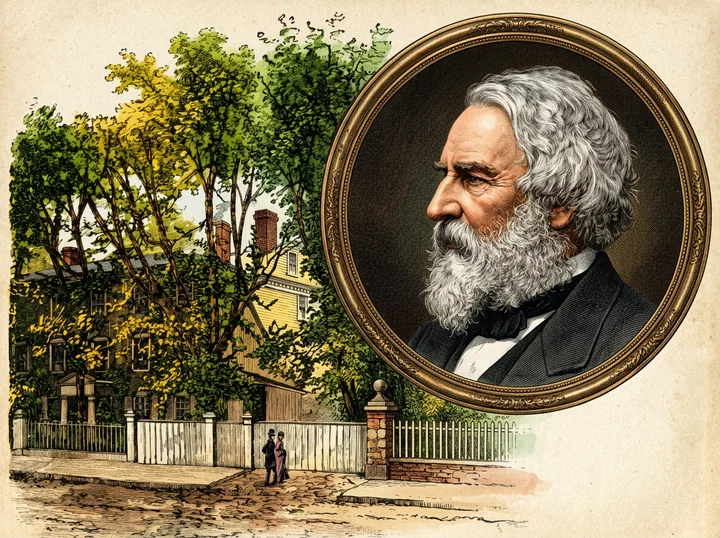
The old place where he so long made his home is rich in historic associations as well as in the beauties of nature. Leaving the street car which has brought us over from Boston, at Harvard Square, a short walk takes us past Memorial Hall, the most imposing of the university buildings; Agassiz Museum; the Washington Elm, under which the great General took command of the Continental armies on the morning of July 3, 1775; and many other places, where we could spend hours with thrilling interest. But we hasten on, for the sky is growing dark with an approaching storm, and we would like to reach the shelter of the hospitable-looking old Longfellow mansion before the rain; but we hurry in vain, for anon there comes a sharper flash and a deafening crash, and a large limb of one of the old elm trees which line the walk is twisted off before our own eyes, just where we should have passed a moment later. The big drops begin to fall upon us like hail, and we are glad to take refuge under the deep stone portico of the Shephard Memorial Church, where are already gathered a score or more of Harvard boys.
The shower is a heavy one, but it does not reach us, though we have a chance to enjoy the society of the Harvardites for a half hour or more. It is but the day before Commencement, and they are full of talk and excitement in regard to it; and seem scarcely to heed the presence of the three strangers who have found refuge in one of the recesses of the portico. But at last the rain is over, the sun comes out; and we pass on under the still dripping trees, and are soon at the poet’s home, which we have come so far to see.
Yes, this is the place, and it looks very much as we had expected, only there are more trees and shrubbery in the yard than the pictures show. Everything is very quiet and dripping after the rain, and not a soul appears to break in upon our reverie, or to ask us why we go hither or yon. Few words are spoken—we are all busy with our thoughts—and soon we each go a separate way to get a better look at some object that interests us. Yes, I muse; this is the same old house I have seen in the pictures so many times; and I begin to recall its history, till I can almost see, gliding down the shaded walks, the stately dames in embroidered petticoats and high-heeled slippers, and gallant courtiers with sheathed swords and powdered queues. And then I remember the stories I have read about the kindness of the latest dweller, the poet; and half expectantly I wait to see him open the hospitable-looking front door and invite us into his sunny library. But there is a deserted air about the house and grounds; and the truth comes home to me that the genial, warm-hearted owner has been carried a little farther down the street, past Lowell’s home, and laid away to rest in one of the quiet graves of Mt. Auburn.
The house was built more than a century ago, by Col. John Vassal, a noted Tory; but was deserted by him in the time of the Revolution, and became the home of Washington and the headquarters of the American army while stationed in Boston. After the Revolutionary war, it passed through the hands of various owners till it at last became the property of Andrew Craigie, the owner previous to Longfellow. It proved to be a burden on his hands, and to keep up expenses, he parted with all except eight of the two hundred acres originally included in the estate. After his death, Mrs. Craigie was obliged to let lodgings to the youth of Harvard, which was a great crucifixion to the pride of the old gentlewoman. Edward Everett, Jared Sparks, Longfellow, and others who have since become famous men, were among the lodgers. After her death, in 1843, Longfellow bought the old place, to which he had become much attached; and from that time, till his death, in 1882, with tender love and reverent care, he preserved and adorned the place. It has been said by those well acquainted with its fortunes that he made it what it had not been in all the changing years—a home. The passing years brought him wealth to gratify his tastes, and he continued until the time of his death to add beauties of art, curiosities from every land, and sacred relics.
The house is set back from the street, behind a lilac hedge, blossoming in spring with purple and white. On either side are the broad verandas, from which one can look across the meadow to the River Charles, which the poet loved so well, winding its way like a silver S; and beyond it to the blue hills of Milton. Longfellow bought the land on the other side of the street, between his windows and the river, that this beautifulp. 206 view might never be shut out from his gaze. Since his death, it has been presented by the heirs to the town, and is to be known as Longfellow’s Park.
We are told that within the house are things rare, beautiful, and exquisite as the poet’s taste, from almost every land upon which the sun shines; and we would like to go inside, but no one invites us; and so we content ourselves with wandering about the beautiful grounds and garden, thinking that only a little while ago the master of all this loveliness walked these very paths, tended the flowers which he loved as children, and sitting in this half-ruined summer house, wrote strong, beautiful words, which have gone out to help and to comfort people in all parts of the earth. And those lines of his, so familiar and yet so inspiring, seem to speak to us out of the trees and shrubbery around:—
“Not enjoyment and not sorrow, Is our destined end or way; But to act, that each to-morrow, Find us farther than to-day. “Trust no future, howe’er pleasant! Let the dead past bury its dead! Act,—act in the living present, Heart within and God o’er head!”
Truly, “the pen is mightier than the sword;” and in the years to come the old place will be far more precious as the home of the poet than famous as that of the soldier. EVA BELL GILES.