It would scarcely be a novelty to any of the readers of the INSTRUCTOR to see a forest, for unless he be on the vast prairies of the West, woods of some sort can be seen bounding the horizon; but it is probable that few of our number have ever been privileged to view such a one as is represented in the cut before us. Our own North American forests, common though they be, are a never-failing source of admiration, and have furnished a subject for the pen of poets and essayists innumerable. From the welcome time in earliest spring, when the first faint tinge of green is perceptibly blending with the hazy purple of the distant trees, till the last brown leaf has been stripped from the bare branches by the winter wind, every day seems to mark some change, calling forth fresh reflection. The glories of a monarch of the forest clad in all the fresh loveliness of summer, or arrayed in the gorgeous robes of autumn, what can surpass?
Though forests vary so with different climates, their attributes for calling forth admiration remain as much a part of themselves as root and leaf. Though they cannot vie with our Northern woods in the changeful beauty of autumn coloring, there is a majesty, a a splendor, about a tropical forest that those of the temperate zone cannot possess. In the lowlands of the South, moss, vines, and tropical shrubs twine about the tree trunks, hang pendant from their branches, choke up the pathways, and interlacing with each other form an inextricable net-work of twig and vine and leaf; but in the uplands, the trees, although attaining great height, are destitute of branches or parasites (for trees as well as animals have dependents that feed upon them, such as moss and some vines) for nearly, and sometimes over, one hundred feet. Imagine yourself in one of these vast cathedrals of nature. Beneath your feet is a thick carpet of dead leaves and vegetable debris, around you on every hand, towering skyward, are huge pillars, columns of the cathedral, supporting a vast dome of living green. The woods seem far above you, and you seem merely walking among a grove of straight sticks. The foliage is so dense that the sky is not visible, and but little light filters through, never the clear sunlight; but a soft, pleasant twilight surrounds you, and its accompanying “hush” adds to the solemnity of the scene. The impression received upon entering some such “green and pleasant glade” finds a fitting description in the last few lines of the poet Southey’s well-known passage on the banyan tree. The quotation is somewhat hackneyed, yet may be new to our younger readers:—
“Beneath was smooth and fair to sight, Nor weeds nor briars deformed the natural floor; And through the leafy cope which bowered it o’er, Came gleams of checkered light. So like a temple did it seem, that there A pious heart’s first impulse would be prayer!”
These trees are not nearly as large around, in proportion to their height, as one might expect; few of them can equal the “big trees” of California. The average circumference is from twenty to twenty-five feet, sixty feet being the extreme, while many of them attain the height of two hundred feet. It is hard to estimate the height of such tall trees, but we may adjust it to our comprehension thus: In our own forests, we have but few trees whose lower limbs cannot be reached by a commonly tall man; but it would take the added height of at least twenty such men to reach to the lowest branches of the trees in a Brazilian forest; and then think of from twenty to fifty feet of foliage still above that. Why, the tops of such a tree would make one of our largest, and that, too, of solid brush! Even their ferns and underbrush attain the height of our tallest trees.
The forests are so dense that each tree has necessarily very little “standing room” for its tremendous height; so to sustain it erect, it is furnished with “props;” that is, the ridge-like projections where trunk and roots unite grow very far up from the base, and are very large and thick. One traveler describes them by saying that the spaces between them would furnish fine stalls for several cattle.
A great many of these trees are leguminous, or pod-bearing, and as you walk along you stumble across huge flat pods, two or three feet long, some leathery in structure, others hard as stone. The beans rattle in them under your feet, or shell out in your path. Many trees, too, are nuciferous, or nut-bearing; indeed a goodly portion of our nuts are imported from South America. Some of the nuts grow in shells that look like large wooden dishes. They are called “monkeys’ drinking-cups,” and some species are even furnished with a lid. These shells are usually difficult to open; but the monkeys seem to have the secret, and the lazy, cunning natives utilize it to their own advantage. The monkeys will collect them and sit patiently hammering away for hours till they liberate the nuts, when the natives will attack them, and the monkeys in their rage will literally rain nuts at them to pelt them away. These are gathered up and loaded in the boats without further trouble.
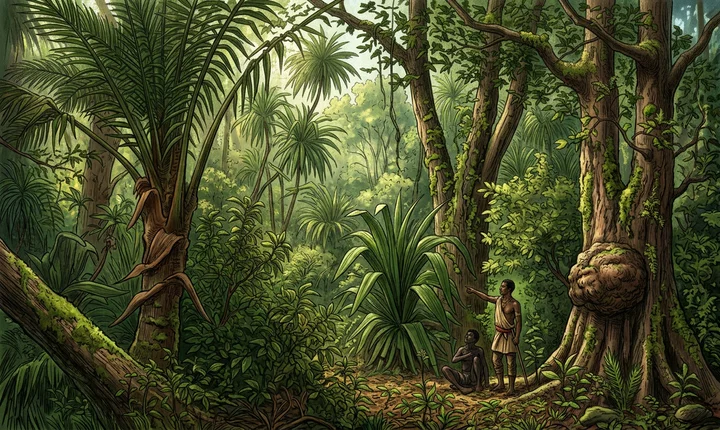
The most useful of all these trees are the different species of the palm. On it the natives depend almost solely for food, drink, and clothing. They grow in almost every variety of form, their leaves varying from the delicate thread-like tufts and spirals, to the broad, flat “fan” six feet across. The trees in the more open forests are neither so tall or so regular in structure as in the denser. They grow into all sorts of grotesque contortions, some with huge excrescences like a camel’s hump, and some with their long branches dividing nearly at the root, and spreading out, like loving arms ready to embrace all that comes within reach. In many of these trees the natives build, or rather weave of palm leaves, their rude huts, as a protection, though slight, from the prowling beast and crawling reptile.
But it is in the low, flat border-land forests of the Amazon, that beast and reptiles of the most deadly kind choose their lair. There the interlacing branches are literally wrapped in clinging vines and feathery moss, forming a perfect labyrinth beautiful to behold, but whose charm is lost when the members of the animal kingdom it shelters are considered; and so the brilliantly plumaged but harsh tongued bird, the chattering monkey, the stealthy jaguar, the gliding cobra, alone are left to thread the intricate mazes of the tropical jungle. S. ISADORE MINER.