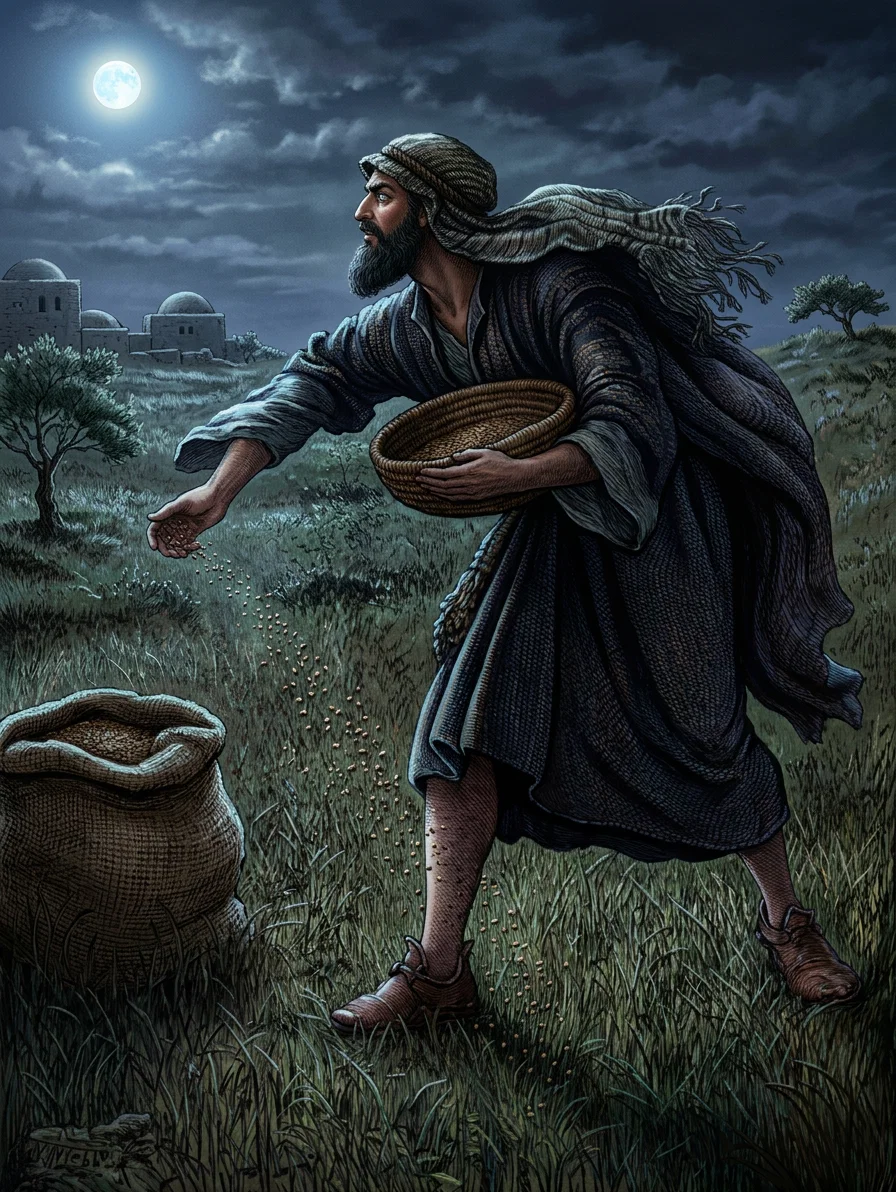
“THE sower!” is your first thought, as you glance at the engraving on this page; and immediately the parable of Matt. 13:3-8 comes to mind,—“Behold, a sower went forth to sow, and when he sowed, some seeds fell by the wayside,” “some fell upon stony places,” “some fell among thorns,” “other fell into good ground,” etc.
Let us give the picture a closer examination and see if it illustrates this parable. You will observe that the sower in this instance is not casting his seed by the wayside, neither upon stony places, nor yet among thorns; and although the ground may be and probably is good, it was the custom anciently, as now, to sow grain upon bare ground, which had been prepared for its reception; whereas the picture represents this man as sowing seed in a field of sprouted grain; and, contrary to the custom of an orderly husbandman, he is doing the work by moonlight, or in the night time.
But “another parable put he forth,” in the same chapter, verses 24-30, which the illustration evidently portrays. It reads:— “The kingdom of heaven is likened unto a man which sowed good seed in his field; but while he slept, his enemy came and sowed tares among the wheat, and went his way. But when the blade was sprung up, and brought forth fruit, there appeared the tares also. So the servants of the householder came and said unto him, Sir, didst not thou sow good seed in thy field? from whence then hath it tares? He said unto them, An enemy hath done this. The servants said unto him, Wilt thou that we go and gather them up? But he said, Nay; lest while ye gather up the tares, ye root up also the wheat with them. Let both grow together till the harvest,” etc.
Restored with AI
Evidently our cut represents a person stealthily scattering the seeds of some kind of deleterious weed among the growing grain, which shall very materially lessen the value of the crop. Roberts states, in his “Oriental Illustrations,” “that the exact counterpart of this nocturnal villainy may be found in India at the present day. A man wishing to do his enemy an injury, watches for the time when he shall have finished plowing his field, and in the night, he goes into the field and scatters pāndinella, or ‘pig-paddy.’ This being of rapid growth, springs up before the good seed, and scatters itself before the other can be reaped, so that it will be some years before the poor owner of the field can rid the soil of the troublesome weed.
“But there is another noisome plant which these wretches cast into the ground of those whom they hate; it is called perum-pirandi, and is more destructive to vegetation than any other plant. Has a man purchased a field which another intended to buy, the disappointed person declares, ‘I will plant the perum-pirandi in his grounds.’”
There are several species of tares, but the kind in this parable most writers and commentators define as the bearded darnel, “a widely distributed grass, and the only kind that has deleterious properties.”214It has a bitter taste, and, eaten in bread, produces dizziness, and sometimes nausea. Before the plant heads out, it so nearly resembles the wheat in appearance, that upon the closest examination one can scarcely detect the difference; and those who weed their fields do not attempt to separate them. But as soon as the heads appear, the tares are easily distinguishable from both wheat and barley, the heads are so dissimilar. Because of this, and for the reason that the roots, when growing together, have a habit of intertwining with each other, the command was to let both wheat and tares grow together until the time of harvest.
But, dear reader, the enemy that sows tares is not confined to India. His field is the world. The Saviour used this parable to illustrate Satan’s underhanded work. Wherever the good seed is sown, there the great arch-enemy follows with his seeds of death. And because it is so hard to remove the roots of his planting, it devolves upon us to be upon the alert to prevent his noisome seed finding a lodging place.
Is the field our own hearts; proportionally as we value a home in the kingdom of God should be our efforts to prevent any but good seed being sown therein. The good seed is the word, or truths of the Bible; and every planting which diverges in the least from these is of Satan, and should be jealously guarded against. Every evil inclination, doubt, or unbelief is his suggestion, which we should firmly resist. The times are perilous; for this enemy is very determined that he will in some way destroy us. We hope and pray that each member of the INSTRUCTOR family may get a firm hold of the hand of the Lord, who is able to deliver from the power of the enemy. M. J. C.