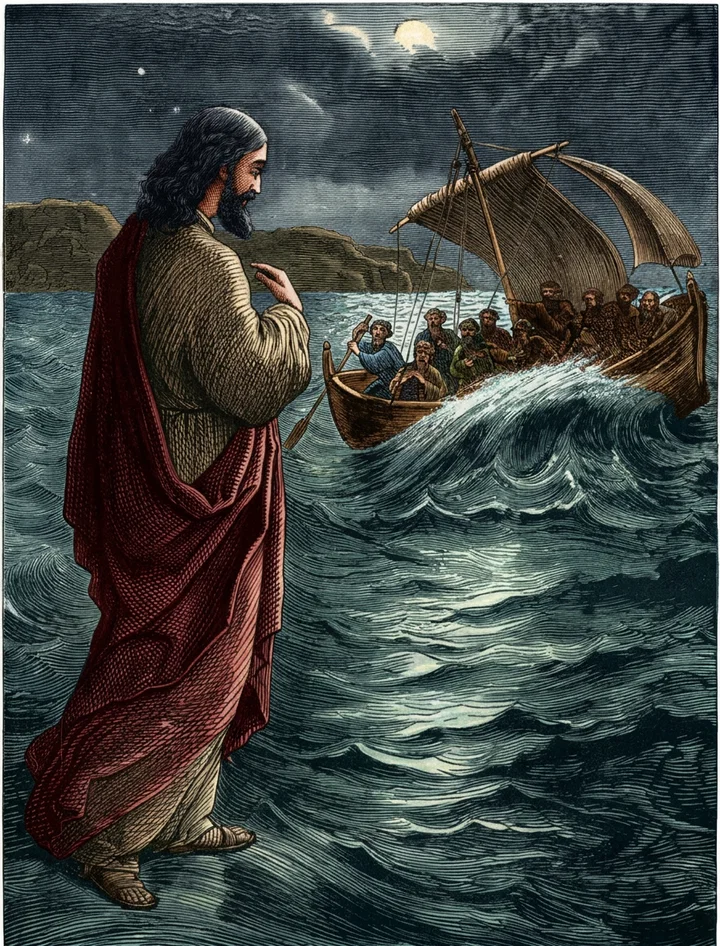
CHRIST WALKING ON THE WATER.
By G. W. A.
THREE of the evangelists,—Matthew, Mark, and John, give us an account of a remarkable miracle wrought by the Saviour on the Sea of Galilee. It was the circumstance of Jesus walking upon the water, in a violent tempest, as is so forcibly represented in the accompanying engraving.
The time, place, and occasion of this miracle are all very interesting to consider. Please open your Bibles at Matthew 14, and the sixth chapter each of Mark and John, and read the full history. By turning to John, we find that after the Saviour had miraculously fed the five thousand, the people were so impressed with his teachings that they said, “This is of a truth that Prophet that should come into the world.” Then the excited multitude, who hoped that the time had come for the Roman yoke to be broken off, were determined to come and take Jesus by force and make him king. The divine Redeemer, to guard against such an unwise transaction, immediately directed his disciples to take the boat and proceed to a place not far from Bethsaida, which was near to Capernaum, while he dismissed the multitude. It is more than probable that the disciples were highly pleased with the intentions of the people, and were very reluctant to embark; for Matthew plainly says, Jesus constrained them to get into a ship and leave.
The Saviour then compassionately dismissed the people, and afterward went up into a mountain alone, to engage in prayer.
In the meantime the disciples were in trouble. After entering the vessel, a wild wind swept down from the mountain gorges, and the bosom of the lake was furiously agitated. The dark night set in, and the disciples toiled at the oars, making but little headway. It was but a few hours' work in fair weather to reach the point they wished to make; but now they were driven off their course, their boat the plaything of an angry tempest. All the long, dark night, with tireless sinews, did the poor disciples buffet with the waves, at any moment liable to be engulfed by the waters. Doubtless they often thought of Jesus, and wished that the commanding presence of their Master was with them in the storm. Their faith was most sorely tried.
But had Jesus forgotten his disciples? Ah, no! When the disciples went to sea, their Lord went to prayer. In the distance, his divine eye pierces the darkness, and he sees the trouble and danger of his few followers. He would not suffer a hair of their heads to perish. “And in the fourth watch of the night Jesus went unto them, walking on the sea.” At first the disciples cried out for fear, and supposed that they had seen a spirit or apparition, as they saw the figure of a man stepping toward them upon the billows. But soon the well-known voice of the Saviour is heard in comforting tones, saying, “Be of good cheer; it is I; be not afraid!”
How soothing, how full of comfort those precious words must have sounded to the tempest-tossed disciples! Doubtless they were speechless with joy, and almost beside themselves. Their fears are gone, and the storm is forgotten, as they hail Jesus as their deliverer.
But the interesting narrative continues: “And he went up unto them into the ship, and the wind ceased.” Then the disciples, and the others that were with them in the bark, came and worshiped Jesus, saying, “Of a truth thou art the Son of God.” “And immediately the ship was at the land whither they went.” Thus we see that one miracle immediately succeeded another.
Our extremity is the Lord's opportunity. Jesus appeared to his disciples at the very moment they needed him most.
They “toiled in rowing.” We must use the oars on the tempestuous voyage over the sea of life, as did the disciples in that stormy night on the sea. Though the wind was “contrary,” and the disciples were likely to perish by the tempest, they did not tack about and come back to Jesus, and tell him they could not get to the place he wished them to go; but they did the best they could under the circumstances.
“It is I; be not afraid.” In the midst of their keenest sorrow, Jesus appeared to his disciples with a comforting message. Let us add to our faith courage.
Jesus' presence with his people, on the sea of life, is enough to make them cheerful, even though in the midst of a storm. G. W. A.