THE SMOKING MOUNTAIN

10%

S. D. A. Publishing Association · Battle Creek, Mich. · Oct 5, 1887

FromThe Youth’s Instructor, Vol. 35, No. 40.

Read the full edition

THE SMOKING MOUNTAIN.

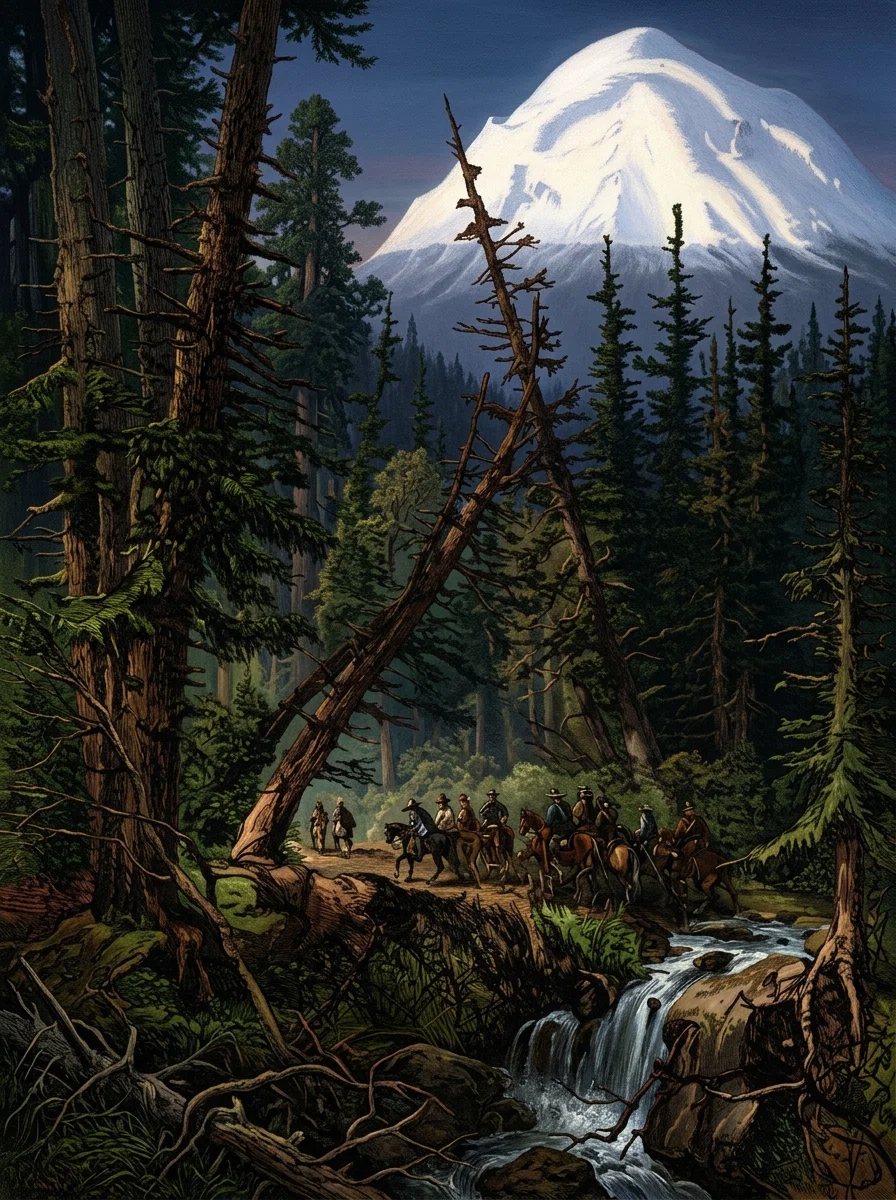
In the heart of southern Mexico rises a wonderful mountain,—wonderful not so much because it is the second highest peak in North America, but because, though nearly 2000 feet higher than the famous Mont Blanc, it can be ascended to the top, and the journey, so far as high mountains go, is a comparatively easy one. Popocatepetl, or as the name signifies, the “mountain that smokes,” is called an active volcano, yet the lazy old giant seems at present to be enjoying a prolonged rest; for it has not had an eruption within the memory of man.
Restored with AI
A fine view of this mountain and its companion Ixtaccihuatl, is obtained from Ameca-ameca, a town some forty miles from the city of Mexico, and the point whence the ascent of the volcano is begun. “East of the town,” says Mr. Frederick Ober, in a description of his ascent of the mountain, “and, in fact, all around, stretch immense fields of corn and barley, parted by hedges of manguey; and beyond them the foot hills commence, with many a fertile tongue of land running up among them, green and golden with grain. Then they rise higher and higher, covered with black forests of pine, until the grand old mountains are fairly reached, which shake off their garments of trees, and tower above them all, brown and barren; next comes the border of the snow-line, its white robe ragged and patched with brown on its skirts; but, finally, triumphing over all below, it drapes the peaked summit in a glistening garment of spotless white. Facing the east, Ixtaccihuatl—La Mujer Blanca (‘the white woman’)—lies above, and apparently nearer the town than Popocatepetl. She covers a long portion of the ridge with her white shroud, and is really suggestive, by her shape, of a dead giantess robed in white for her burial. Far and near this volcano is known as the ‘White Woman,’ and from the plains of Ameca-ameca and from the city of Mexico the resemblance to a dead woman lying on her bier, and covered with a white sheet, is most perfect. The neck is a trifle too long, but the dead face is perfect, and the hair streams in silvery locks from the snowy forehead back over the head and down the sides of the bier. Her feet are turned towards her companion giant, grim old Popocatepetl, and between the two lies a long uneven ridge, mainly below the snow-line, brown, and for the most part treeless. Popocatepetl is a solid cone of glittering snow, which appears jagged and sun-bitten at about the same level as is Mujer Blanca, and allows his diadem to lose itself in little streams that trickle down his giant shoulders.”
As we near the snow-line, we come upon the last attempts at civilization,— the rancho of Tlamacas, 12,500 feet above the sea, the highest habitation, perhaps, in North America. This is the home of the Indian guides and purifiers of sulphur; for the crater forms one vast bed of sulphur deposit. “The ‘volcaneros,’ or volcano men, are a hardy race of Indians who toil day after day, gaining a living by picking up the sulphur and conveying it to the rancho, where it is sublimed and taken to the towns for sale.”
“From the snow-line to the crater,” says another traveler, “the ascent was decidedly laborious, but there is no danger—we found no crevasses, no clefts, no chasms, and no avalanches. The smooth, cone-like summit of the mountain is covered with a cake of snow, which, by alternate freezing at night and thawing at noon, is as slippery as glass, were it not that where the guide takes you it is thickly covered over with upright blocks or small columns of snow-ice. When you slip, you only slide a foot or two till you are brought to a stand by one or more of these pillars of ice. The edges of these pillars, large and small, are sharp as razors. I luckily had on a thick pair of woolen gloves, and escaped scathless, but the gloveless hands of my companions were so badly cut that our ascent might have been traced by their blood on the snow.”
But at length the crater is reached. This is said to be about three times the size of Vesuvius, and of similar shape. “The lip of the crater,” says Mr. Ober, “is a narrow rim of sand, lying above the black abyss, and at the edge of the sea of snow, like the coral ledge composing an atoll of the southern sea. . . . The snow stopped abruptly at this wreath of sand, rising to a height of from six to eight feet, and curling over it, but prevented from advancing further by the heat from the crater.”
Out of the vents in the dark depths below ascends a sulphurous cloud, suggestive of the infernal regions. Here, the volcaneros work in gangs alternate weeks, and live in the crater, beneath rough sheds. For twenty years this dangerous sulphur mine has been worked. At first, there was the accumulation of centuries to be removed, but now the principal supply is obtained from the vents and fissures in this yawning abyss.
However long a traveler may be in making the ascent, it is but short work to come down. “Down the ice cone,” says our traveler, “the laborers of last month had dug a long straight trench, leading from crater to volcanic sand, down which they used to slide sulphur. Had they been working now, I should have borrowed a kind of straw mat, and slid down on that, as they were wont to do; but as they were not, I stood upon my broad-soled shoes, and, guiding my course with the alpenstock, sped downward with the swiftness of the wind, . . . over the snow, and out upon the sand, and finally reached La Cruz.
“At sunset, old Popocatepetl seemed on fire, his peak took on a rosy glow that soon suffused the whole cone; and later, as the sun sank down and spread its warm coloring over the eastern sky, he seemed encased in burnished gold; but, as old Sol disappeared entirely, he relapsed into cold, dead white, standing out like a mountain of marble against the steel-blue sky. “The White Woman” did not share this afterglow of the sun, but remained resting on her bier, a slight mist draping her, and giving her the livid hue of a corpse, as she is. But when daylight had just faded, and the stars began to twinkle one by one, both the dead giant and the dead giantess were wrapped in the serene white calm of this upper atmosphere.” W. E. L.