As a means of gaining the attention and promoting a lively interest in the lesson, we fear the blackboard has been greatly undervalued. No other Sabbath-school help has been so little appreciated as this one. This no doubt arises from a misconception of the true use of the blackboard. It is a mistaken notion that elaborate or highly artistic pictures are necessary. The immediate object of the Sabbath-school is to teach the lesson; when, therefore, the drawing or the lesson help becomes so elaborate or so complicated as to divert the mind of the pupil from the thought of the lesson to the skill or ingenuity of the artist, the lesson help may be counted a lesson hindrance. Whenever your scholars exclaim, “Oh, what a beautiful picture!” you may know that your effort is a lamentable failure. Elaborate pictures may do some good; but we believe there is a more excellent way, whereby a teacher of little skill in artistic work can attain results that would at first seem improbable.
“Curiosity and imagination,” remarks one who has had long experience in training the minds of children, “are especially active in childhood; and whoever would hold the attention of a child, must give room for the exercise of those faculties on the subject he is presenting, or they will immediately fall into employment on some other subject.” It is, therefore, by exciting the curiosity and thus gaining the attention of the child, that the blackboard is mainly useful.
Since first impressions are lasting, and with most children difficult to efface, it would seem best for the teacher to spend a portion of the time each Sabbath in going over the next week’s lesson with the class. “Teaching a lesson,” says one, “is very different from hearing a lesson. In teaching a lesson, the first thing is to get the lead of the minds in your class, to get them all to think and talk about some one thing.” In this work of concentrating thought, the blackboard is mainly useful. As an illustration of how this may be done, let us take the lesson on Jacob’s departure from home.
We will suppose that you have illustrated the preceding lesson while teaching it the Sabbath before, and have made Isaac’s tent, and Jacob’s home, in Beersheba. You will now, while asking a few general questions, that all can answer together, rapidly sketch the tent, with the palm trees and the low-lying hills of Judea in the distance, something like the following:—
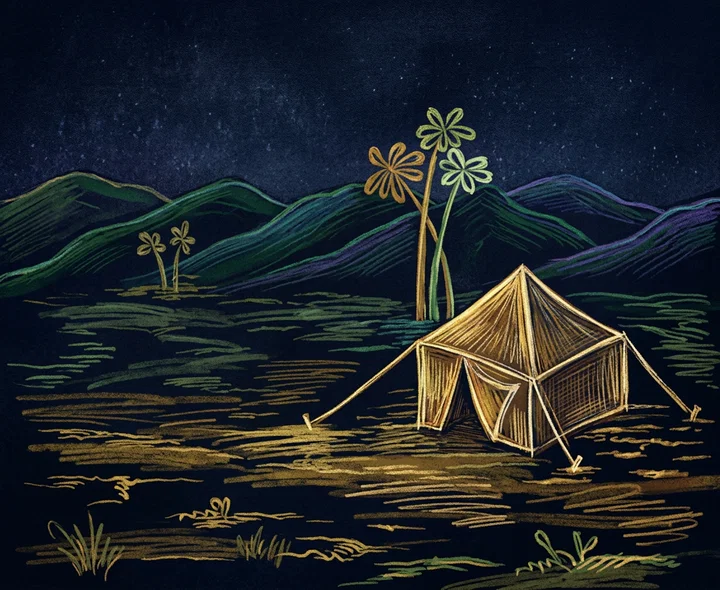
In questioning, you might say: “What did Isaac live in,—a house or a tent? What was the name of the place where he lived? How many sons had Isaac? What was their mother’s name? Which of the sons did she like best? What did Isaac ask Esau to do for him? Why did Jacob deceive his father? Who put him up to do this? Was it right? What did Esau threaten to do?” (And having thus connected the last lessons with what you wish to teach to-day, begin to take advance steps into the lesson of the next Sabbath, having a care to go no faster in your drawing than you do with your word picture.) “Rebecca was very much afraid Esau would really kill Jacob, just as he said he would do. She felt so worried about their quarrel that she hurried him off to his Uncle Laban’s; for Isaac was so old and feeble that he might die any day, and she did not dare to wait. She must have felt sad at this parting from her best-loved son; for she was old herself, and might not live to see him again.” (While talking, you may add, to the picture you have already made, Jacob and his mother at the door of the tent.)
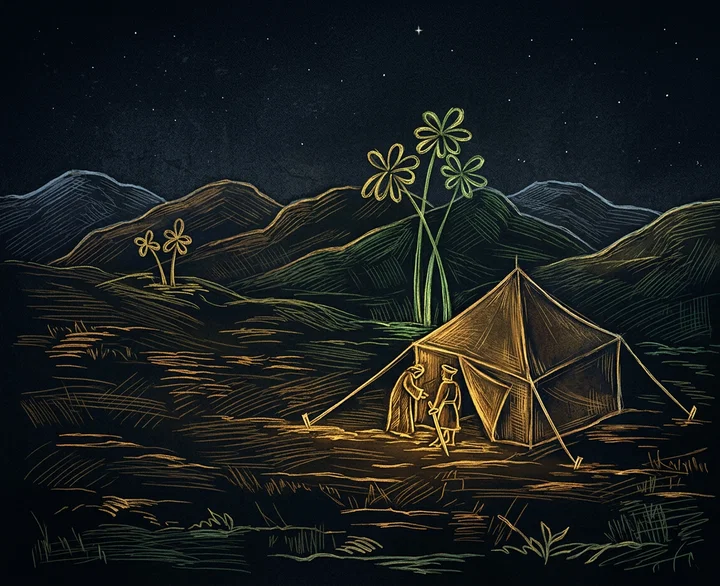
Laban’s home was away to the northwest of where Jacob lived, in Haran. Do you remember the name of a good man we once learned about, who lived for awhile in this town? Yes; Abraham stopped here while on his way to Canaan. (Here complete your first picture, and while talking about the road, make a mountain pass, with a man hurrying swiftly along, as seen in the next picture.)
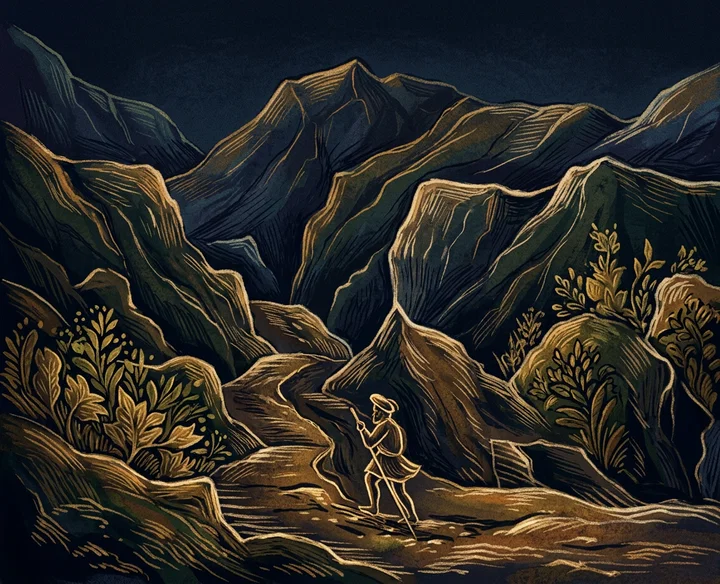
“The road from Beersheba to Haran was rough and crooked, as it is now, and it passed through many wild places in the mountains. Do you not think Jacob had a lonesome journey? I suppose he thought about his quarrel with Esau, and may be he wondered whether his Uncle Laban would be glad to have him come and live with him or not.”
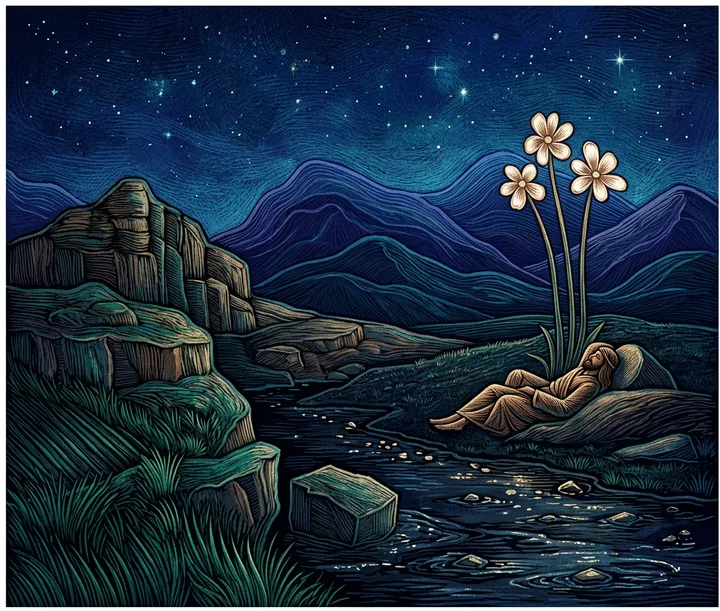
“Jacob must have traveled very fast; for when night came he was as much as sixty miles from home, near a little city called Luz. He did not know anybody near here, and so he lay down in a lonely place, and took a stone for his pillow.” (By this time you should have nearly completed a drawing like the following:—) “How do you suppose he felt when he thought of his father’s comfortable home in Beersheba, and how he himself now had no place he could call home?”
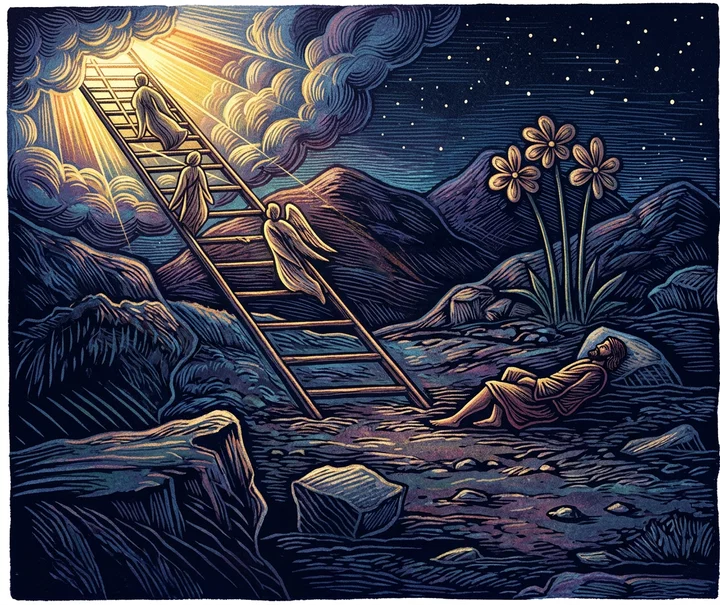
“But Jacob was not alone. God was watching him all the time, though he did not seem to remember it. When Jacob had fallen asleep, the Lord sent him a wonderful dream. (Here begin to make your ladder and the angels as in the following:—) He thought he saw a ladder reaching from earth to heaven, and that angels were going up and down on it. At the top was the Lord of glory (add to the picture the clouds with the light shining out), and he talked with Jacob. He made him the same promises that had been made to Abraham and to Isaac. God told Jacob not to be afraid; for he would give him all the land whereon he was now lying, and promised to be with him in all places, and bring him back to that spot again.

“Do you think Jacob felt lonesome after that? or that he dreaded so much to go to live with strangers? When Jacob woke up, he said, ‘Surely the Lord is in this place, and I knew it not.’ And he set up the stone he had used for a pillow as a pillar to mark the place where he had had this wonderful dream. (While you have told this, you will have made changes in your picture, like those in the one on the next page.) Jacob named this place Bethel, which means ‘the house of God.’”
It would be a good plan if, after teaching the lesson in this manner, you should ask a few questions on what you have just been talking about, so that the story may become more firmly fastened in the children’s minds.
In the few minutes usually allotted to teaching the lesson,p. 193 nothing elaborate in the line of illustrations can be attempted; the drawings will of necessity be rude, but a child’s quick imagination will fill up all deficiencies. A teacher who was illustrating this lesson to a class of children was perplexed when she came to that part of the story about the angels. Not having any natural skill in drawing, it seemed beyond her power to picture an angel; so she said, “I don’t know how we shall put all the angels on this ladder.” “Oh,” replied an interesting listener, “you couldn’t make them go up and down anyhow.” So the angels were omitted, to the great relief of the teacher.
A clear distinction should exist in the teacher’s mind between hearing the recitation and teaching the lesson. In hearing the recitation, you are to test your pupil’s knowledge of the things he has been taught. He is to tell you what he remembers, and you are to supply merely what you cannot bring out of the class. It will therefore be readily seen that the blackboard work described above has no place in the recitation.
But when you teach the lesson, you should make the narrative so vivid that the whole story will be given a life-like reality; you should make the Bible characters live men and women, and their actions should be pictured as things that really occurred; and as you proceed Sabbath after Sabbath, and lesson after lesson, in this manner, the Bible will open up to your pupils as one vast panorama; its characters will come to seem like people we have personally known in by-gone days; and the solemn warnings and injunctions, and the bitter lessons, and the tender entreaties, which were sent to them, will come with tenfold weight to a mind thus prepared to receive them as the lively oracles of God.
But do not make the grievous mistake of drawing your pictures beforehand. No picture, however elaborately drawn, can take the place of this off-hand work. Should you do so, you will lose that co-operation on the part of the child that is so essential to any success in teaching. Capture his curiosity by legitimate means, and fasten it on the lesson. It is a temptation, to be sure, to leave your picture on the board when you have succeeded in making one with which you are comparatively suited. But put this temptation behind your back. Rub your pictures out. Remember you are not working to secure a reputation as an artist.
But you say you could never learn to draw. Perhaps you could not be even a tolerably good artist; but I am satisfied that the majority of our teachers could do efficient work in off hand drawing if they would put pride and ambition aside, and resolutely set themselves to the task.
You will see by examining the pictures on this page, that it is not necessary to make many lines to tell your story. If you are troubled to give natural positions to your figures, select from some picture book a figure that suits your purpose, and placing it against the window pane, put over it a thin piece of paper, and carefully trace the outline. Study this outline, and draw it on paper without holding it to the light. Use your eyes when you look at a picture. Notice where the light and shade fall, and make yours in the same place. Watch objects in nature closely, and learn from them. When you have trained your eyes to see things as they are,—and this no one can do for you,—you have gained half the victory.
But among other things do not neglect to study diligently Bible manners and customs, and conform your pictures to them. Do not make the mistake that one young teacher of my acquaintance made, and deck your Rebecca and Rachels out in a hat with feathers, and in a dress with an overskirt, ruffles, and other feminine furbelows; and your gentlemen in dress-coats, rattan canes, and plug hats. But make it as much a reality of the Bible times as you can. This teacher knew better; but instead of leading the children, she allowed them to lead her, and yielded to their importunities to “fix Rebecca up.” It may be well to let them occasionally suggest in regard to the pictures, but while seeming to let them tell you, hold the reins firmly in your own hands and guide them instead of being guided by them.
Do not give up if you fail once or twice, seven times, or seventy times seven. The race is not to the swift, nor the battle to the strong, but to those who are willing to work. May you succeed, dear teachers, in making the Bible a living reality to your pupils, so that they will love to study it because it is a delight to them. W. E. L.