The ark was the most sacred object among the Hebrew people. It was a kind of chest of oblong shape, and was made of acacia wood. It was covered within and without with the purest gold, being nearly four feet in length, and about two feet and three inches in width and height. The ark was covered by a lid of solid gold, and extending around its upper surface was a border or crown. This cover was called the “mercy-seat.” On each end of the mercy-seat were two cherubim, with expanded wings, their faces looking downward. These angelic figures were made of beaten gold. The wings of the cherubim overshadowed the ark, and nearly touched, as seen in the illustration. In each of the four corners of the ark was attached a ring of gold, into which were placed staves, or poles, that were overlaid with the finest gold. By means of these staves the ark could be carried about. They were never to be removed from the rings under any circumstances. Ex. 25:15.
It was from between the covering wings of the cherubim, above the mercy-seat, that the Lord communed with his people. See Ex. 25:22. This passage says: “And there I will meet with thee, and I will commune with thee from above the mercy-seat, from between the two cherubim, which are upon the ark of the testimony, of all things which I will give thee in commandment unto the children of Israel.” In 1 Chron. 13:6 it is spoken of as “the ark of God the Lord, that dwelleth between the cherubim, whose name is called on it.” There are a number of texts which speak of God as dwelling between the cherubim.
The Lord was said to “dwell between the cherubim,” because it was here only that he taught the people through his chosen instrument. So we read, “And when Moses was gone into the tabernacle of the congregation to speak with God, there he heard the voice of One speaking unto him from off the mercy-seat that was upon the ark of the testimony, from between the two cherubim; and he spake unto him.” Num. 7:89. Thus it was that God communed with his ancient people from between the cherubim. It was over the cherubim and mercy-seat that the Shekinah, or divine presence, in the form of a luminous cloud, hovered perpetually, both in the tabernacle and the temple.
The ark was sometimes called the “ark of the covenant,” because it contained God’s law, the ten commandments, which was the basis or conditions of the covenant between him and his ancient people. See Ex. 19:5. It was called the “ark of the testimony,” because the two tables in it were witnesses against every transgression. The ten commandments are called the testimony in numerous passages. See Ex. 31:18. “And he gave unto Moses, when he had made an end of communing with him upon Mount Sinai, two tables of testimony, tables of stone, written with the finger of God.”
During the journeyings of the children of Israel in the wilderness, the ark was covered with a three-fold covering, the outer one of which was a canopy of blue. Num. 4:5, 6. Whenever it was moved, it was always carried, with the greatest reverence, upon the shoulders of the Kohathites, a branch of the family of Levi; and even these persons could not touch it under pain of death. Num. 4:15, 20. Except at stated times, even the high priest could not come into the presence of the ark, lest he should die. Lev. 16:2.
The history of the ark from the time that the Israelites crossed the Jordan till the destruction of Solomon’s temple may be briefly stated.
When the ark reached the River Jordan, the waters divided, and when the host had passed on, the river closed up again. Joshua, chaps. 3, 4. Before the ark the walls of Jericho fell down, and the city was taken. Josh. 6:4–12. After the entrance of the Jews into Canaan, the ark remained awhile at Gilgal, where there was an encampment of the people. Josh. 4:19; 10:43. After the land was subdued, the tabernacle was first set up at Shiloh, and the ark rested for about three hundred years. Josh. 18:1. In a war with the Philistines, at a time when the people had greatly departed from God, the ark was taken from the tabernacle to the Hebrew camp; but in the engagement that followed, it was taken into captivity by the enemy. 1 Sam. 4:3–11. The triumph of these poor pagans was, however, very short. They were so sorely afflicted by the judgments of God that they were glad to restore the ark to the Hebrews, which they did in a very ingenious way, after having kept it seven months. 1 Sam. 5:7. As the ark came back by the way of Bethshemesh, a number of the people were smitten for looking into this sacred depository. 1 Sam. 6:19. Then it was removed to Kirjath-jearim, where it remained separate from the tabernacle a number of years, and the people mourned that God had left them. 1 Sam. 7:1, 2. This was in the time of Samuel the prophet.
When David became established in the kingdom, he assembled a body of thirty thousand men, and attempted to bring the ark of God up to Jerusalem. They placed the ark upon a new cart, but as the oxen shook it, Uzzah stretched forth his hand to steady it. For this rash act he was smitten with death. David, in his terror, then left the ark at the house of Obed-edom the Gittite. 2 Sam. 6:1–12. The king afterwards acknowledged that this judgment occurred because they “did not seek God after the due order.” 1 Chron. 15:13. After three months, hearing that the Lord had greatly blessed Obed-edom and all his house, David, with great reverence and caution, brought the ark of God up to the city of David, Jerusalem, and placed it in a tent which he had prepared for it. And there they offered burnt offerings and peace offerings before God. 1 Chron. 16:1. Nearly forty years later, when the magnificent temple of Solomon was erected, the ark, with great devotion and circumstance, was deposited in the holy of holies. 1 Kings 8:6–9. Toward four hundred years after this, in the days of good King Josiah, when a great reform was in progress, he commanded the Levites to put the “holy ark” back into the house which Solomon had built. 2 Chron. 35:1–3. From this it is supposed that during the reign of the idolatrous kings, the pious priests had removed the ark to preserve it from sacrilege. Or it may be that wicked King Manasseh removed it himself to give place to the “carved image” which he set up in the sacred temple. 2 Chron. 33:7. Still later, when Jerusalem was taken by the Babylonians, and the people and the saved vessels removed to Babylon, the holy ark passes wholly out of sight. 2 Chron. 36:18, 19.
Restored with AI
What became of this sacred object the Scriptures do not tell us. The Jewish people believe that it was concealed from the heathen “spoilers,” and regard it among the hidden things which the Messiah will yet reveal to them. The quite probable view is that stated by the author of the Book of Maccabees, that when the destruction of the temple by the Chaldeans was imminent, Jeremiah and others took the ark and concealed it from the enemy.
In the second temple there was no ark, but in its stead a stone occupied the place where the ark formerly stood. Indeed, that sacred edifice lacked five important things, as Dr. Clarke well says, which were the glory of the temple of Solomon. These were the ark, the sacred fire, the spirit of prophecy, the Urim and Thummim, and the holy Shekinah. See Clarke’s Notes on Matt. 28:22. It was the absence of these glories that made the ancient men weep when Ezra and others laid the foundation of the second temple at the return of the Babylonian captivity. Ezra 3:12. But the promise of the Lord by the prophet Haggai, that the glory of the latter house should exceed the former, was fulfilled by the Lord Jesus coming personally into the temple and proclaiming salvation through his234name to both Jews and Gentiles. See Hag. 2:3, 9, and Luke 4:16–21.
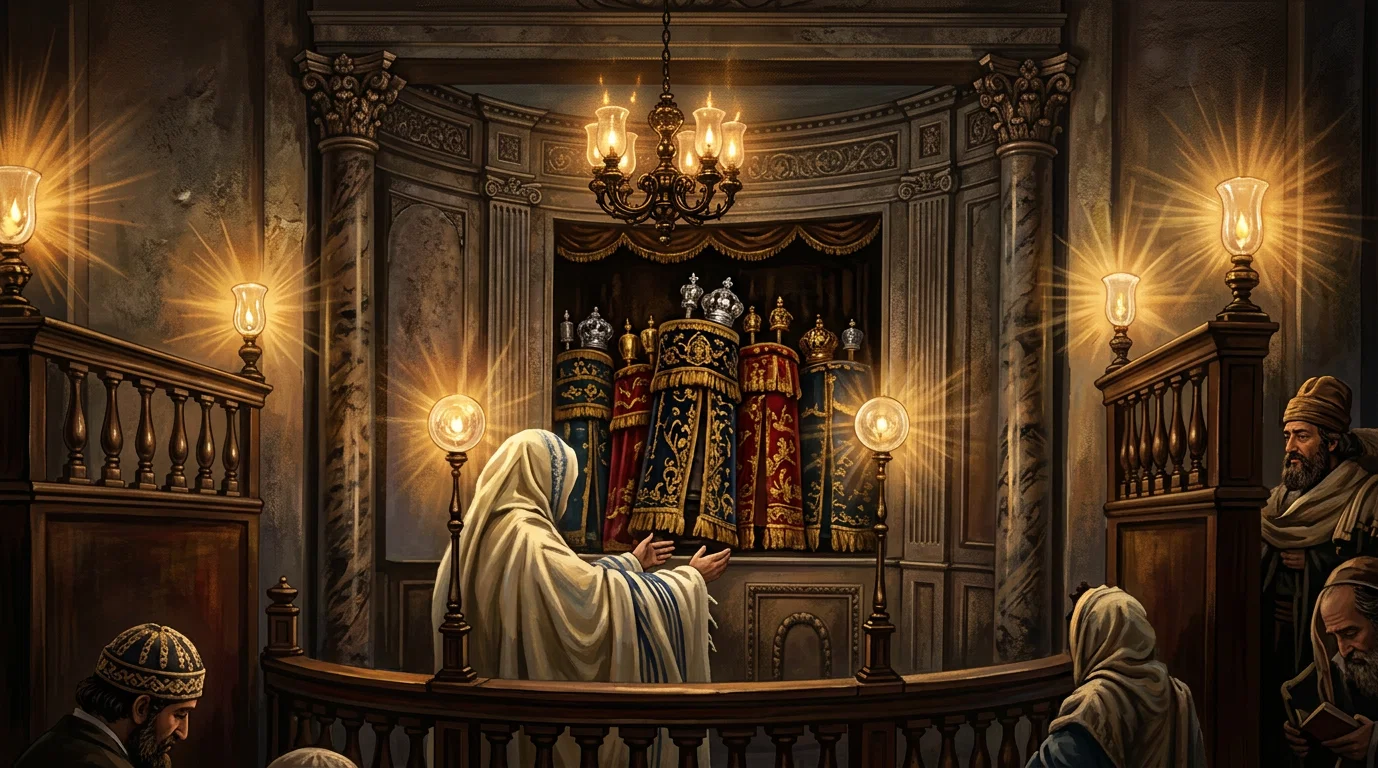
In the illustration on the first page there is a view of the eastern portion of a Hebrew synagogue. All Jewish synagogues face the east so that the worshipers can pray looking toward Jerusalem. See Dan. 6:10; 1 Kings 8:44, 48; Jonah 2:4. This is a general law among the Jewish rabbis. The dark background seen under and back of the chandelier is called “The Holy Ark.” It is an open receptacle, made of wood. In this ark we notice the five rolls of the law, or rather the beautiful cases which inclose the five books of Moses: Genesis, Exodus, Leviticus, Numbers, and Deuteronomy. The lamps are always lit in a Jewish synagogue during worship. The person in front, whose dress resembles that of a woman, is the reader of the synagogue, called the chazan. He is in the act of taking out one of the sacred rolls, or books. The man at the right is the “president,” or Jewish minister. The two persons before the chancel are at prayer, with their faces turned to the east toward Jerusalem. As you notice, all have their heads covered, as it is a law among the Jews, that all heads shall be covered in their places of worship.
In the small illustration is represented the sacred ark, with the covering cherubs, and in front is the golden table with the twelve loaves of shew bread; this last signifying our continual need of that heavenly Bread which gives life to all mankind. John 6:35. G. W. A.