In the great city of London, sometimes called “The City of Masts,” by reason of its vast shipping, there once lived a little boy who had never known father’s or mother’s care. Either his parents had died before he could remember them, or else, like many other poor and wicked ones, they had cast him off in infancy. Whichever way it was, his only home was an ill-smelling lodging house down by the water side.
He never knew what it was to watch at the window at evening for a kind father’s return, and then, after a loving greeting, to climb upon his lap by the fireside, and tell him all the wonderful history of the day, as regarded sleds, snowballing, and other winter fun. He had no mamma to listen to him, when his stories were not so full of play; to sympathise with him over the trials of the first day of school “when novelty had lost its charm;” or to tell him how the Saviour loves little children, and to teach him to pray to him.
Poor Tom had none of the comforts or delights of childhood; for though only eight years old, he had to work early and late, in cold and wet, sweeping the crossing clean for the passers by, and begging with hat in hand for the few pence they chose to give him. At night he went back to his heap of straw, and scant supper, which was usually seasoned with harsh words and blows, because the slender little boy had not brought more money to his keeper.
One morning Tom was driven out very early. As he went along munching his bit of dirty bread, his rags fluttering in the frosty air, he saw the fog rolling in from the ocean, and advancing up the Thames and the streets parallel to it in a distinctly visible cloud. In a few minutes the sun was shut out, and all was darkness. He saw the lamplighters hurrying along to light the gas on the streets; for the smoke of a million chimneys was beaten back, and rested within a few feet of the earth, blackening the mist, till a great pall seemed spread out over London, and all the dust was turned to mud.
On this day Tom’s work was particularly hard. The slippery crossing, the jostling crowds, and the cold, drizzling rain on his bare feet were enough to discourage a braver lad than he. No wonder the tear stains were thick on his young face. But looking up, he saw a man trying to pick his way across the crowded street. In an instant Tom was at his side, piloting him safely among the wheels and horses, whips and umbrellas, to the other side.
The gentleman carelessly tossed him a piece of money, and hurried on. The boy looked at the bright yellow piece, and rubbed his eyes to see if he were dreaming. No, it was surely gold; then a change suddenly crept over his face. He did not know the amount of the money, he only knew it was gold, and could not have been meant for him.
Tom was truly “a diamond in the rough,” for under all the layers of ignorance and neglect, he possessed the bright gem,—honesty! So he ran after the man, tangling his broom in the legs of pedestrians in his haste.
He overtook him at last, and standing shivering in the dismal fog, held out the piece of money, saying, “I expects you ’ave made a mistake.”
The gentleman said, “Well, my honest little fellow, it was a mistake; but I guess the gold piece could not have been given more worthily. Tell me something about yourself. Did your mother teach you honesty?”
“I never ’ad a mother as I knows on,” replied Tom.
“What is your name?”
“Tom.”
“What is your other name?” asked he.
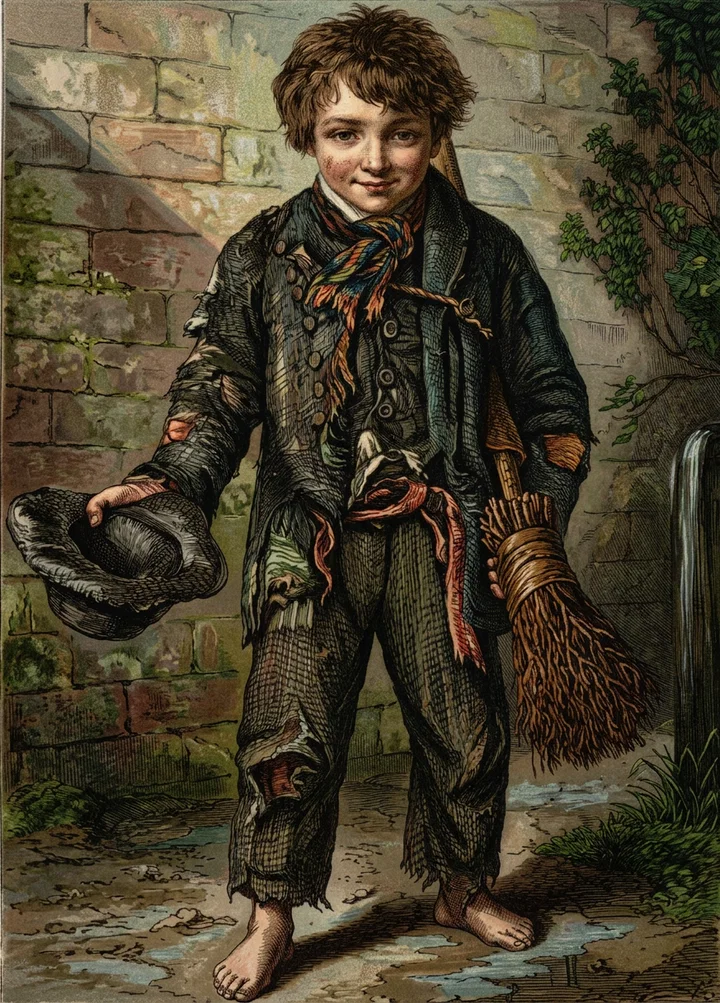
“Ragged Tom, is my other name, but I am called ‘Tom’ mostly.”
“But,” said the man, “have you no friends or relatives in this great city? Are you all alone in the world?”
“I don’t know wot you calls ‘relatives,’ but I ’as no friends ’cept the man wot beats me every night, when I takes only a few pence to him,” said Tom.
Then the gentleman took the boy by the hand, and said, “Come into this chop house near by. I will buy you a warm breakfast, and then I want to talk with you.”
While Tom was eating the first comfortable meal he had ever had in his life, the gentleman told him about himself and of his home far across the water, in a land of clear skies, and pleasant homes, and schools and playgrounds. When he had finished his story of the country, he said, “Tom, I have only one child, a boy of your age. I have plenty, and can give you a home and all the good things that go with it, if you will go with me, and leave London forever. What do you say? Can you trust me? Shall America be your future home?”
The boy gave one searching glance at the kindly face bending over him, and answered, “Thankee, sir, you are werry good to me. I have nothink to give you, but I will try hard to do right, and will go if you will take me.”
“Then, Tom, it is a bargain,” said the gentleman, “and may God deal with me, as I do with you!”
Years have passed since then. Tom has dropped his uncultivated speech, and become a cultured gentleman; yet he never forgets he was once a friendless boy in the streets, and his heart goes out to the poor, and his life is largely spent in mission work trying to lessen suffering wherever found, and to bestow on others some of the blessings he received in his need from one of Christ’s followers.
L. E. ORTON.