ABOUT six centuries before Christ there lived in India a prince named Gautama.
He dwelt in a beautiful home, surrounded by well-watered rice fields, the pride of an Indian's heart; and always before his eyes loomed up the grand Himalayas, clear cut against the bright blue sky. He had kind friends, and wealth, and everything that is supposed to bring happiness; but they did not bring peace of mind to Gautama.
The old legends say that one day the prince was riding along with his charioteer, when he met a very old, broken-down man; at another time, he saw a person suffering from an incurable disease; and at another ride, he passed a decomposing corpse. Strangely moved at these sights, he asked his charioteer what it all meant; and the wise man told him that this was the fate of all human beings. Shortly after this, he met in his ride a hermit, whose calm and dignified manner was in such contrast to the misery he had formerly met, that he marveled at it, and inquired of the charioteer in regard to the cause.
Gautama thought much about these things; and when he saw that wealth and pleasure often brought sorrow and misery, he thought his present mode of life an unworthy one, and that he would do well if he should give up home and wealth, and live like the hermits. So he turned a poor monk, and spent many years in the forests and in solitary places in study and meditation. He offered many sacrifices, according to the religion of the times, and fasted long and often, till his brother monks thought him more holy than one of the gods. But nature revolted against these penances, and one day Gautama's bodily strength, his resolution, and his faith gave out together. When his disciples saw such signs of weakness on the part of so great a saint, they fell away, one by one, and sought other teachers.
Poor Gautama did not know what to do. He had found that wealth did not bring happiness; he had tried study and meditation, and was counted very wise, but that had not brought him the peace he desired; neither did his ascetic life, with the fastings, severe penances, and the sacrifices he offered to the gods. How attractive the loving home, and the wealth and power he had left, now looked to him! He would have found the sympathy of his friends very pleasant in this time of need, but they had all left him.
However, Gautama did not yield to the temptation to abandon his calling. He thought a great deal, and at last concluded that to reach happiness, one must conquer his mind, and subdue all evil passions. Then he thought he ought to go out into the world, and teach other people how to find peace. Gautama did not know about the true God or the Christ who was to die for the sins of the world; so of course he taught much that was wrong. He thought that life on the whole was a curse rather than a blessing, and that those who did evil would be born again into a new body, perhaps of some animal or a bird; but that those who did well would at last reach the paradise of rest, which simply meant that when they died, they would be as though they had never been. Gautama taught that if this paradise was to be reached, we must first become free from all impure thoughts; then from all revengeful feelings; then from all evil desires, from ignorance, from doubt, from heresy; and last of all, from all unkindness and vexation. “As even at the risk of her own life, a mother watches over her child, her only child, so let him (the saint) exert good-will without measure towards all beings.”
First a pure mind, and then right actions; for right actions spring from a mind freed from revenge and passion. It seems wonderful that in the midst of so much error and idolatry, Gautama should have discovered so great a truth.
Gautama had many disciples whom he taught in the winter time, or rainy season, and sent abroad in the summer to teach the people. Gautama was known by his title Buddha, meaning, the Enlightened One, and his followers are called Buddhists; they number to this day nearly one-third of the human race.
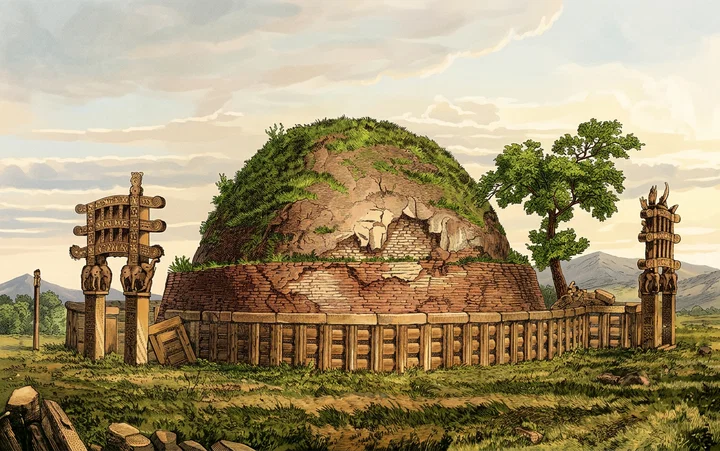
But Gautama's followers did not live out his doctrines so well after his death as they did during his life. They found it was much easier to worship Buddha as a god than to fight against the evil inclinations of their own hearts. Gautama's body was burned at his death, and his bones were distributed as relics among the people, who built topes for their preservation. The picture shows the famous tope of Sanchi, which is one hundred and six feet in diameter and fifty-six feet high. At its base is a terrace, upon which the worshipers could march. The tope is said to contain one of Buddha's bones and a lock of his hair, which were placed in a gold casket, and put in a cell in the centre of the tope. And these relics are worshiped by millions of pilgrims who visit the shrines.
W. E. L.