BY E. C. CHAPMAN.
THIS peculiar and interesting tree, which is native to the Pacific islands and to the Indian Archipelago, forms one of the valuable possessions of these ease-loving inhabitants. Its fruit is one of their principal articles of food, and under the shade of its wide-spreading branches the warm days of perpetual summer are smoked away by the natives, who apparently take no thought for the morrow, and are content to live in a wigwam of coconut limbs and eat of the breadfruit, bananas, coconuts, and fish, while the rest of the world moves on in the struggle for bread and riches. With large pinnatifid leaves, that are of a glossy green, and lofty branches that often attain the height of fifty feet or more, this tree presents a majestic and beautiful appearance, especially when the extremity of each branch is drooping under the burden of fruit that sometimes hangs in clusters of three, which gives to one’s mind a faint idea of what Eden must have been before the curse.
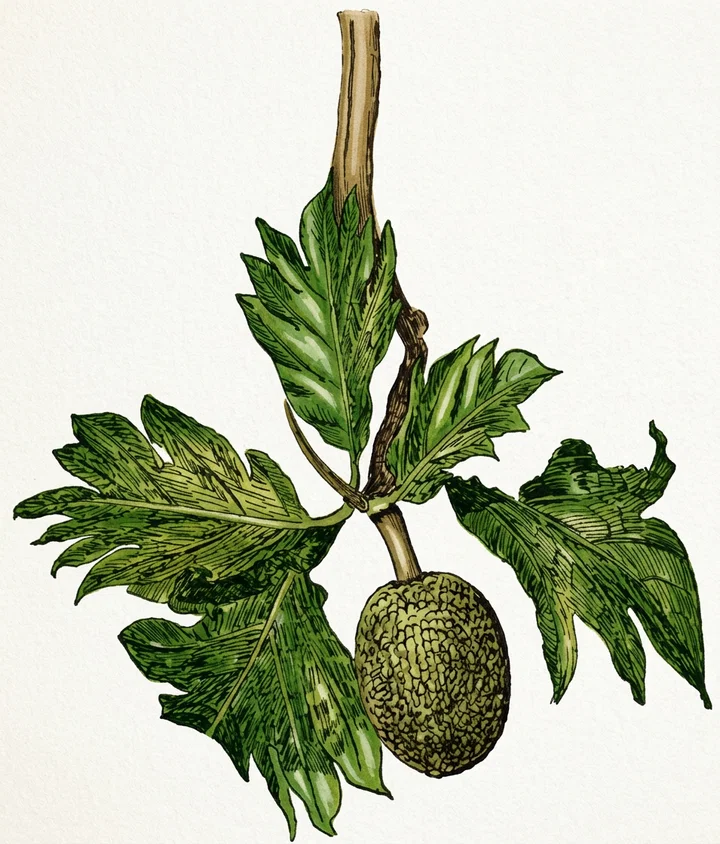
Several varieties of the tree are found here. On some of the trees the large leaves are split with deep incisions, while in others the notching is less prominent. The fruit of most varieties is nearly round, and is about the size of a child’s head, while other trees bear fruit of a larger order, that is oblong in shape and of a softer texture. To the native the round and hard breadfruit has the preference, as tradition tells them of a great man of the past who was choked to death by eating of the soft variety. A tree that would dispense with the necessity of bakers by furnishing nicely raised loaves of the staff of life would indeed be quite a tree, but no such material is plucked from the branches of even nature’s fruit trees.
The breadfruit tree comes nearer to filling the place of the potato than of crowding out the baker. It is roasted in the fire, baked in ovens, or boiled in water and eaten with a relish by those who have learned to like it. On some islands where fresh food is scarce during part of the year, it is buried in the ground and allowed to decay until the time arrives for it to be eaten. Because of its perishable nature, the breadfruit is never seen in the markets of the world, and for this reason less is known about it in other countries than of most any other fruit. The exterior of the fruit is green and rather rough. The stem is joined to a tough core, from which the fine-grained inner texture of the fruit appears to radiate toward the exterior. In ancient times cloth was prepared from the bark of this tree. The wood is also of a substantial and valuable grade.
The thrift and fruitfulness of the breadfruit tree is as the righteous, of whom it is said, “He shall be like a tree planted by the rivers of water that bringeth forth his fruit in his season; his leaf also shall not wither; and whatsoever he doeth shall prosper.” Ps. 1:3. It matters little how high the surrounding shrubbery may be, or how great the difficulties in reaching up to the clear light above, the breadfruit tree surmounts them all and spreads its broad leaves above the tops of surrounding vegetation. Such “is the man that trusteth in the Lord, and whose hope the Lord is. For he shall be as a tree planted by the waters, and that spreadeth out her roots by the river, and shall not see when heat cometh, but her leaf shall be green; and shall not be careful in the year of drought, neither shall cease from yielding fruit.” Jer. 17:7, 8.
Papeete, Tahiti.