THE RIVER HORSE.
By W. E. L.
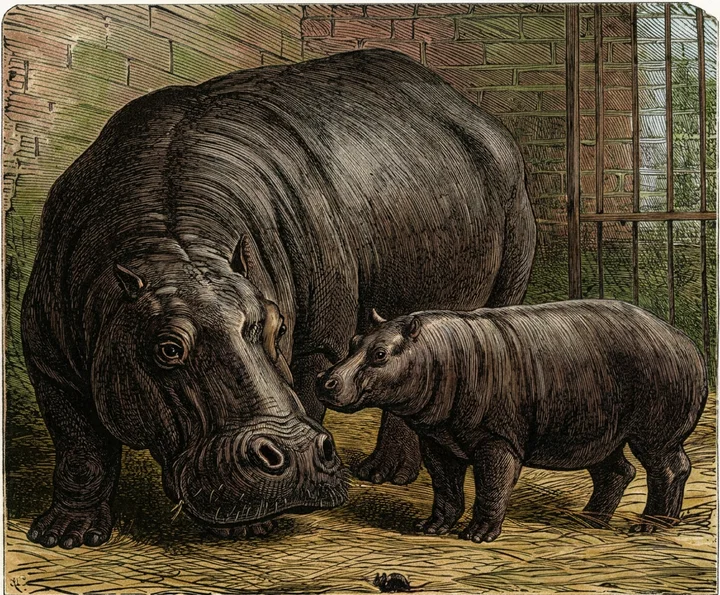
If we were to travel up the wild, reedy river banks of Africa, we might come across such a great, ungainly animal as this one shown in the picture. It is called the hippopotamus, from two words that mean horse and river.
This great, clumsy animal is usually fourteen feet long from the tip of its nose to the tip of its tail. Just think of meeting an animal as long as an ordinary living room! This old giant’s mouth is two feet wide, and down this cavernous opening he can put five or six bushels of vegetable stuff at one meal, without any trouble at all to himself. His ears seem much too small for him, as they are only three or four inches long. He has four large tusks in his mouth, which he uses in hooking up grass from the river bed, and an array of such gleaming white teeth as would make you shudder when you think how he might use them. His chocolate-colored hide is covered with an oily substance, and is in some places an inch and a half thick. When the skin is taken from the dead animal, it is drawn off in strips, like so many planks.
The hippopotami live in herds of twenty or thirty. They sleep most of the time during the day, but at night they leave the river banks, and go out to hunt their enormous suppers. If any farmer has been so unfortunate as to plant a rice-field in their neighborhood, they are sure to find it. They stand listening upon the banks for an hour or two at dusk; and if they hear no noises, they make a raid on the rice-fields, tramping down and destroying more grain with their great awkward feet than they take into their stomachs.
To be sure the farmer does not like these friendly visits from his giant neighbors. So he makes up his mind to put an end to them. He digs a deep pit in their path, puts a sharp stake upright in the bottom of it, and covers the whole with loose brush and grass, so that it looks like undisturbed ground. Then he goes home to wait.
The hippopotami remember the inviting rice-field, and at night set out on another friendly visit. They go lumbering along until within a step of the fatal trap, when they stop, smell the ground, give a knowing grunt, and go around another way. Sometimes, however, one falls in, and then the farmer is glad; for he not only eats his flesh, but sells the ivory tusks and other parts of the animal for a good price.
A traveler on the banks of the Simpopo river once saw a colony of these animals. “We heard,” he said, “the sea-cows bellowing, and approaching somewhat nearer, beheld a wonderful and interesting sight. On a sandy promontory of the island stood about thirty cows and calves; while in the pool opposite and a little farther down, stood about twenty more sea-cows, with their heads above water. About fifty yards below, again shoving out their heads, were eight or ten immense fellows, and a hundred yards below these, in the middle of the stream, stood another herd of eight or ten. The sea-cows lay close together in the mire, and had not the least objection to the others laying their heads on them in an affectionate manner.”
The little calves are carried on their mother’s necks; and as they cannot remain long under water, they are often brought to the surface to breathe.
This is supposed to be the animal called “behemoth” in the Bible; for Job says of him: “He eateth grass as an ox.” “His bones are as strong pieces of brass, his bones are like bars of iron.” “He lieth under the shady trees, in the covert of the reeds and fens. The shady trees cover him with their shadow; the willows of the brook compass him about.”
W. E. L.