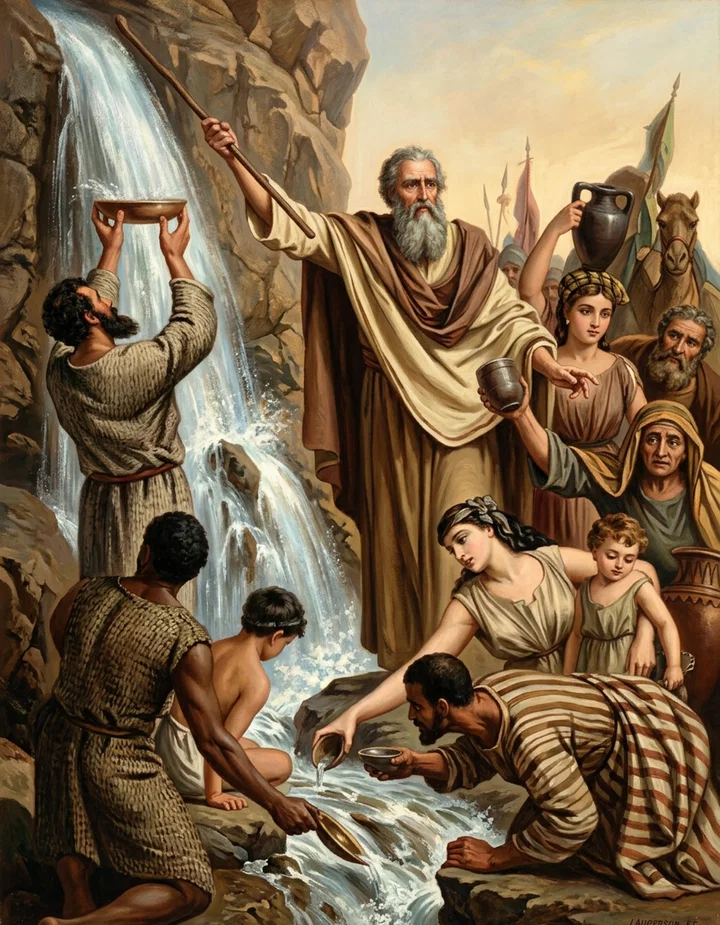
Moses, God's chosen leader to conduct his people from Egypt to the land of Canaan, is pursuing his journey at the head of the armies of Israel, following an unerring Guide, and protected by an irresistible Power. Having been delivered from the hand of the Egyptians,—
“Their chieftains all fallen, though their bows were still bent; Their legions all sunk, though their shafts were unspent: The horse and his rider o'erwhelmed in the sea; Jehovah triumphant, and Israel free,”
this vast body sing that most wonderful song of deliverance recorded in the fifteenth chapter of Exodus, feeling that—
“Our slavery is finished, our labor is done; Our tasks are relinquished, our march is begun.”
They were just released from most oppressive and cruel bondage, and were hastening to the home of their fathers, which promised land they hoped soon to have in peaceful possession. One would suppose that after all the hardships they had endured in Egypt, relief from them would make them very patient and amiable; but on the contrary, they were fault-finding and exacting, complaining of their food and drink, even accusing Moses of bringing them with their cattle out of Egypt to die with thirst.
In thus chiding Moses, they were really finding fault with God who sent him, and charging God foolishly. For Moses's sake the Lord bore with them, sweetening the bitter waters at Marah, providing them manna and flesh in the desert, and miraculously giving them water from the flinty rock.
Already in their short journey to Rephidim, which was but a little way from Horeb, their murmurings were so great that Moses cried out to the Lord for help, saying that the people were almost ready to stone him. They had come up to a place where there was no water, and instead of trusting God, and waiting till he should show his salvation, they indulged in sinful thoughts, and talked very wickedly to Moses. But notwithstanding their murmurings and rebel-
lious feelings, the Lord mercifully spared them, and instructed Moses to smite the rock, from whence issued a stream of pure water which followed them a long way in their travels.
Continuing their journey until they reached the wilderness of Paran, Moses sent spies to see what the land was. But they all returned, save Caleb and Joshua, with an evil report, which put such rebellion into the hearts of the people that they were about to choose a leader and go back to Egypt. The Lord was so much displeased with them, that but for the intercession of Moses he would have disinherited and destroyed them. For his own name's sake and the greatness of his mercy he spared them, but declared, “All those men which have seen my glory and my miracles, which I did in Egypt and the wilderness, and have tempted me now these ten times, and have not hearkened to my voice, surely they shall not see the land which I swore unto their fathers.” He says further, “Your carcasses shall fall in this wilderness;” “your children shall wander here forty years;” and for that length of time “shall ye bear your iniquities,” “save Caleb, the son of Jephunneh, and Joshua, the son of Nun.”
A full description of their wanderings and journeyings, and of their fall by the way, as predicted, is recorded in the “Books of Moses.” This we will pass over, until they reach the borders of Canaan, in the fortieth year of their journey. The fathers being nearly all dead, their children are now the principal actors in the scene. As they approach Canaan, they come upon higher ground, and the stream which had followed them is stopped, so that again the congregation have no water. Like their fathers before them, the children fall to murmuring and chiding, or quarreling, with Moses.
Again from a rock the Lord commands Moses to supply them with water. Upon this occasion he bids him speak to the rock. But Moses is so wearied with their rebellions that for the first time it is recorded of him that “he spake unadvisedly with his lips;” “Hear, now, ye rebels! must we fetch you water out of this rock?” as though he and Aaron could do it by their own power.
Contrary to God's order, too, instead of speaking to the rock, he smites it twice, thus manifesting impatience. How easily God could have humbled them by withholding the stream. He gave the supply, as he had promised, but he delivered to this humble servant the sad message: “Because ye believed me not, to sanctify me in the eyes of the children of Israel, therefore ye shall not bring this congregation into the land which I have given them.”
Were it not that the infinite God sentenced Moses, poor finite man might think he was too severely dealtp. 138 with. Moses had borne with their murmurings and jealousies all those forty years, and at times was so afflicted and discouraged in consequence that he would yield to the temptation to ask God to let him die. And now that the journey was made, and they were just ready to set their feet upon the long-desired land of Canaan, he must turn aside from those he had loved so well that he would rather his own name might be blotted out of God's book than they should be destroyed, and go by himself to die.
Moses was forgiven. His mistake did not shut him out of the heavenly Canaan; but the effect of lightly regarding his sin would not prove salutary upon those disaffected ones, as Moses himself knew, therefore he must needs come under the power of Death. And so, at the command of God, this faithful servant ascends Mount Nebo, there to die, while his heart is with his people on the plains below. As he reaches the highest summit of the mount, God grants him from that elevated point a sight of the promised land. Perhaps the last scene which met his gaze before he closed his eyes in death, was a view of this long-coveted rest.
Ancient Israel was a type of God's people in this, the last, generation, and the things which “happened unto them were for ensamples, and were written for our admonition upon whom the ends of the world are come.” Yet for all the light of their experiences, how faithfully the type is met in the antitype; for now, as then, murmuring and rebellion have place in the heart, and are causing many to turn aside to fables. It would seem as if the accumulated evidence of six thousand years confirmatory of God's faithfulness with those who walk uprightly would remove all cause for distrust and fault-finding. That we are traveling over the same ground as did Israel anciently, is evidence that the heart is not right with God; and as there remains but little time to secure a title to the heavenly inheritance, the borders of which we have almost reached, let us at once and forever banish unbelief, and make our right doubly sure.
M. J. C.