AFRICAN NOTES

10%

Pacific Press Publishing Company · Oakland, California · May 23, 1895

FromSigns of the Times, Vol. 21, No. 20.

Read the full edition

AFRICAN NOTES.

BY JOSIAH TYLER.
RICHARD HARDING DAVIS represents various nations as nibbling at the rind of Africa, knowing as little of its people and the countries they have annexed as did Hannibal and Scipio. This is not true of all nations. Great Britain, for instance, which received the richest slice of the African cake, when it was divided among European powers, is thoroughly cognizant of the territory she dominates. Such is her hold of mid-Africa, through the new Belgian treaty, that one has observed, “It is possible to march a regiment from Alexandria to Cape Town, without departing from under the British flag.”
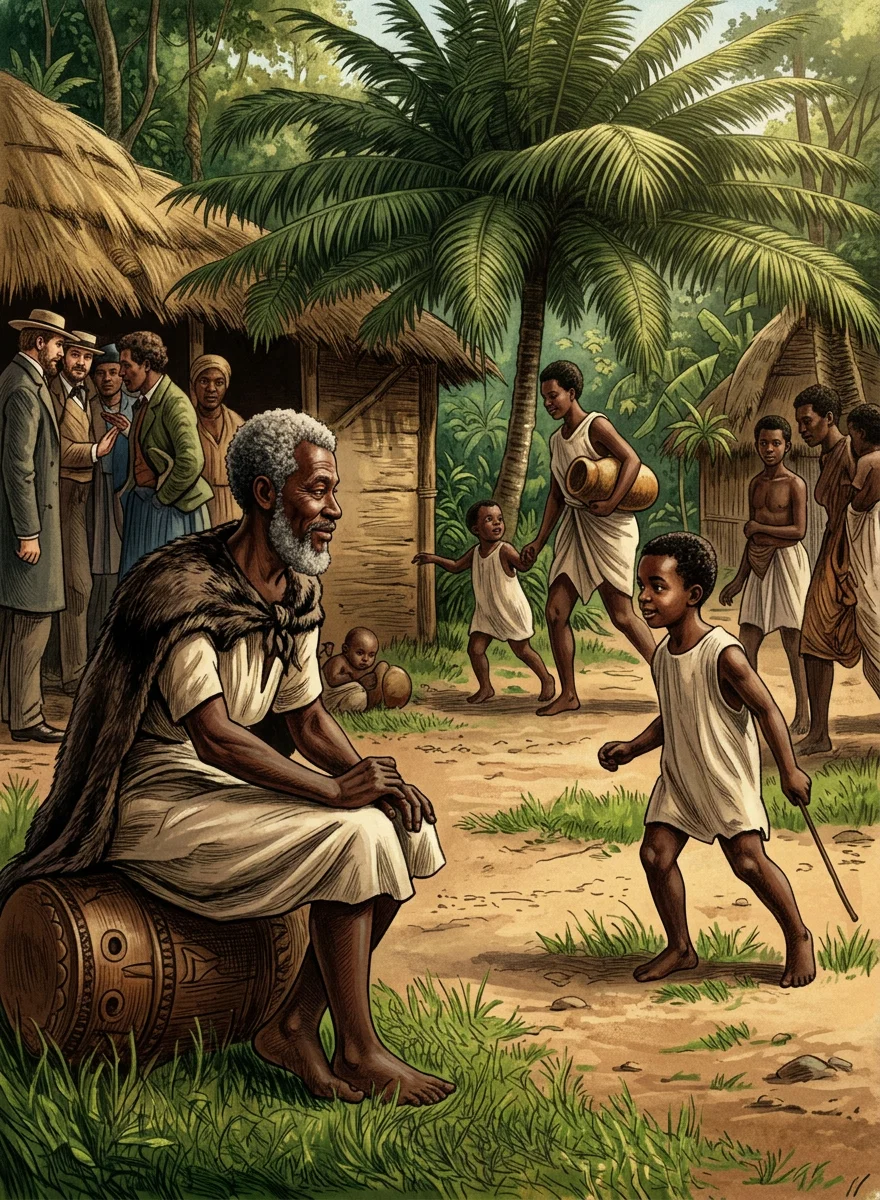
AN AFRICAN HOME.Restored with AI
AN AFRICAN HOME.
According to a census of Great Britain, lately published, the population of her African colonies and dependencies is 4,035,669, while that of her protectorates, or spheres of influence, is 25,504,374, making a total of 29,540,043. In Central Africa 4,000,000 square miles of territory are at present unoccupied by civilized people. The main obstacle to European commerce along the Nile is the influence of the Mahdi, but that must soon succumb to superior and civilized authorities. In less than three years telegraphic communication will doubtless be established between Cape Town and Cairo. The wire has already reached Blantyre, in the Shire Highlands, and soon we shall hear of it at Uganda, then on, by the way of Lakes Tanganyika and Victoria Nyanza, to the Nile. Railroads follow telegraphs, and it is not chimerical to predict that some now living will see the day when a railway ticket can be purchased at Cape Town for Alexandria.
Note the rapid development of Southeastern Africa. Dr. Livingstone, when laboring to suppress the slave traffic in Nyassaland about thirty years ago, marked the richness of the soil, products, climate, etc., and pronounced it a fine country for white people. Now there are to be seen in that district large coffee plantations, owned chiefly by Scotchmen, who leave no stone unturned in improving the country. The pluck with which they meet difficulties in transporting their crops to the seaport reflects on them great credit. From Chuide, the best landing place at one of the mouths of the Zambesi, six paddle steamers ascend that river, and into the Shire as far as Katunga, a distance of 150 miles, carrying supplies from Europe, and returning with coffee, groundnuts, India-rubber, cotton, and other products. How different it was when Mrs. Livingstone went out to meet her husband, and was delayed on the Zambesi till seized by malarial fever! A stagecoach line between Blantyre and Katunga is said to be on the tapis. If that region becomes, as is predicted, the “coffee-growing country of the world,” railroads will connect it with the sea, and less than one day will be required to reach Chuide.
Nyassaland has an exceptionally able and energetic magistrate in the person of H. H. Johnson, who has effectually stopped Arab slave raiding, and rules the natives efficiently and humanely. He recognizes in Africans the elements of manhood, and is more optimistic than most British officials in reference to their development. The following is one of his utterances: “In the course of two or three centuries, the negroes of British Africa will differ from their white fellow-subjects only in the color of their skins. . . . We can give them the benefit of our inherited improvements, experience, and experiments in religion, morality, political economy, party government, and brotherly love.” He does not believe, as some do, that a native educated and Christianized is “a native spoiled.” The training school at Blantyre, after the model of Lovedale in Kaffraria, has 300 pupils, some of whom are as good printers as trained Europeans of that occupation. The results of patient missionary instruction are clearly manifest. Livingstonia is another popular institution, for the support of which friends in Scotland have given $450,000.
Look for a moment at the Kongo Free State. Four years ago there was no trade there, except that carried on by Arabs, who despatched gangs of slaves with ivory on their heads, some to Matadi and Boma, on the Kongo, others to Zanzibar. Now we are told that “thirty steamers ply the waters of the Kongo, and innumerable steam launches cleave the waters of the great lakes. There are at present over 1,000 official administrators of the laws of civilization, when three years ago there was but one white man.”
Sierra Leon has an area of 25,000 square miles, with a population of 100,000. The British claim in that district 1,120 square miles, the population of which is estimated at 60,546. Notice the colony of the Cape of Good Hope. Its imports for 1893 amounted to $57,695,000, while its exports were valued at $65,780,000. The custom receipts of Natal for 1893 were valued at $903,540. The revenue for the Transvaal—the “Golden state of South Africa”—for 1893 had an increase of $6,013,380. Its expenditure was $6,510,270, with a balance in its treasury Dec. 31, 1893, of $2,427,250. The increase on customs over 1892 was more than a quarter of a million of pounds sterling.
Would that I could note a decrease in the African liquor trade. Not so much rum goes from this country as in former years, but we read that in the year ending June 30, 1893, 561,365 gallons were exported, valued at the customhouse at $679,357; but who can estimate the mischief it caused to the poor Africans? At the Berlin Conference of 1885, America, England, France, and Italy were in favor of keeping it out of Central Africa, but Germany, Holland, and Portugal overruled those nations, contending that the Kongo basin was consecrated to “free trade.”—New York Observer.