BEFORE us, as we lean over the “wire fence,” referred to last week, is an enormous excavation, measuring in capacity about 9,500,000 cubic yards, deplacing over 40 acres of land surface, and more than 20,000,000 tons of earth, and reaching in depth (not including the under-ground workings), over 500 feet. The walls of this huge orifice are not perpendicular, but slant to the center, from the surface downward.
Looking at the bottom of this immense hole, we notice lively movements of human beings, who appear no larger than clothes-pins. We can distinguish neither race nor color. We are only quite sure that they are men. They are filling those tubs, which we see playing up and down all sides of the mine, with “diamondiferous earth,” that is, earth containing diamonds.
Each tub, we notice, is supported by a car, or truck, which runs on two steel wire ropes, the wheels being grooved so as to ride safely on the ropes. You notice (see picture) that attached to this car is a third rope, smaller than the others. This rope is fastened at the other end to a large horizontal cylinder pulley, which, driven by an engine, draws the tub to the “receiver” at the top of the mine, where it automatically empties. This pulley has two such ropes, one winding over, the other under; thus, at the same moment a filled tub starts from the bottom of the mine, an empty one enters it. There are as many as twenty of these tubs emptying their precious burdens day and night, resting only four hours out of the twenty-four. In these four hours the blasting is done. In the morning at 6:15, at noon at 12:15, in the evening at 6:15, and at 12:15 at midnight.
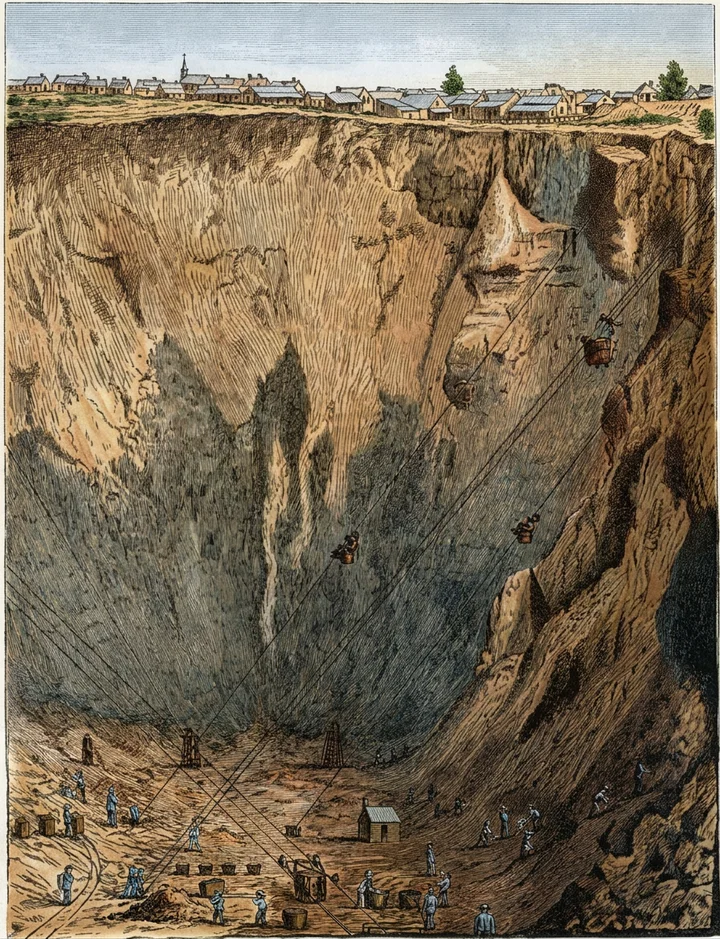
In the bottom of the mine you notice two stagings. These are directly over two shafts which go deep into the earth, and lead to the under-ground workings. Let us make application to enter. We succeed in securing a pass, since all who enter the mine must have one, and all visitors must also be accompanied by a guide; not alone for the visitor’s benefit, however, but also the Company’s, as some might be tempted to conceal and carry away one or more of those precious gems, which are quite abundantly found in this mammoth excavation.
Our guide tells us to follow him. Soon we arrive at one of the “diamondiferous receivers.” Here we wait a moment until one of the tubs reaches the “receiver.” Instead of its immediately returning into the mine this time, it is ordered to be halted. We wonder why, but soon discover the reason, for the guide tells us to “climb in;” yes, climb in to that empty tub, to be dispatched, as it were, along the wire, to the bottom of the mine. We very hesitatingly obey. It is, “Ruba-dub-dub, three men in a tub,” sure enough. The signal given, away we glide. Although it is a very warm day, during our flying trip we feel sufficiently cool.
In less than two minutes we find ourselves on the bottom of the mine. Our guide now calls our attention to the different strata of earth under and around us. The one in which the diamonds are found is quite blue. It is termed “the blue” by all the miners.
Walking over to one of the stagings previously referred to, our guide says, “If you wish, we will go down this shaft, and see what is going on far below us.” Inwardly questioning as to the safety of such a venture, we reluctantly follow him. [Text obscured.] The visible text continues: “first case. After being [text obscured] from the wire rope, it is pushed by Kaffirs along a track to one of the tubs, and there emptied. Its capacity is just the same as that of the tub, being about 1,000 lbs.”
An empty car is now attached to the shaft cable, and our guide, after furnishing us each with a miner’s lamp, cries again, “Climb in.” Down, down we go, deep into the bowels of the earth,—not quite so pleasant as the first descent, for we have no light save that from our smoky lamps. On the way our guide tells us that our time will permit us to descend only as far as the first horizontal shaft, or tunnel. On reaching it, we are only too glad to stop, and stand on solid ground.
Here we meet a number of men, principally Kaffirs, who are engaged in digging up the precious ground, and filling these little cars ready to be hoisted to the surface. Our guide informs us that over four thousand Kaffirs are employed in this mine, a good proportion of whom work under the ground. Said he, “This ground over, under, and around us, is completely honey-combed with shafts and tunnels, and the bees [men] are kept at work night and day. Of course you understand that at night a fresh set of ‘bees’ go to work.”
After following our guide around to some of the most interesting parts of the under-ground mine, we cheerfully return to the perpendicular shaft, where we “climb in” once more, and are soon safely hoisted top. 146 the “beautiful sunlight.” Oh, that is how to test its beauty!
As it is rather late, we endeavor to “catch the first tub.” For the last time we climb in, and have quite an enjoyable trip, no doubt owing to the fact that we are homeward bound. It is certainly something desirable to have the privilege of going down into a diamond mine; but we do not hesitate to assure you that the desire to get out of one is much greater than the desire to go in.
With the payment of a few additional shillings, the guide consents to show and explain to us the process of separating the diamonds from the “blue ground.”
“Let us commence,” says he, “with the ‘receiver,’ one of the places where the tubs are emptied.”
“It is said,” continues he, “and truthfully, too, that no tub in which is diamondiferous ground, comes out of the mine without containing one or more diamonds. You notice this ‘receiver’ has two shoots, which serve to fill those little trucks which you see just now being placed under the shoots. Let us follow this truck load. It is not at all improbable that that load contains several fortunes.”
The truck, having been pushed by men several rods, is now linked with a number of others, and a horse is made to draw the little train of cars for some distance to an open, level piece of ground, which is inclosed by a wire fence. Here the “blue” is emptied on to the ground. This inclosure is almost covered with the “blue.” Hundreds of men are busy at work preparing it for the washing machine. It is done in this wise: At first the “blue” is sprinkled with water, which softens it. Then the large lumps are broken with mauls, and watered again, and lastly rolled with heavy iron rollers, drawn by oxen. Now it is ready to be trucked to the washing machines. Next week we will learn more about this process.
R. S. ANTHONY.
South Africa.