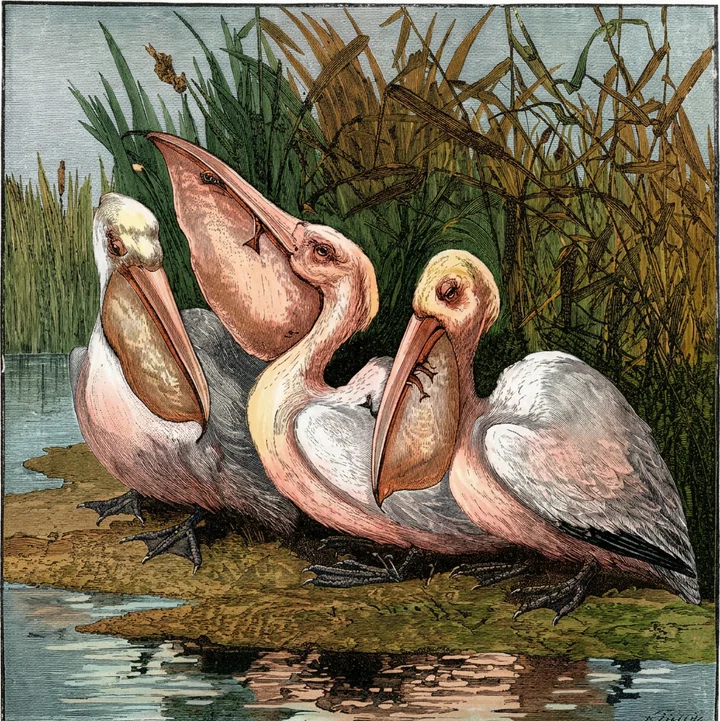
THE strange looking birds shown in the picture are called pelicans. They are large water-fowls, and live almost entirely on fish. There are said to be ten species of this family of the feathered tribe, some one or other of which are found in nearly every part of the globe. They are, however, most numerous in mild climates, and where the country abounds in shallow lakes and rivers, although they are frequently met with along the sea-coast.
The pelican of Australasia builds its nest on the ground among the reeds bordering the waters it frequents. Its young during the first year are of a greyish-brown color, but afterward all the plumage, except the large wing and tail feathers which are black, gradually becomes white, deeply tinged with a rich rose or salmon color, passing into yellow on the crest and lower part of the neck in front.
It seems astonishing what a quantity of fish one of these birds will devour at a single meal. Early one morning one of them alighted in the pond at the Melbourne Botanical gardens, and began to devour the gold-fish it found there. He was shot soon after, and upon examination it was found that he had caught sixteen good-sized fish, which will give some idea of what it requires to give one of these birds a decent breakfast.
We are told that years ago pelicans were very plentiful about the numerous lakes of Gippsland, in the extreme south-eastern part of Australia. Now one is seen in that region but seldom, they having left that part for a more congenial country. In Western Queensland they say that the pelican has transferred its home to the unexplored lands in the direction of the setting sun. It has therefore become in those parts a common saying of one who goes into the interior that he has gone “where the pelican builds its nest.” But this is not wholly true; for they are found in great numbers upon the islands of Bass’s Straits, and also about lake Corangamite in Western Victoria. Like the aborigine, the pelican will not remain with the white man. The two can never thrive together. As the tread of the settler advances, the pelican retires before it, choosing its haunts amid the most desolate scenes of nature. In whatever country it is found, its isolated habits are the same, and may still, as in the days of David, be appropriately called “the pelican of the wilderness.” See Ps. 102:6.
J. O. Corliss.