THE very first objects which meet one's sight on nearing the Hawaiian, or, as they are familiarly called, the Sandwich Islands, are two lofty peaks, Mauna Kea, and Mauna Loa, each rising to the height of 14,000 feet, or about two and one-half miles. They are both located on the island named Hawaii, and one of them is capped with perpetual snow.
Situated on the eastern side of Mauna Loa, and about 4,000 feet above its base, is the great volcano Kilauea. This has the largest active crater of any volcano in the world, it being about three and a half miles long, and two and a half wide, or nine miles in circumference, and nearly 1,000 feet in depth. This inclosure is an immense cauldron of burning lava, a veritable lake of fire. It never emits smoke, and is therefore not seen at a distance only at its seasons of rarer violence, when the lava is thrown to a great height, and rolls down the mountain side, destroying everything in its path. At such times the fiery track of the lava may be seen a great way off, as it lights up the surrounding country.
Fortunately this monster does not often become angry, and vomit its fire. But for over two years, from the middle of 1856, rivers of lava rolled down through the forests, and over the precipices, destroying the gardens of the natives, and driving them from their homes. In January, 1859, another eruption occurred, when the fire rose 250 feet above the crater, sometimes in the form of a cone, at others in that of spurting jets, resembling a display of artificial fireworks.
Ordinarily, a thin vapor arises from the mouth of the volcano, and hangs above it like a little silvery cloud. The varying effects of this at different periods are said to be very beautiful. A Mr. Hill, who had opportunity of exploring the country in that vicinity, says that as the day declined, the cloud seemed denser, and was tinged with a faint light. As darkness increased, the light assumed the appearance of the Aurora Borealis in its most fixed condition, and in the darkness of night the glare was like that of a forest on fire.
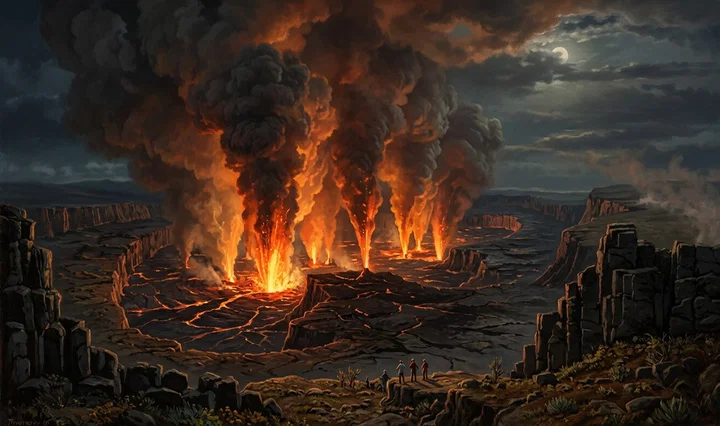
Some travelers have ventured to descend into the crater, the sides of which are formed of huge pieces of cooled lava, broken and rough. In doing this some have lost their footing, or fallen through the deceitful lava crust, and have been lost. The scene below in the crater is described as one most terrible to contemplate. At a great depth beneath boils the fiery lake, while on all the sides of the place is frightful desolation.
Prof. Alexander, of the Panahou College, with some companions occupied several days exploring this wonderful crater, at the time of its great eruption in 1859. They followed one stream of the lava to the point where it issued from the mountain. Its appearance there was like a pool of blood, boiling up like a spring, and spouting up thick, clotted masses to the height of ten or twenty feet. Lower down the mountain, the lava appeared almost as fluid as water, and ran with a velocity which the eye could scarcely follow. The stream was from twenty to fifty feet wide.
“To describe the scene,” says the professor, “is impossible. For the first time we saw actual waves, and actual spray of liquid lava. As its surges rolled back from the inclosing walls of rock, they curled over and broke like combers on the reef. There was, besides, an endless variety in its forms. Now we passed a cascade; then a smooth, majestic river; then a series of rapids, tossing their waves like a stormy sea; now rolling into lurid caverns, the roofs of which were hung with red-hot stalactites; and then under arches, which it had thrown over itself in sportive triumph.”
This stream of lava found its way into the ocean, and filled up a bay, forming a promontory instead. The native village of Waiohinu, now nestled at the base of the mountain in a forest of orange, fig, and guava trees, looks very pleasant as seen in the picture on the next page. But should the lava flow in that direction at any time, the beautiful spot would become a desolate, forsaken place in a few hours. This illustrates how one's fondest earthly hope may be overthrown. When we think we are well on the road to the accomplishment of some cherished plan, it is suddenly overturned by an unforeseen circumstance. So uncertain is human happiness. How much better to place one's affections on things above, and not on things on the earth; for the things which are seen are temporal, but the things which are not seen are eternal. J. O. CORLISS.