The first people who live in any country are called by a long name. Wonder how many of you can pronounce it? It is spelled “ab-o-rig i-nes.” When Christopher Columbus discovered North America, in 1492, he called the aborigines of America, Indians. He gave them this name because he thought he had reached India, the country for which he started. On account of their copper-colored skin, they are called red men.
We have space here to tell you but little of this interesting race of people. It would pay you to get some books sometime, and read about them. Some of our letter-writers have told what they have seen of some tribes; and others have promised to write more.
You know the native Indian lives a wild life, by hunting and fishing and trading; and some tribes are very warlike, and like most to fight and kill. We suspect what made them so cruel was the way the white men treated them when first they settled this country. They deceived the poor Indian so many times, taking his hunting-grounds from him, and in most every way were so unjust toward him, that he supposed the white man was a bitter enemy, come to rob him of all he had, and may be to take his life. For his own safety, therefore, the Indian thought his best way was to drive the white man out, or kill him.
But instead, the white man was the stronger, and he has kept crowding and crowding the Indian from his lands, until now the remaining tribes in the United States are mostly found in the western and south-western territories.
These people worship the “Great Spirit,” as they call their god; and they believe that when they die, he will take them to beautiful hunting-grounds, where they will always be happy. But many of them now believe in the true God, and are happy, believing Christians.
Away back in the early settlement of the country, good men and women began to try to teach and civilize them; and all the way along there have been missionaries who have worked very hard, and given much money for this purpose, but the Indian loved his wild, easy life so well that it has sometimes seemed almost a hopeless task.
However, within the last few years, the missionaries and the government begin to see good coming from what they have done. In some places in the south-west the Indians have their farms and homes, and are living much like the white man. And in many parts of the country, one may find intelligent Indians, whom we hope may yet have all the light of the gospel.
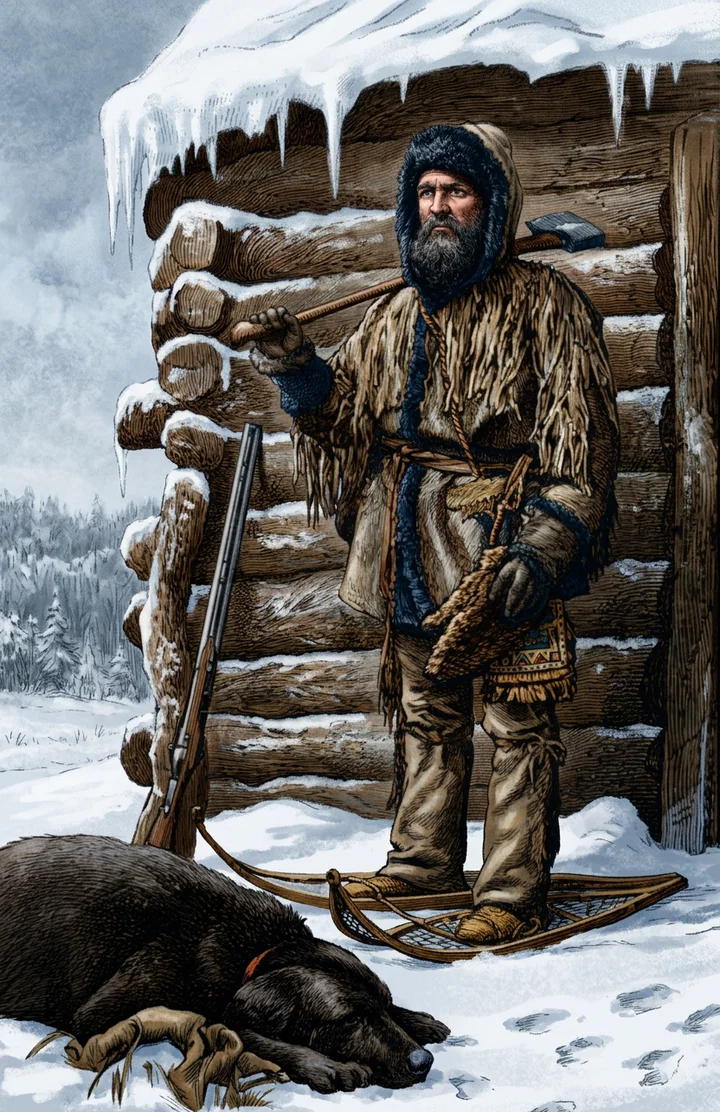
But among the missionaries to the Indians, we wish to tell you about one who went away to the Northland, 400 miles north of Winnipeg, in British America. It was the Rev. E. R. Young, whose picture you have on this page. It is so cold there that sometimes the thermometer is as low as 55 degrees below zero, and he would have to dress in furs from head to foot. He carried his baggage and food, and rode himself, on sledges drawn by dogs. He wore snow-shoes to keep from breaking through the snow.
Mr. Young tells of these dogs that if one of them cut his foot in traveling, he would hold it up for him to put a little shoe on it. After they reached their camp at night, the dogs would all go to him to be shod. Their shoes being put on, they would go and dig out a hollow place in the snow, and all lie down near each other, so as to keep warm. Although these dogs are often quarrelsome, Mr. Young says that those pulling the same sled never fight each other.
This missionary labored with the Indians of the north nine years, and with good success. He relates some interesting stories about them. At one time, he says there came into his room a number of Indians, very still, as is their fashion to do. The room was filled with them before he knew it.
When he asked where they came from, they answered, “From a journey of fourteen nights. (They measure the distance they travel by the number of nights they are on the road.) We have got the Keesenaychen [the Great Book], but we don’t understand it, although we can read it.”
When asked from what missionary they learned, they said they had never seen a missionary, or teacher. Mr. Young showed them a Bible printed in the “beautiful syllabic character for the Cree language, and opened to Genesis, which they read at once correctly,” as they did many other places in the same book.
These Indians had come from far north of Hudson’s Bay, hundreds of miles from any missionaries. Their hunting-grounds joined those of some Christian Indians, from whom they had learned to read. They said to Mr. Young, “We visited your Indians, and found that they had the Keesenaychen. We got them to read it and then to teach it to us; and we were so pleased with it, that we all learned to read it during the winter.”
In a village of three hundred, this missionary says that every one had actually learned to read the Bible without ever having seen a white teacher. The agent of the Hudson’s Bay Company had given them copies of the book, and they had made the “journey of fourteen nights,” in that cold climate, to be taught from the book they had learned to love.
So you see, dear children, that even the poor Indian loves the Bible, and wants to be taught the way of truth. The same God made him that made the white man; and he invites all races of men to come freely and be saved by him.
Are you doing all you can to give everybody the light God has given you? What you do for them, you do for the Saviour, who will pay you well in the end for all the faithful work done by you. Even though you are little missionaries, you can help answer the old slave’s prayer, which was, “Lord, help the missionary to put one foot ’fore toder, and preach the gospel every where.” M. J. C.