THE engraving shown on this page presents a view of the capital of the Samoan Islands. This group in the Pacific is composed of ten inhabited islands, ranging in size from ten to seven hundred square miles in extent. The island of Upolu, upon which is located the town of Apia, contains 560 square miles. It is about forty miles long, and thirteen wide. Extending through the island from east to west is a succession of low mountain peaks, which gradually slope down to the shore. Encircling the whole is a coral reef, with several openings through it, large enough to admit vessels of moderate size.
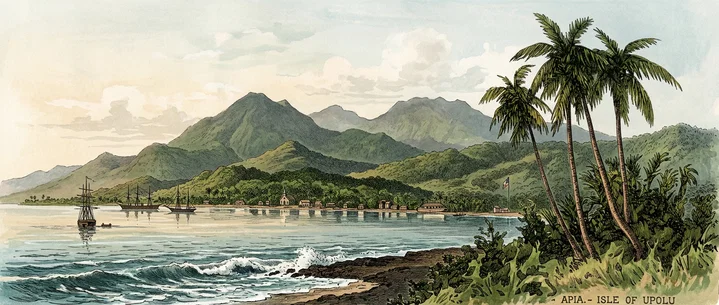
The harbor shown in the picture is located on the north side of the island. Vessels lying at anchor in its waters are protected from the ocean waves by the coral reef extending across its entrance. The town of Apia is well represented in the engraving. It is but a straggling line of wooden houses near the water’s edge, with the single exception of the Catholic cathedral, which is built of stone. This is shown near the center of the town. At the right is seen the German consulate, with the German ensign waving over it. Most of those who live in the town are Europeans.
The native Samoans are generally tall and well-proportioned. The men look strong and hardy, and seem to be as much at home in the water as on the land. Some of their feats seem quite remarkable. While at the islands two years ago, some of our party tossed into the deep water small pieces of money, to test the diving qualities of the natives. No sooner had the silver struck the water, than a brawny fellow would plunge headlong after it. His feet would hardly be hidden from sight before he would turn, and appear on the surface with the piece between his fingers. This was tried several times, with the same effect.
These people are said to be kind, truthful, and hospitable. In conversation among themselves, or in dealing with foreigners, they appear very courteous. They have different styles of salutation, according to the rank of the person addressed. In speaking to a chief, or a distinguished stranger, they say Lau Afo, meaning “your Majesty.” To a common person they say, Sau, which means, “You are here.”
They differ from the Maories of New Zealand in the matter of tattooing, in that they do not mark their faces; but from the waist to the knees, are nearly covered with black stripes. Only the men tattoo. The women usually wear a short skirt, made of long leaves.
Nature has given these people an abundant supply of food, which grows wild all about them. They are not obliged to work for their subsistence, and consequently have much time for eating and sleeping. They do, however, have structures which serve the purpose of houses. A native hut is built by planting stout posts in a circle, upon which is placed a conical roof. The sides are left entirely open, in order to receive the benefit of any passing breeze. For protection against storms, the walls are hung with mats made of the long, narrow leaves of the cocoa-nut tree, a group of which is shown in the foreground of the engraving.
The Samoans were never cannibals. Their traditions show that they have always been a merciful people, free from treachery. Women are treated with the greatest respect, and children are regarded with an affection that amounts almost to extravagance. They are naturally of a religious turn of mind, hence yield readily to the influence of the missionaries. The London Missionary Society claims something over 30,000 converts among them as a result of their labors alone. Of course some of these, perhaps a large proportion of them, are but nominal adherents to Christianity.
Until the white man came among them, they were said to be among the best-behaved races in the Pacific islands. The whites taught them the use of gunpowder, and now they have trouble enough. It seems too bad that the advent of the white man among these simple islanders should be so detrimental to their peace and happiness. And yet it is so. It is said upon good authority that about the only material advancement the Samoans have made since their acquaintance with the ways of civilization, is their improved knowledge of rifles and gunpowder. If these islands could secure freedom from rash adventurers, their future would be much brighter than the present outlook. Let us hope that ere long they will so learn the ways of the Lord as to be prepared for his coming. J. O. CORLISS.