Having Good Times

6%

S. D. A. Publishing Association · Battle Creek, Mich. · Sep 12, 1888

FromThe Youth’s Instructor, Vol. 36, No. 37.

Read the full edition

Having Good Times.

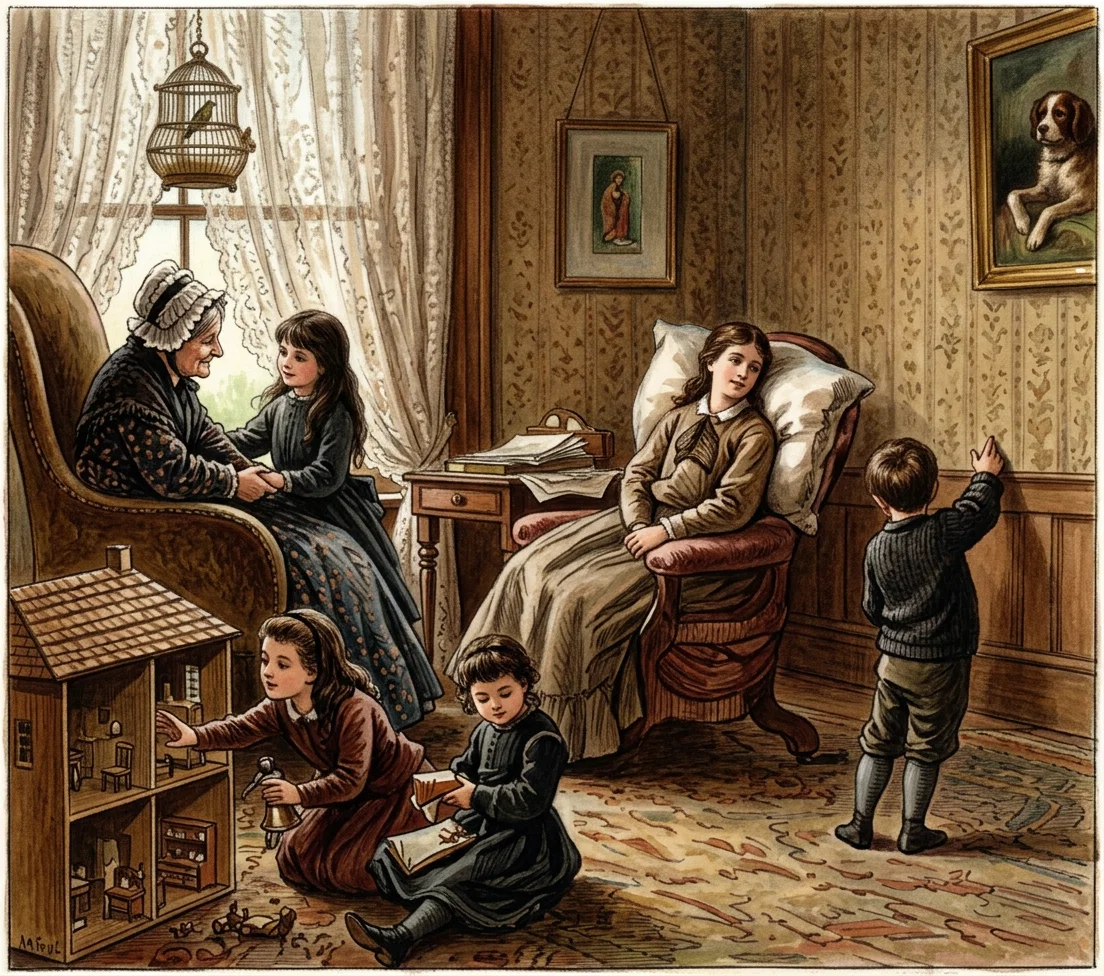
“I like to play over here,” said Lottie Brown to her little friend Carrie one day; “you always have good times at your house.”
“Don’t you always have good times at your house?” asked Carrie, looking at her friend in surprise.
“No, we don’t,” said Lottie, putting her doll on the sofa in the doll-house; “that is, not always.”
“I wonder what makes the difference,” said Carrie.
Lottie had often wondered about that herself. If we should take a peep through the doors when the little people did not know we were looking, do you suppose we could find out?
If you had looked through the door at the breakfast room in Lottie Brown’s house this morning, this is what you would have seen. A little girl with her shoes unbuttoned, her apron-strings untied, and her hair uncombed. She had a great scowl on her forehead, and a whine in her voice, and she didn’t see why she couldn’t have hot cakes and honey instead of that “horrid” brown bread and milk. Anyhow, mamma never would let her have anything good. There were rosy-cheeked peaches, to be sure, but she didn’t want peaches that morning, she wanted cucumbers.
Restored with AI
Half an hour later you would have heard this same little girl say to her brother Tom, as he lay stretched out in the hammock, reading a story book, “Tom, get out of that hammock; I want to swing with my doll.”
And Tom replied very gruffly, “I’ve just as good a right here as you have; and I won’t get out till I please.”
Then Lottie grew angry, and said boys were just “too hateful for anything,” and that “Tom never would do anything she wanted him to.”
By and by, if you had looked through the vines that shaded the wide veranda, you would have seen Lottie bouncing a fine rubber ball; and pretty soon you would have heard Tom say, “That’s my ball; give it here. Girls are always meddling.”
In the breakfast room at Carrie’s house, three sunny faces appeared at the table, and three little people ate their bread and milk contentedly, and thought it very good fare.
About an hour later you might have heard a little voice on the play-ground cry, “O Georgie! I want to roll that hoop!” and another voice reply, “Well, so do I.” “You’ve rolled it twice,” said the first voice. “Well,” said the second, “we’ll take turns. You can roll it down to the gate and back, and then I will.”
By and by a voice called from the house—it was mamma’s voice—“Georgie, I want a pail of water.” Georgie was making a sand house just then, molding it over his bare brown foot, and he didn’t want to spoil it. He had his mouth opened to say, “I don’t want to;” but he happened to remember how mamma left her things to help him—just that morning she had left the bread to help him hunt his hat when Anna was going off without him;—so he changed his cross words to a pleasant, “All right; I’m coming.”
If you had stayed there all day, you would have seen clouds gather sometimes on the young faces, and you would have expected a storm; but somehow the sunshine always came from somewhere, and drove the clouds away before any rain had a chance to fall.
Now I wonder if you can tell why they had “good times” over at Carrie’s house, and didn’t have them at Lottie’s? Wasn’t it because each one tried to please others instead of himself?
I remember what a white-haired old man once said to us children when we went to him to settle a dispute. With a twinkle in his kindly blue eyes, he said, “My dears, you must always keep two bears in the house, and then you will never have any quarrels.” We looked at him in open-eyed astonishment, while visions of brown and white bears such as we had seen dancing in the streets rose before our eyes. “Their names are Bear and Forbear,” he added, “and no house can be happy without them.” W. E. L.