ONE day Frank and May and little Rose went out with Cousin Grace to take a “wonder-walk,” as they called it; that is, the children were to use their eyes in seeing how many wonderful things they could find, and Cousin Grace promised to tell them all she knew about them.
They had been talking about squirrels and prairie dogs, when a rabbit crossed their path, evidently in great fear.
“Poor little thing!” exclaimed Grace pityingly.
At that moment a terrific whoop was heard, and the little rabbit, overwhelmed with fear, stopped motionless as stone, and the next instant a farmer’s hired man sprang forward and picked it up.
“Why! if I ever saw anything like that,” said Grace, hastening forward.
The man laughed.
“He’s most skeered to death, sure. Just put your hand on his heart, Miss.”
When Grace felt the wild, quick throbbing of the little thing’s heart, tears came into her eyes, and she asked its liberty.
“Sure, Miss, and I’d like to oblige you, but my wife is uncommonly fond of stewed rabbit.”
“Oh, you won’t kill it—the dear little wabbit!” exclaimed Rose, indignantly.
“I will give you fifty cents if you will let me have it,” said Grace.
The man took the money gladly and walked off. Grace and the children stroked and caressed the little thing, until its eyes wore a softer look, and then they let it go. It ran for a moment, then stopped, tremblingly; then again darted forward, and this time went on, disappearing down a hole into its home.
“Rabbits live in the ground. We have found that much out,” said May.
“Do they belong to the same family as squirrels?” asked Frank.
“No, their family is the Leporidæ, from the Latin word Lepus—hare. They live wholly on vegetable food, and are the most timid of all creatures. They love sandy hillocks, because light soil is so much more easy to burrow. The gray rabbit is the most common in America.
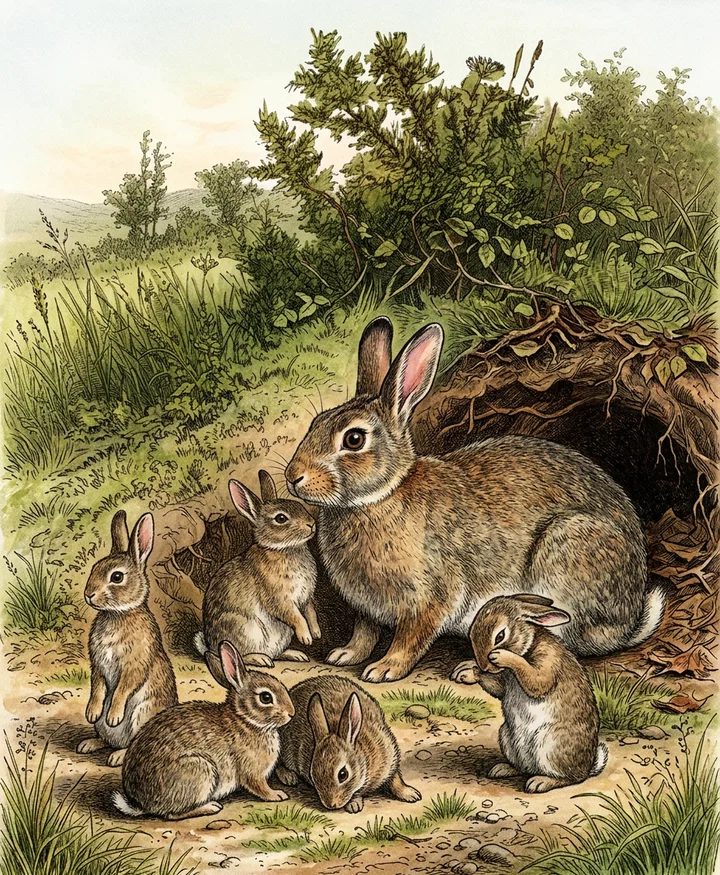
When I was a little girl, I knew an old mother rabbit who raised several families of children. When I first became acquainted with her, she was feeding on a grassy knoll with two of her rabbitkins. What had become of the rest of the family I never knew. These two, also, soon left her, and a few days afterwards she was missing. Searching around where I had seen her so much, I found a hole.
Very carefully I followed this up in a zig-zag direction with a sharp-pointed trowel, until I came to a large, commodious, underground room, carpeted with a quantity of soft hair she had actually pulled from her own body. There I found eight wee, blind, naked baby-rabbits. The mother rabbit will scarcely leave them for the first two days, and then, so the story goes, she has to hide them from papa-rabbit, who, perhaps disgusted with such forlorn-looking creatures, thinks the best thing he can do is to eat them up out of their helplessness! The mother even keeps their nest a secret by covering up the hole every time she goes out, until the little rabbits are a month old. Then she takes them to the mouth of the hole, and brings them vegetables to eat. When papa-rabbit sees them, he is glad, and draws them beneath his paws, strokes their fur, and tries to show how very much he cares for them!
As rabbits cannot make sounds with the voice, they have a way of thumping on the ground with their hind feet to warn other rabbits under the surface, of danger.
Once three or four railroad tracks were laid over a waste of ground that had served for centuries as a home for these feeble folks in the woods. A mother-rabbit was in her home with her babies, when a locomotive went thundering over the ground, making poor Bunny quake with terror, and crouch closer to her little ones. But as the sounds were heard again and again, and still unfollowed by danger, Bunny determined she would explore, and bring her little ones something to eat. Who can tell the terror she felt when for the first time she saw the snorting fire-horse! With just strength enough to tumble into her hole, she lay at the bottom, panting for breath; but her little ones were growing, and they must be taken out and introduced to the world; so she brought them to the surface with their little heads and ears just in sight, while she sat upon her haunches and looked and listened. If there was no sight or sound of danger, then she ventured out with them to gambol in the moonlight.—Adapted from “Children with Animals.”