Were you asked which is the first country of importance in the Western world, who is there but would say, “The United States”? Would you know the second, you have but to look on the map of South America. It occupies the greater part of the eastern portion of that peninsula, and is said to be thirty-five times the size of Great Britain. For reasons which we shall tell you by and by, it was named Brazil.
Not for its size alone is it distinguished, but Nature has heaped treasures of every description within her borders. Besides the bright gems and rich minerals imbedded in the earth, she has a generous supply of lofty mountains and majestic rivers, which, combined with her luxuriant tropical vegetation, cool breezes, and refreshing showers, make it a desirable land to dwell in. What adds to its attractiveness as a tropical climate, is that it has no deserts, with their scorching winds; neither is it, like the western coast of South America, visited by earthquakes. While Brazil is so well watered and fertile, on the country west of it, beyond the Andes Mountains, rain never falls. It would take volumes to describe the varied productions of this prolific soil and climate. As proof of this, when Professor Agassiz was in Brazil in 1866, he saw a collection of Amazonian products which had been prepared to send to the World's Fair at Paris, in which there were “no less than one hundred and seventeen different kinds of highly valued woods, cut from a piece of land less than half a mile square.” Many of these were “dark-colored veined woods, susceptible of a high polish, as beautiful as rosewood or ebony.” He remarks, that “an empire might esteem itself rich in any one of the sources of industry which abound in this valley, and yet the greater part of its vast growth rots upon the ground.”
Speaking of the palms, he says “their name is legion, and the variety of their forms, of their foliage, fruits, and flowers, is perfectly bewildering.” And the same might be said of almost every other species of vegetation in this climate.
Restored with AI
Brazil was first discovered by Vincent Yanez Pinzon, a companion of Columbus when he made his first voyage which resulted in the discovery of the new world. He set sail again from Palos in 1499. Crossing the equator, he first landed on the green promontory just south of Pernambuco, which he named Cape Consolation, now known as Cape St. Augustine. In the “name of Castile” he took possession of this newly found land; but before he reached Spain on his return, a Portuguese expedition, under Pedro Alvaraz Cabral, claimed it for Portugal. Cabral named it Vera Cruz, meaning the true cross, and set up a large cross as a reminder of his discovery.
In those days the Pope of Rome took upon himself the right to settle disputed claims of newly found land, and he decided this in favor of Portugal. The king of Portugal sent out another expedition, and among those who set sail for the new territory was Americus Vespucius, after whom the whole Western continent was named.
And now for the origin of “Brazil.” A modern author says, “The most valuable part of the cargo which Vespucius carried back to Europe, on his second expedition to Brazil, was the well-known dye wood, Cæsalpinia Brazilensis,—called, in the Portuguese language, pan brazil, on account of its resemblance to brazas, “coals of fire;” the land whence it came was termed the ‘Land of the Brazil Wood.’” The name was finally shortened to Brazil, and took the place of Vera Cruz, or Santa Cruz, which Cabral named it.
Brazil remained a colony, governed by viceroys from Portugal until 1815, when it “was elevated to the dignity of a kingdom;” and finally, in 1822, after a comparatively bloodless war, the court of Lisbon declared it independent. In the meantime, Dom Pedro I. was crowned emperor, and by the liberal constitution framed in 1824, the empire is still governed. In 1831 Dom Pedro abdicated the throne in favor of his son, Dom Pedro II., who is the good emperor of whom you sometimes read in the INSTRUCTOR.
The principal city of the empire is Rio de Janeiro, the capital, situated on a bay of the same name. Tradition says that one of the first Europeans to discover the bay, De Souza, supposed he had entered a mighty river, and named it as above, the name signifying182the “River of January,” after the month of January, 1531, in which he first entered the bay. Whether this is or is not the origin of the name, the same appellation has been given to the bay, and the capital, and the province in which these are situated.
The beauty and sublimity of the scenery, as you enter the bay, seems to inspire even the dullest observer. One writer has said, “I have seen the most rude and ignorant Russian sailor, the immoral and unreflecting Australian adventurer, as well as the cultivated and refined European gentleman, stand silent upon the deck, naturally admiring the gigantic avenue of mountains and palm-covered isles, which, like the granite pillars before the temple of Luxor, form a fitting colonnade to the portal of the finest bay in the world.”
Rio de Janeiro has many charmingly picturesque environs, which the traveler for pleasure should not fail to visit. Besides what Nature has done for these surroundings, gardens, walks, and avenues of exquisite beauty have been carefully prepared, adding enchantment to their original loveliness.
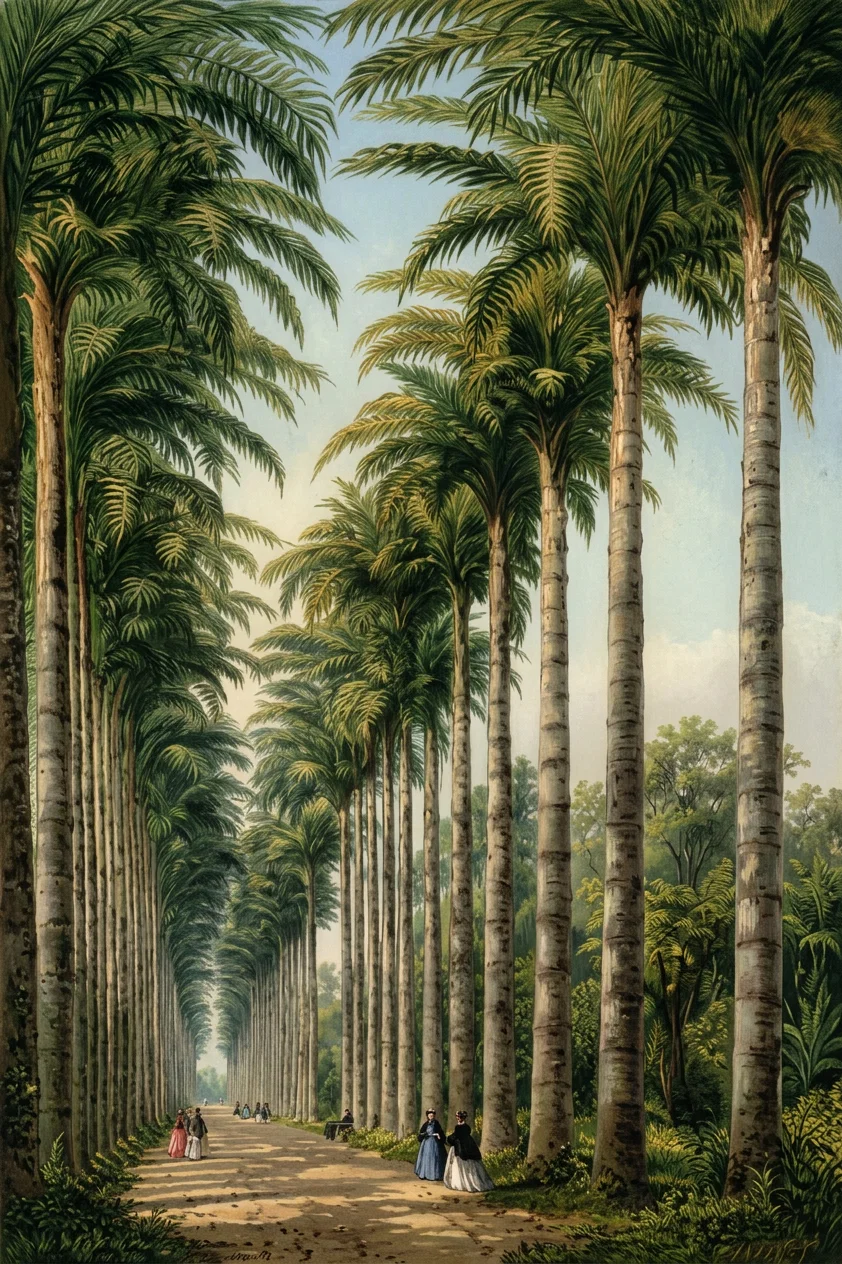
The Botanical Garden, some eight miles out of the city, is well situated for pleasantness, and although not so well kept as it should be, is remarkable for its beauty. One attractive feature of this garden is its long avenue of palms, some eighty feet in height, represented in the picture on the preceding page.
Professor Agassiz writes, after viewing these palms, “I wish it were possible to give in words the faintest idea of the architectural beauty of this colonnade of palms, with their green crowns meeting to form the roof. Straight, firm, and as smooth as stone columns, a dim vision of colonnades in some ancient Egyptian temple rises to the imagination as one looks down the long vista.”
Another visitor to Rio de Janeiro says, “I thought I should never see anything in the whole world that charmed me as the Bay of Rio de Janeiro. It is even more beautiful than the renowned Bay of Naples, or the Golden Horn of Constantinople.” After describing the bay as it appeared to him in all its loveliness, he adds: “but I brought another picture to remember best. It rests me to recall it, and I can close my eyes, and see at will that stately avenue—that grand old avenue of palms in the city of Rio de Janeiro. Your books tell you much about the Brazilian forests. Well, their magnificence is awe-inspiring, with their foliage showing every tint of green, and birds of glittering plumage flitting through giant boughs, and flowers of rainbow beauty everywhere. They are worth talking about, but this palm avenue is too exquisitely beautiful for words to picture. You must see that for yourself.”
With a ruler so liberal, learned, and accomplished as the present emperor, Dom Pedro II., it would seem as if the only great drawback to Brazil's rapidly coming to the front among the nations,—now that slavery is abolished,—is its State religion, which is Catholic. But those who understand the situation see hope for Brazil; for “the intelligent population are ready for the light of the gospel. The more the priests oppose the Bible, the more the people welcome it.”
We must leave for another time to tell you how nearly this empire, upon its rise, came to being a great Protestant nation. In the meantime let us not cease our efforts in trying to get the true Protestant religion before them and every other people who are destitute of the truth.
M. J. C.