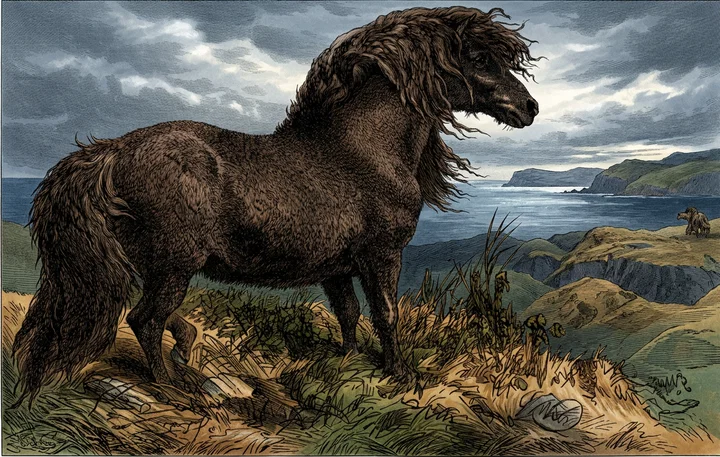
Far north from Scotland, and but seldom visited by southern travelers, are the Shetland Islands. From these rock-bound, treeless islands come the Shetland ponies that we so often see at the circus, or pulling little phaetons patiently along. A Shetland pony is almost a child's first desire, unless, perhaps, it may be to own a monkey. To have a pony to ride, or to drive, and especially a real Shetland, long-haired, short-legged pony is a dream of perfect happiness, indeed.
But have the readers of this little sketch ever thought about the home of these ponies? If you never have, then take a map of the British Isles, and in the far North you will see the small group of islands called the Shetlands, and from there the ponies came; and to-day they are raised there in great numbers.
Shetland is a very different country than many see. There are no green fields and trees, and the children living there hardly believe it when you tell them that in England or Scotland there are green lanes, and that birds build nests among the trees. . . . The people of the Shetland Islands are very quiet, orderly, and industrious. They live by many means. . . . One class of people make a living by raising ponies and sheep to send to England and even to America. We will imagine ourselves in the town of Lerwick, and all ready for a start to Noss Island, where a man lives who has a large herd of real Shetland ponies.
I remember the morning perfectly. The bay was all dotted with the white sails of the fishing boats. The town was all awake carrying dried fish to the boats at anchor, and on the corners of the streets were gathered women and young girls selling potatoes they had just brought in from the distant field. We took a row boat and rowed across Bressay Sound to Bressay Island, and then walking across it, and after looking back at the town and out at sea, we came to a small strait, and had to hire another boat to take us across the water to Noss Island. This island is not very large, but has more green grass than any other of the Shetland group. One end of it almost buries itself in the sea, and then it gradually rises higher and higher, until the opposite end rises a thousand feet right up from the sea. There is only one house on the island, and in that lives the keeper of the ponies and his two children. I wish you could have seen these children when they saw us coming in the boat. They hardly ever leave the island themselves, and so when any strangers come to see their ponies, how happy it makes them! They were very pretty and bright children, too. They had light hair, and bright blue eyes, and cheeks as red as roses. Running down with them was their pet dog, who seemed just as glad as any of the rest to see strangers. The house the man lived in was very lonely-looking to us. It was built of stone, and then painted white, and stood on a little knoll overlooking the blue waters of the cold North Sea.
After a short rest, we walked out to explore the island and see the ponies. Here was their home, and we should see them here in their real life. . . . There must have been fully two hundred of the shaggy-maned little fellows. Some were eating, some biting one another, some running as though having a race, and others stood still, looking at us. When we came nearer, the whole herd pricked up their ears, gave little snorts of anger, and galloped away as fast as their short legs could carry them.
The keeper told us that when one wishes a pony, to ride or sell, he must take the one he keeps near his house, mount him, and then riding out to the herd, lasso one at a time until you obtain all you wish. In winter, the ponies of Noss Island have rather a hard time of it. Though there is not much snow on the island, still the winds often blow very fiercely, and poor pony has no barn to go to. Sometimes the keeper builds a wall about a square piece of ground, and pony can go into the inclosure, and so be somewhat sheltered. But usually he must face the wind and storm, no matter what the weather. . . .
A pony in the Shetland Islands, even, has often hard work to perform. If a poor person is possessed of a pony, then, indeed, he feels rich. Now on certain days in the week, there are market days at Lerwick. From all about come the people bringing things to sell. Some walk to the town, some sail, and others come riding on their ponies. Just inside of Lerwick is a narrow path leading over the hills. I have often seen, coming along this narrow way, a long line of ponies and women. And such a curious appearance they present! The ponies seem only legs. They have no bridle, only a cord about the neck, and each follows the one in front. You can't make them go at the side of one another. On either side of each one are two immense saddle-bags filled with peat or potatoes; on his back are piled other goods, and even his neck has a cloth or other saddle-bags strapped, so that seen from a short distance it seems just as though the bags had legs, and poor pony seems buried out of sight. Sometimes, too, if there is room to keep seated, his mistress, with shoeless feet and short dress and white cap, seats herself in great state, and away goes pony, bags, and woman, off to Lerwick.
Sometimes, when on these pilgrimages, pony will watch his chance, and if his mistress should be absent, will dart away down the steep hill-side, to nibble a bit of something good he has seen; and then when his mistress sees him, such a pounding as pony gets as she leads him back to his proper place! But he only looks meek, and will no doubt do the same thing again when he gets a chance.
Shetland ponies are very sure-footed. They will walk along the very edge of a high cliff, and before putting a foot down, will carefully feel if the ground is firm or not. Some of them are driven by their riders down steep passes where one misstep would send both rider and pony down to the depths below. . . .
A Shetland pony on his native heath is extremely willful. If he dislikes a rider, he will spare no pains to unseat him. I rode one once who expended a great deal of unnecessary strength in this manner. He would sit down suddenly, and rise up more so. He would bite, shake himself, and roll over, if allowed. As he was almost small enough to be carried by his rider, these antics were more amusing than dangerous.
And so the ponies of the Shetland Islands live and wait for masters in the South. In the cold winter of fog and rain, when there is almost no day, or in the summer time, when the sun does not set, they run wild about the Noss, take burdens to Lerwick, or carry the stranger over the bogs and dreary hills.—Wonder Stories of Travel.