BY REV. ARTHUR H. SMITH.
It is one of the claims of Christianity that it is a religion which is profitable for the life that now is. The civilization of Christian lands is in many respects so much superior to that of non-Christian lands that it is very natural for missionaries to cast about for ways in which they may inject some of the forces of the higher civilization into the lower. Something of this sort is the legitimate outcome of the introduction of Christianity anywhere, as the history of missions in all ages and in all lands abundantly shows. It is the purpose of the present paper to give, from a single, limited field in the northern portion of the Chinese Empire, a few illustrations of the difficulty of introducing new sociological conditions among ancient races with a hoary civilization.
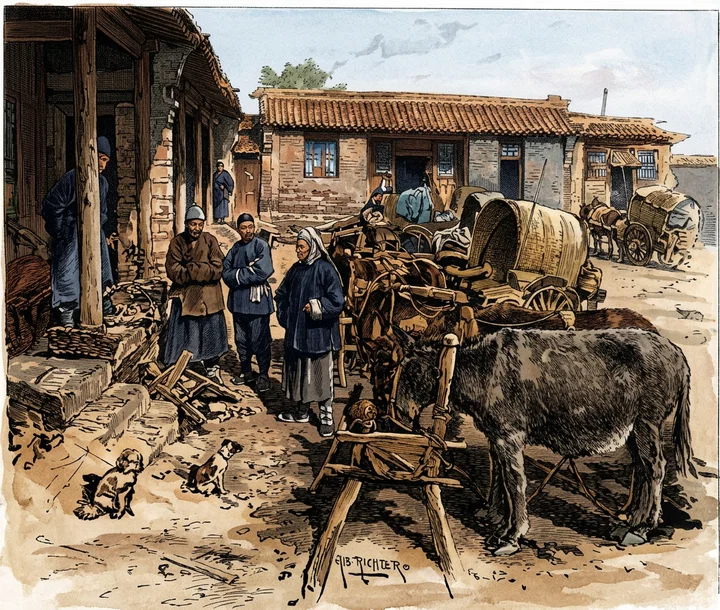
Nothing is more essential to the well-being of a community than good roads, facilitating communication. In Northern China the travel is largely by carts, and yet the public highways are never repaired, and are so far from justifying their name that it is a proverb that an old road becomes a river, which in the summer rains is literally the case. Much of the waste and misery resulting is preventable, yet it cannot be prevented. When we try to influence a farmer to repair the road over against his own house, he refuses, on the ground that the track is no more his to use than it is that of others. He has no time to waste on such work—that is to say, he is unwilling to confer a benefit on others, even though he reaps a greater one himself. But there is a deeper reason still. The repair of roads requires earth, and, in a land where every available square foot is necessary for tillage, who is to furnish the earth?—Nobody. And therefore it never is furnished.
Every missionary is able to perceive that, despite the industry of the Chinese, they are laboring under great disadvantages, owing to the lack of good tools; but he can seldom introduce better tools into actual use, either because they are far too expensive for the narrow means of a single farmer, or because, while they might be used for several families, jealousy and selfishness would prevent the experiment from becoming a success. One of the clumsiest of the Chinese machines is the set of rollers by which cotton is very slowly and imperfectly seeded, but a foreign machine cannot be introduced to take the place of the other, for the reasons already given, as we have had opportunity to observe.
The same has been found to be the case with grains. Yet tobacco, maize, the peanut, a variety of beet, cabbage, and the potato, have all been introduced into Northern China during the present dynasty, and all of them are well acclimated. Yet every such innovation has to fight for its existence for a long time, and there are probably few plants that can spring at once into favor, as the poppy has done—a type of the persistence of evil and its universal adaptations.
Conservatism and suspicion are in all oriental countries twin sisters, which resent any interference with what already exists. It is due to these traits that one is so often struck with the fact that contrivances for saving labor, which have long been in use in one region, are altogether unknown in other regions not far distant. An instance of this sort is to be found in a district in the province of Chihli, where the common form of water wheel is fitted with buckets drawn up by a rope coiled on a windlass turned by a donkey. The machinery is rude, the buckets ill made and leaky, and the waste of power very great, but, on the whole, this is much more economical than drawing water by hand. Yet in a belt of country along the Grand Canal, only about two days' journey from the district where water wheels are used, these devices are wholly unknown, and the only method of irrigation is either from wells with a windlass worked by men, or by two men tossing water from wicker baskets from the river into a pool above, and from thence to the field to be irrigated, thus using the labor of four men, and spilling about half the water in transit. Within a few years, however, the water wheel, in a very imperfect form, has made its appearance on the banks of the canal, introduced by two men relatively more enterprising than their neighbors. The reason given for not having bought a machine sooner was poverty—the compendious explanation of so many of the ills of China.—Missionary Review.