Editorial
Man’s Way or God’s Way—Which?—Perhaps the better title of these notes would be, “Satan’s Way or God’s Way—which?” for every way of man’s which is contrary to the way of God originated with Satan. Man was originally created in God’s image—“in righteousness and true holiness.” He was made “upright,” and was declared by his Creator to be “very good.” But Satan came in, perverted God’s way, presented the perverted way to man as a better way, and led man to believe that this perverted way was the better way, and that it originated in his (man’s) own wisdom.
Wisdom in Man.—In this way Satan has led man to seek for wisdom and knowledge in himself or in his own attainments. Lucifer sought his own glory. His motive was exaltation of self. His language was, “I will exalt my throne above the stars of God,” “I will be like the Most High.” Isa. 14: 13, 14. But this meant the dethronement of God, for only one could be Most High, and Lucifer was determined to be that one. Man in yielding to the suggestions of the enemy, in receiving them into the heart, partook of the same spirit, and is seeking his own exaltation at the price of others’ degradation. God’s message to Lucifer, showing the result of self-exaltation, was, “Thine heart was lifted up because of thy beauty, thou hast corrupted thy wisdom by reason of thy brightness,” and, therefore, because of his perversion of truth and righteousness, he is become a terror, and shall perish, and “never shalt thou be any more.” See Eze. 28:12–20. In the same way as man has exalted himself, he has corrupted his wisdom, has degraded himself, has proved a curse instead of a blessing; and his self-exaltation ends in his utter destruction.
Man’s Motto.—Man’s motto in seeking wisdom and knowledge has ever indicated his selfish spirit, the mind of Satan, the god of this world. It was inscribed over the old heathen Delphic temple, “Know thyself,” and has been repeated as a wise saying by the worldly wise men in church and state all down the ages. Says Pope, in his “Essay on Man”:—
“Know thyself; presume not God to scan; The proper study of mankind is man.”
But it is the old heathen lie, the basis of which is Satan’s deception. Man has sought to know himself; he has sought wisdom in himself; he has studied himself, and to what has it all amounted? How much wiser is unaided man than in the beginning? How much good has his study done toward elevating the race? What new wisdom has he given to the world? What gospel of healing have his knowledge and wisdom evolved?
The Sad Result.—The sad result of it is that man’s source of wisdom has brought him no good, has given no new wisdom to the world. On the other hand, it has brought only sin and misery and degradation and death upon all mankind. The apostle expresses it all in the following scripture:—
“Because that, when they [man] knew God, they glorified him not as God, neither were thankful; but became vain in their imaginations, and their foolish heart was darkened. Professing themselves to be wise, they became fools, and changed the glory of the uncorruptible God into an image made like to corruptible man, and to birds, and fourfooted beasts, and creeping things. Wherefore God also gave them up to uncleanness, through the lusts of their own hearts, to dishonor their own bodies between themselves; who changed the truth of God into a lie, and worshiped and served the creature more than the Creator, who is blessed forever.” Rom. 1: 21–25.
This is not all. The same apostle tells us in the following verses of the chapter somewhat of the depths of the wickedness and darkness to which mankind have been led simply and solely because they chose Satan’s way instead of God’s way, and sought wisdom in themselves, and glory for themselves, instead of wisdom from God and God’s glory. Almost every object in nature has been worshiped, by the direction of man’s wisdom. Every crime in the catalogue of crimes, and every transgression of God’s law, have been justified by the wisdom which man finds in himself.
The Chiefest Idolatry.—The chiefest idolatry which has cursed the world has been that of sun worship. Says Dr. S. W. Chambers: “The universality of this form of idolatry is something remarkable. It seems to have prevailed everywhere.” And it has. Egypt, Persia, China, Babylon, Phoenicia, Greece, Rome, the barbarous and savage tribes of both eastern and western continents, worshiped in some form or other the luminary of day. It placed its indelible stamp upon the apostasy of the Jewish people. It had a prominent part in the apostasy of the early church, which resulted in the Papacy. It lives to-day, not clothed in the gross wickedness of the early ages, but no less seductive in blinding minds, leading men to turn their backs upon God’s truth. It is man’s way and wisdom instead of God’s.
The Worst Idolatry.—This idolatry was the worst because it resulted in turning men from the true God more absolutely and effectually than any other form of worship. The sign, the seal, the token, between God and his people is the Sabbath. It points out God as the Creator and hence the Re-creator, not only of the heavens and earth, but of man. But sun worship has succeeded in putting in the place of the Sabbath the Sunday, the day named after the sun, because dedicated to its worship. It has in this way shut away from millions in heathen lands and in apostate “Christian” lands a knowledge of the living God, who made all things and gave his Sabbathp. 2 (130) as his memorial. True, Sunday has been called the Sabbath by many honest souls, but that does not make it the Sabbath. God has not so called it, and he has not required it at the hand of any man to presume to speak or do when he has not commanded. Not only is the sun worship guilty of all this, but it is guilty of benumbing and paralyzing man’s moral faculties as no other idolatry has. It is a nature worship which has connected with it essentially the sexual idea in some form or other. Hence there has arisen from it the most unbounded and abominable licentiousness which the world has ever seen. And there is nothing more benumbing to the consciences of men than this.
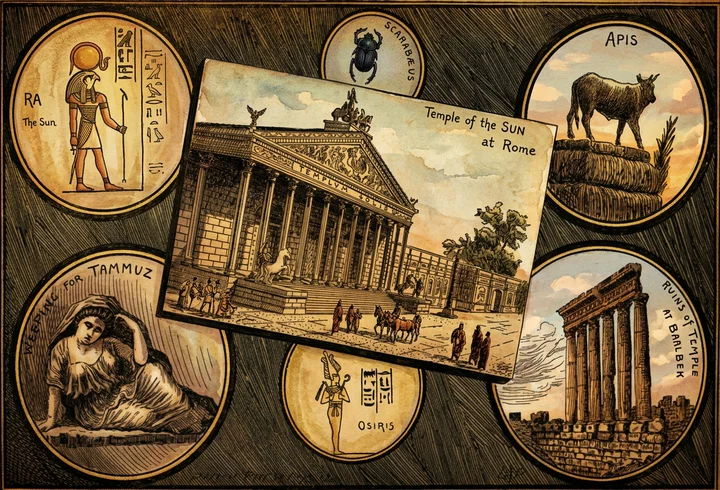
Our combination illustration will give the reader something of an idea of sun worship. In the center we have a cut of the temple of the sun erected at Rome. Magnificent temples were erected in other places. Baalbec, in Syria, and Heliopolis, in Egypt, were cities of the sun. At Baalbec was one of the most magnificent and costly buildings erected to the sun which the earth ever saw. Ra, Apis, Osiris, and others were Egyptian sun gods. Tammuz was another name of the sun, for which the women of Israel wept. See Ezekiel 8. Other figures will explain themselves. All this idolatry, let it be observed, came because man sought knowledge and wisdom in himself. He has evolved great schemes, wondrous ideas, grand plans for the regeneration of man, but man is no better; rather, the wickedness increases, and man, being in honor of himself, is like the beasts that perish.
Reformations.—There have been times when God’s message and power have swept away the darkness, and hearts have been brought out into the light of the Lord Jesus Christ. It was so in the time of the Exodus from Egypt; it was so in the days of Samuel and Haggai, and especially true at the first advent of our Lord. There was also a reviving in the days of Martin Luther, and another in the time of Wesley. But soon after all these reformations and wondrous manifestations of God’s power, man has chosen his own way, his own wisdom, and has departed from God. He has sought to supplement God’s plan by his own schemes, and has brought cumbersome weakness instead of strength. He has substituted his own ways for God’s ways, and idolatry has come in, and God has been dishonored.
Early Introduction of Error.—We have an illustration of this departing from God in the substitution of man’s way for God’s way shortly after Israel left Egypt. The incident also shows how rapidly error spreads, and how little time it takes to utterly depart from God. Before the thunders of Sinai had hardly ceased their reverberations, during the forty days which followed the speaking of that Decalogue by the living God, Israel had turned their back upon him and had turned to the Egyptian sun god Apis. The record of this is found in Ex. 32: 1–6. In the absence of Moses the fickle people demanded visible gods to go before them. Aaron made a representation of the god Apis, and proclaimed, “These be thy gods, O Israel, which brought thee up out of the land of Egypt.” With this same transgression of God’s command to not observe heathen times and gods. Lev. 19: 26. In his blindness Aaron said, “To-morrow is a feast to Jehovah.” It was, in all probability, the substitution of the sun-god festival for the appointed day of Jehovah. Thus the people “corrupted themselves.” This same licentious sun worship in various forms became the greatest curse of Israel in later days. Baal worship was sun worship, and was ever emphatically condemned of God. See Numbers 25; Ezekiel, chapters 8 and 20; 2 Kings 21: 1–6, and many other scriptures. It was demonstrated throughout the history of Israel that the worst of all idolatry was sun worship, and that this always meant violation of the Lord’s own day, and the observance of the days and times of heathenism, chief among which was “the wild solar holiday of all heathen times,” the present Sunday. That special idolatry became so interwoven and inbred in the very life of the nations of earth that almost every departure from God meant going back to sun worship.
Early Apostasy in New Testament Times.—In the New Testament we have a similar illustration of departure from God to heathen worship and heathen times. The church at Galatia was largely composed of converted heathen. Said the apostle, “When ye knew not God, ye did service unto them which by nature are no gods.” Gal. 4: 8. They were heathen idolaters who had accepted Christ. But the Galatians had departed from the Gospel of Christ to “another gospel,” which was not a gospel. It was the substitution of man’s way for God’s way, and it resulted in turning these converts from the worship of God back to idolatry, and the observance of heathen days and times. The apostle says:—
“Howbeit then, when ye knew not God, ye did service unto them which by nature are no gods. But now, after that ye have known God, or rather are known of God, how turn ye again to the weak and beggarly elements, whereunto ye desire again to be in bondage? Ye observe days, and months, and times, and years. I am afraid of you, lest I have bestowed upon you labor in vain.” Gal. 4: 8–11.
Now, as the worship of the sun was the chief and most popular worship of the world in some form or other, and as the chief day of idolatrous worship was the Sunday, the first day of the week, it is most probable that among the days and times observed by the Galatians was that of Sunday. Already had the mystery of iniquity begun to work. Christ in the heart by faith hindered its full development (2 Thess. 2: 3–8), till the hearts of the majority composing the church had chosen their own way instead of God’s way in Christ. No wonder that the apostle exclaimed, as he saw the Christian church turning back to the old heathen festivals, “Ye observe days, and months, and times, and years. I am afraid of you.”
The Result.—The result of this early departure in the Christian church is seen in the terrible darkness of the days of the papal supremacy, in the setting aside of the Sabbath of the Lord, and the enthronement of the man of sin in the place of Christ. It is the perversion of the worship of God as truly as Baal worship was the perversion of the worship of God in ancient times. It is true that men have called and do call Sunday the “Lord’s day,” the “sabbath,” the “Christian sabbath,” etc., but God does not so call it. Jeroboam called the golden calves he set up at Dan and Bethel the representatives of Jehovah, who brought Israel out of Egypt (1 Kings 12: 28–33), and Aaron said that the feast to the sun god Apis was a feast to Jehovah. The Jews also mixed the worship of Baal with the worship of God till the rites and customs and penances of idol worship were offered to God, and supposed to be acceptable to him. Compare Jer. 41: 4, 5 with 1 Kings 18: 26–28; Lev. 21: 5, and others. The Reformation barely touched the subject of the day of the Lord’s Sabbath, though it was based upon principles which, if followed, would have led to obedience to all the commandments of God, the fourth among the rest.
But the Protestant churches have departed from the principles of the Reformation, and the Sunday now demands by right the place in God’s law it has so long usurped. But, not having the authority of God’s word, it demands human might, the might of human governments, for its promotion and enforcement. It is the acceptance of man’s ways instead of God’s ways. This has already led to persecution; it will lead to still more. God is not in it, nor can he be without giving his glory to another. Would that the professed people of God would listen to his voice, repeated so many times: “O that my people had hearkened unto me, and Israel had walked in my ways!” The question is between man’s ways and God’s ways, man’s wisdom and God’s wisdom. The crucible of testing is God’s eternal word. What is not in harmony with that word will be rooted up and destroyed. What is authorized by that word will stand forever.