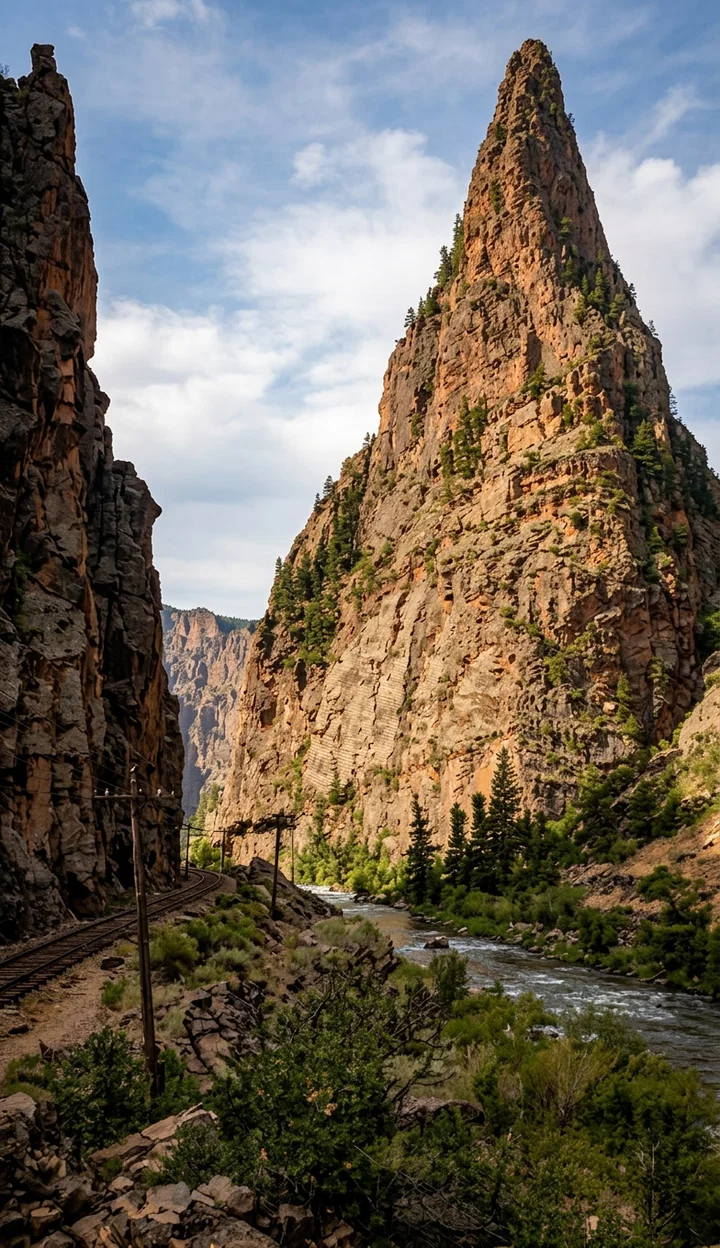
THAT it should have been called “black” is a surprise to every one who makes a trip through this canyon, for the river is quite wide, and while the walls of stone are sometimes of great height, they are not somber, but of great beauty, varying in color; so, instead of entering a dark chasm, as the name would indicate, we come into a most beautiful amphitheater. At Sapinero, a small station twenty-six miles west of Gunnison, an observation car was attached to the train. This car was open at the top as well as on both sides, thus affording a fine view, for while Colorado is a large state, a good deal of it is “set up on end,” and the traveler often obtains the finest views by “looking upward.”
The hot July sun beat down upon our unprotected heads, while the rapid motion of the train created a stiff breeze, that wrested from our grasp the umbrellas we vainly endeavored to hold aloft. Cinders from two locomotives filled our optic organs to overflowing. Happily for the ladies, they had provided themselves with veils that protected them from further difficulties, but the gentlemen, not having veils among their baggage, winked and blinked in the sunlight, and held onto their hats with both hands. By the time the train had reached the canyon we were in readiness to view the scene.
The porter of the car in which we were traveling gave us the benefit of his travels through the canyon, and called our attention to the principal objects of interest as we came to them. On the side of the wall of stone that rose up beside the track he pointed out with a cane the outlines of a human face, that was so plainly depicted that we saw it when the train was moving quite rapidly. The high walls of granite rear their heads to a height of 2,000 feet above the Gunnison River, that flows at the bottom of the canyon. The railroad clings to the base of the wall on one side; then, when some impassable barrier rises in its path, it crosses on a substantial bridge to the other side of the river. The most notable object in this canyon, which is about twenty miles long, is the Currecanti Needle, of which our illustration gives a good view. The “Needle” rises high above its surroundings, and so graceful are its proportions that it appears as though it might have been hewn out of stone by some master workman.
An exclamation of delight arose from the lips of all as a turn in the road revealed to our eyes the Chipeta Falls, white as snow, gleaming and sparkling in the sunlight, falling from a height of 2,000 feet into the river below. Our eyes lingered as long as was possible on this beautiful scene of falling water.—Our Young Folks.