In the month Magh of the Hindu year, which corresponds to the latter part of January and the first part of February, a great concourse of people may be seen wending their way from all parts of India to the city of Allahabad; for at this season a festival is kept, and often as many as two million people come hither to observe it.
It is a motley crowd that congregates,—rich and poor, high and low,—to bathe in the river flowing by the city. The sacred waters of the Jumna here unite with the Ganges; and as if to make the spot more holy in the eyes of all devout Hindus, the priests teach that a third river, invisible at its juncture to mortal eyes, descends direct from heaven down the slopes of the Himalayas, and unites at Allahabad with the other two. In a subterranean temple a little water trickling from the rocky walls is pointed out to the credulous as the divine stream; however, this river, the Saraswati, after descending the snow-capped Himalayas, really loses itself in the desert sands four hundred miles northwest of Allahabad.
In describing the festival a writer says: “There were pilgrims of all degrees, poor men and women who had begged their subsistence along the road, and rich men who came in grand state with trains of elephants and camels, and with gorgeous tents spread for their occupation. There were many fakirs, some holding their withered hands high in the air, where they had kept them for years. Others with the skin worn from their knees in consequence of dragging their bodies along the road, and others covered with dust and ashes, in accordance with their vows. It is a peculiar principle of the Hindu religion, that its holiest men are the dirtiest; and if one wishes to get up a reputation for sanctity, his first duty is to become as repulsive as possible by never washing himself, covering his body with rags, allowing his hair to go quite untouched by comb or scissors, to perform some act of bodily torture, and then sit by the roadside, and beg for food. The fakirs are even exempt from the injunction to bathe in the holy rivers, possibly through fear that the accumulated dirt, which is the seal of their profession, might be washed away. But they come in great numbers to all the sacred places, and probably the chance of picking up a liberal allowance from the charitable may have something to do with their coming.
“Formerly there were great cruelties practiced by these fakirs on themselves in the name of religion, but they are no longer allowed. . . . There were several of these fakirs whose hands had been so long held upright that they were fixed in that position, and others whose finger nails had been allowed to grow until they were turned like the claws of birds, and pierced the palms of the hands. One man had his feet and hands bound together, and was rolling along like a cart-wheel, and he had doubtless come hundreds of miles in this way.
“At the junction of the rivers the crowd was more dense than elsewhere, and hundreds of persons were clinging to rafts anchored for the safety of those who could not swim. Before a pilgrim enters the water, he sits on the bank and submits himself to a barber, who removes his hair and beard, and throws them into the river. He is told that for every hair he thus gives to the gods, he will have a million years in paradise. After the shaving is over, he bathes; the next day he goes through a ceremony in honor of his ancestors, and is then ready to depart for home. . . .
“The priests who have charge of this festival make a great deal of money, as the pilgrims are required to pay according to their means for the services of the barbers and the privilege of bathing. Several times it has been proposed to make an end of this idolatrous worship by closing the place altogether, and giving a cash allowance to the owners to replace their revenues. But the government is unwilling to interfere in the religion of the people, and so the festival is kept up.”
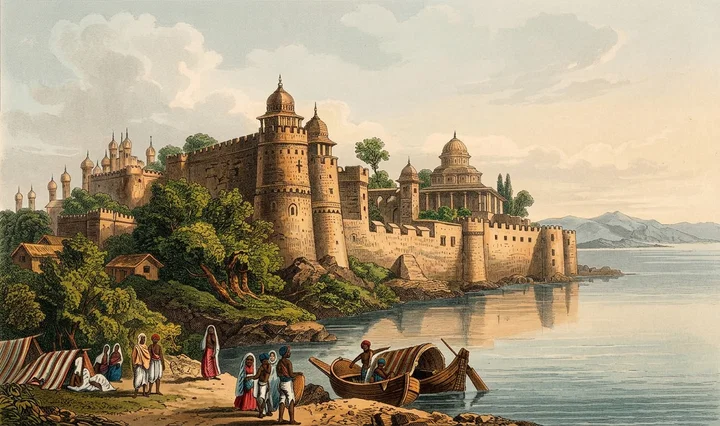
“Allahabad means ‘city of God.’ The name was given to it by the great Moslem emperor, Akbar, who conquered it from the Hindus and built a fort, which is now occupied by the English garrison. . . . There is not a great deal to be seen at Allahabad besides the festival at the junction of the rivers, as the fort contains nothing remarkable, and there are no public buildings of consequence.
“The population of Allahabad is a mixed one of Moslems and Hindus, the former descended from the conquerors of three hundred years ago, and the latter from the more ancient inhabitants.” W. E. L.