Percy had never spent so delightful a vacation. He lived in a thrifty village. It had a good school, which was held three-fourths of the year, and Percy went to it. He never missed a day, for he liked the teacher, and he also liked to study.
Among all the merry children swinging their satchels of books on that balmy June afternoon when school closed, I think Percy's face was the only one that was clouded. He was really sorry vacation-time had come.
Percy's father was a market-gardener, and raised vegetables to sell in a neighboring town. I am afraid that the thoughts of the long forenoons when he would have to hoe in the garden instead of playing or reading, had something to do with making the vacation such a dread to the young boy.
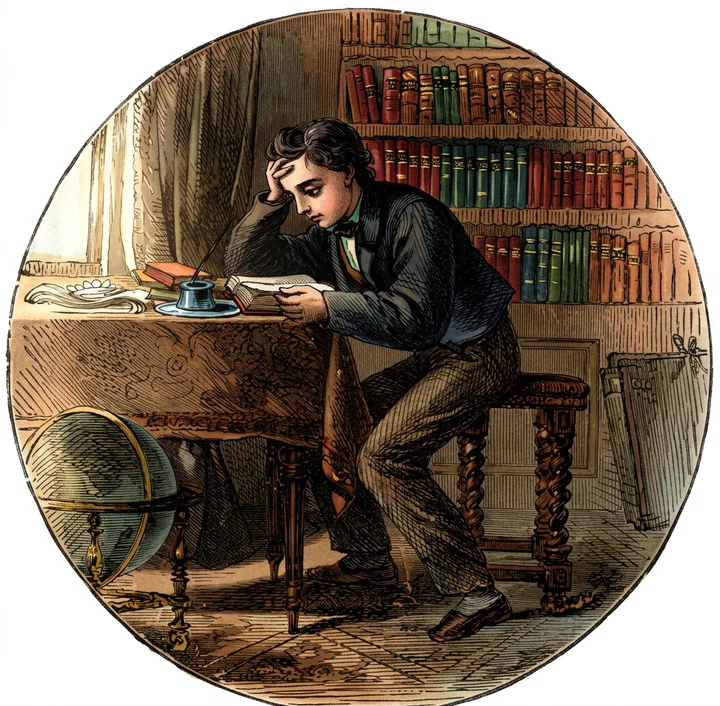
But there was a pleasant surprise for Percy when he reached home. It was a letter his mother had got from her brother only two days before, and in it was an invitation for Percy to come and spend two whole months by the sea-shore! What was better still, Percy's father and mother had decided to let him go. Can you think how delighted he was? He had never been so far away from home before.
But I did not want to tell you about Percy's long journey to the sea all by himself, which was very much like all other boys' first journeys, nor to tell you what a beautiful place he found at his journey's end, nor of the little room his uncle gave him, with its hooded window looking out over the great ocean. But I wanted to tell you of a talk Percy and his uncle had near the close of vacation time.
There was one place in the house that Percy liked better than all the rest,—better, in fact, than all the beautiful world outside; it was the library. Every minute he could get when his cousins were not teasing him to go somewhere, he would spend in this cozy place, with its walls lined with shelves of books, and with globes, and atlases, and maps.
“You seem very fond of reading,” said his uncle, as he came into the library one morning, and found Percy busily poring over a book.
“Yes, sir,” replied Percy, looking up, “I like this place the best of any in the house.”
“Well, what have you found to read that you liked?” asked his uncle, drawing a great easy-chair up to the table, and sitting down by the boy.
“Pretty much everything,” Percy replied, with a laugh. “I didn't think it would make any difference where I began, so I have read most all the books on that shelf.”
“That is quite a good many for only six weeks,” his uncle replied; “there are twenty books in that row.”
“Yes, sir,” Percy replied, with some pride, “I read a great deal, and I can read very fast for a boy of my age. I mean to be a scholar some day.”
“Ah!” said Uncle Peter, “that is a good mark for a boy to aim at. How old are you?”
“I am eleven—most twelve,” Percy replied.
“You must indeed read fast,” said his uncle; “you have read more than I could well read myself in the same time.”
Percy looked pleased; he thought his uncle meant that he was an unusually smart boy.
“Now,” asked his uncle, “how much can you remember of what you have read?”
Percy puckered up his brows and tried to think; but there was only a confused mass of new things in his mind. Stories of the Reformers, legends of the Northland, and of Greece, the Tales of the Boy Travelers, Robinson Crusoe's adventures, and many other things were hopelessly mixed.
“It is rather a hard matter to straighten out, isn't it?” said his uncle, with an amused smile.
Percy only looked uncomfortably confused, and made no reply.
“I like your desire to be a scholar, and learn all you can,” Uncle Peter replied soberly; “but I think you are making a mistake in the way you take to do it. A boy's mind must be treated in a good many respects like his body. You would not grow any taller or stronger if you should eat six meals a day instead of three comfortable ones, would you?”
“No,” said Percy, “I should expect to get sick if I ate all the time.”
“Well,” continued his uncle, “that is what you have been doing to your mind this summer. You have stuffed it so full of really good things that it cannot take care of any of them properly. You cannot remember anything you have read with certainty. How much good do you think such knowledge will do you?”
Percy looked thoughtful, but made no reply.
“Now I have been watching you for some time when you didn't know it,” said Uncle Peter, “and I have thought of a plan that I think will help you.
“When you finish a chapter, shut the book up and see how much you can remember of what you have read. Do this at the end of every chapter of all the books you read that are worth remembering, and I am sure that you will know more at the end of the next two months' reading than you do at the end of this. But remember that reading a great many books will not make you a scholar, as you suppose; it lies in reading only good books, and remembering what they contain. It is not anything to be proud of that you are a very fast reader, but it is something to be satisfied with if you can keep what you do read.”
These were all new ideas to Percy; and as he believed his Uncle Peter was a very wise man because he had so many books, he thought a great deal about what he had said, and you may be sure it helped him to grow stronger mentally when he had learned to do some thinking on his own account.
W. E. L.