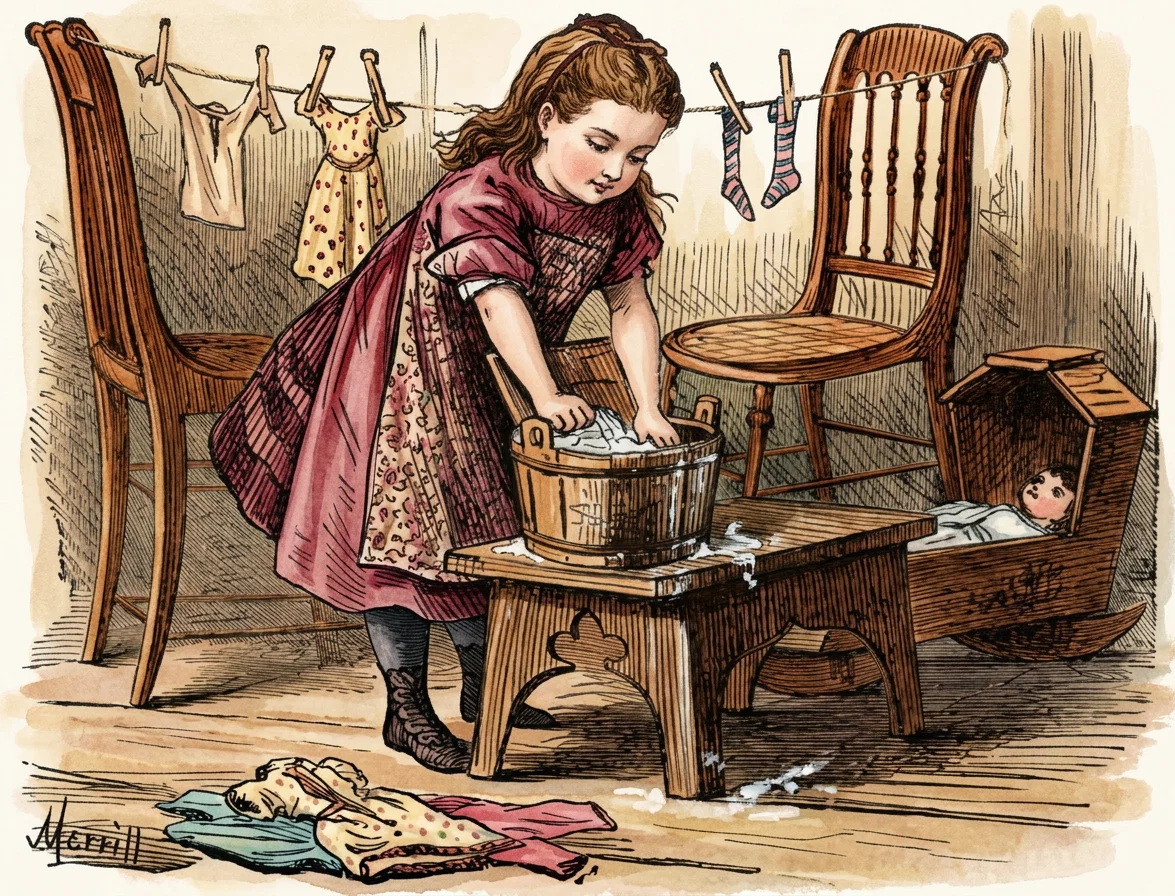
WHY DOLLY DIDN'T GO

3%

S. D. A. Publishing Association · Battle Creek, Mich. · Oct 3, 1888

FromThe Youth’s Instructor, Vol. 36, No. 40.

Read the full edition

WHY DOLLY DIDN'T GO.

At last everything was ready. The lunch-basket was packed with the daintiest lunch that mamma could think of—boned chicken, and little thin sandwiches, and tarts, and chocolate cake, and three big oranges.
Restored with AI
Dolly stood in the doorway, fresh and sweet in her new cambric, and her pretty lace-trimmed hat. Mamma knotted the blue sash in a wonderful bow on one side. Then she tied the silver quarter that was to pay for Dolly's ride, in the corner of a handkerchief, and fastened it to Dolly's belt, for the little girl was apt to lose things.
“Now mind, Dolly,” said mamma, “don't lose your money, and remember your things when you come home. And Dolly,” mamma spoke very softly then, “if God has anything he wants you to do to-day, don't fail him, will you, dear?”
“No, I'll be all ready,” said Dolly, with her eyes very bright, and her cheeks very red.
Then mamma kissed her, and off she started down the road.
Dolly was very happy that morning. There was to be a picnic down by Shelley's pond, four miles away, and all the little boys and girls in the Bigelow school, who could afford the money to pay for the ride, were going. They were to meet at the school-house, and have the long ride in big teams, and there were to be boat rides, and swings, and a dinner, and the ride home in the cool of the day. Dolly had thought about it for a whole week almost all the time.
“Mamma talks funny, sometimes,” said Dolly to herself, as she tripped along. “I don't believe God'll want me to do anything to-day, 'cept to have a good time.”
Dolly came to the covered bridge that crossed the river. She stopped, as she always liked to do, to peep out for a moment through the great timbers of the sides, and down into the black, roaring depths below. Just as she reached the other end, and was passing out of the bridge, she heard a faint sob. Dolly looked everywhere, and at last, down by the very edge of the river, half buried in the cool, green ferns and tall flags, she found Bessie Stone, crying as if her heart would break.
“Why!” said Dolly. “What is the matter, Bessie?”
Dolly could see that she had started for the picnic. She had a lunch-basket beside her, and her school dress and pink sun-bonnet had been freshly washed and ironed. “Come, Bessie,” said Dolly, creeping down to her, and trying to take her hands away from her face. “I heard the teams coming when I was on the bridge. We'll miss them if we don't hurry.” At that Bessie cried harder than ever, and wrung her hands.
“Oh, dear, dear! I can't go. I can't go. I lost my money down through the bridge, and now I'll have to stay at home.”
“Run home and get some more,” suggested Dolly.
“Mamma can't give me any, because she's poor. I picked up chips for Mrs. Bean and earned this. I never went to a picnic in all my life, and I wanted so much to go to this.” And the tears came faster and faster.
“Dear! dear!” said Dolly, “never been to a picnic?”
“No,” said Bessie, “and I worked four weeks to earn the money. I had it in my hand, and I stopped to tie up my shoe on the bridge, and laid the money down, and it fell through.”
“I'm so sorry,” said Dolly.
They were not far from the school-house. They could hear the gay chatter of the boys and girls as they came together, and then the loud rumble of the teams, as they drove up. Bessie gathered up her sun-bonnet and basket, and then, with a very sad face, started to go home.
Did somebody whisper to Dolly, that she jumped up so suddenly? There wasn't a live creature in sight except an old frog, who had come up on the shore to hear what all the noise was about. But Dolly very distinctly heard these words in her heart: “If God has anything he wants you to do to-day, don't fail him, will you, dear?”
Another moment and Dolly went hurrying back over the bridge, and caught Bessie and crowded the precious handkerchief that had the money in it into her hand. “Here's my money,” she said. “Now go quick, Bessie, or you'll be late.” She was a little afraid she might change her mind, if there was any delay.
Bessie's eyes opened wide. “Why, what'll you do?” she said.
“Oh! I don't care about picnics; that is, not very much,” answered Dolly bravely.
Bessie refused at first; but she was very small, and she wanted so much to go. Dolly urged her very hard, and at last she took it.
“We'll exchange lunch-baskets,” said Dolly. She had noticed that Bessie's basket had altogether too lean a look for a basket that was going to a picnic.
So they exchanged, and Bessie ran on up the hill, urged on by Dolly's cry of “Hurry now, Bessie!” behind her.
It was baking day at Mamma Carr's. She was just holding up a little cranberry roll that was to go into Dolly's dinner pail the next day, when the door suddenly burst open, and Dolly herself came rushing in.
“Dear! dear!” said mamma. “Why, Dolly, what is the matter? Did you lose your money?”
“No; I gave it to Bessie Stone. She lost her's, through the bridge, and she has never been to a picnic in her life, never.”
Mamma dropped the turnover onto the molding-board, and all floury as she was, she sat right down and took Dolly in her arms, and gave her a hug.
“Why, Dolly Carr!” she said, “I'd rather my little girl should do a thing like that than have her made a queen.”
“And sit on a throne and wear a crown?”
“Yes,” said mamma. “And, Dolly, I think God has put a crown away to keep for you this very day.” So Dolly was comforted.
They opened Bessie's lunch-basket. I am sure you never could have guessed what was the lunch that poor little Bessie was to carry to the picnic. It was just two dry crackers and a piece of codfish. “I'm so glad I thought to exchange,” said Dolly.
Mamma gave up her baking, and devoted herself to her little daughter all day. They had dinner out under the old elm, and then they went out into the woods after wild flowers. And the little girl was full of sunshine all day long.
“Somehow,” she said to her mother, “I keep growing gladder and gladder all the time.”
Bessie stopped on her way home to exchange lunch-baskets. “I never had such a good time in all my life,” she said to Dolly, “and I'll never forget it in you, Dolly Carr, never.”
“It has been the happiest day I ever had,” said Dolly, when she was snugly tucked in bed that night.
“And I know why,” said mamma. “Do you?”—New York Observer.