Glimpses of Switzerland: Canton of Bern and Its Industries
By Addie S. Bowen
GLIMPSES OF SWITZERLAND.—NO. 4.
Restored with AI
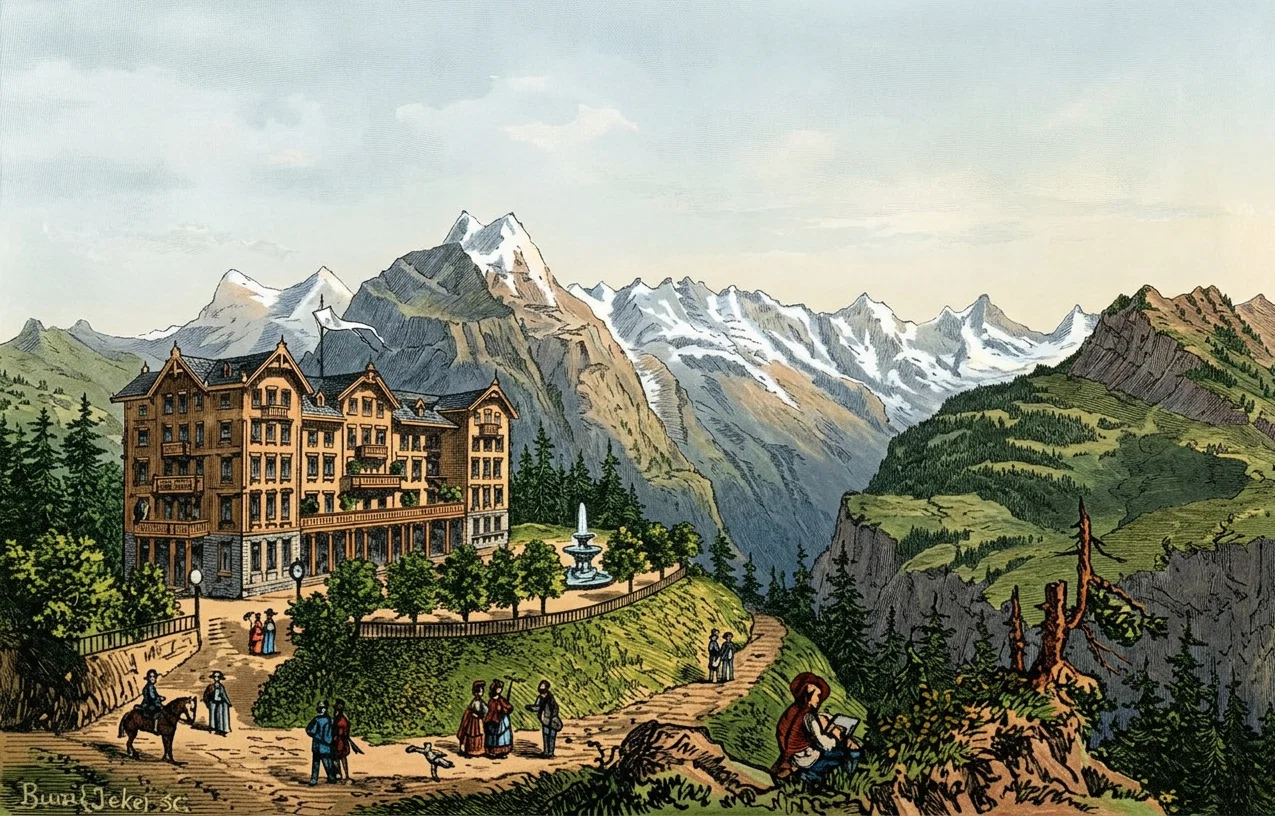
MUERREN NEAR LAUTERBRUNNEN.
In a former article, comparisons were made between some features of the broad extent of the United States and la petite Suisse. If we come a little more to details, we notice quite a contrast in some particulars. Take, for instance, the canton of Bern, which, while it is next to the largest of the twenty-two cantons, having an area of 2,652 square miles, or one-sixth the extent of Switzerland, is only 276 square miles larger than one county of the United States, where a county has thirty-six townships each six miles square. Except the counties of New York and Philadelphia, there is not one in the United States which comes within several thousands of the 532,200 inhabitants of this canton; and were they not of the most frugal in their living, subsistence would be impossible, for imports are scarce.
In the watch business, 14,000 persons gain their livelihood, making about 1,000,000 watches annually, most of them silver; 2,500 more work in linen factories, and one small section alone, at the foot of the Alps, has 2,000 sculptors in wood. Of cotton, woolen, silk, and gun factories there are more than a dozen; also several iron foundries, fifteen match factories, and the largest parqueterie in Switzerland. (A parqueterie is where the fine woods are prepared for their noted inlaid floorings.) Its plateau produces more grain than the canton uses; its nine hundred cheese-factories turn out for annual export 12,500,000 lbs. (worth over $3,000,000), and its net-work of fifteen railroad lines connect its principal towns with all points of the continent.
All these industries, as well as farming and stock-raising, are carried on by the common people, some of them with the improved methods of modern invention, others in the rude ways of their forefathers, and are located within the limits of this canton, which stretches away from the frontier of France on the north-west in irregular shape, nearly sixty miles in a south-easterly direction over the mountains, gorges, and valleys of the Jura range, across its central plateau, taking in the highest heights of the world—the famed Bernese Alps at its southern boundaries. Here we get away up into the sixth region, among the peaks of eternal whiteness and intensity of cold, the beautiful Jungfrau, Wetterhorn, Breithorn, with all the lesser horns, and Finsteraarhorn, the father of all, rising above them to the proud elevation of 14,000 feet,—up where Wurer, an American tourist, who, on the route from Zurich to Meiringen, had frequently remarked, “This is nothing to Yosemite,” standing in the presence of the indescribable grandeur and beauty of these majestic Alpine monsters, awed to silence, forever laid aside his references to even the wonderful Yosemite. Truly, to appreciate, one must see.
Leaving now these summits in their sublimity and awfulness, we descend among the great fields of ice and snow, the glaciers, which seem as immovable as the rocky peaks above them, but in reality are moving a few inches daily, carrying along in front and in their depths great rocks and quantities of soil which they have scraped off the mountain sides in their onward course to the valleys. Still lower down and farther away, we come to a section presenting the most fascinating and infinitely varied attractions to the admirer of beautiful landscapes.
Here the Aar passes through two small lakes, Brienz and Thun; and between them, situated on the river, with most romantic surroundings, is the little town of Interlaken, which, with its suburban villages, has a great number of hotels and restaurants, for the accommodation of tourists. Every summer they entertain more than 25,000 visitors, mostly foreigners, English, Americans, and others, who spend from a few days to several months here, meanwhile taking in the wonderful sights and sounds around, and out in the mountains, as they are physically and financially able to do. One of these sights is the cascade of Staubach at Lauterbrunnen, pouring its large volume down 940 feet over a perpendicular mountain wall, the rocks and velocity breaking the water into a beautiful foamy whiteness.
Near Lauterbrunnen is Murren with its hotels, up where it is so cold that in winter no one remains, and from which during summer many a party goes out to visit the Alps, whose snowy summits appear in the background.
Farther north in the canton, near its center, is the capital of Switzerland, Bern, which is also one of the largest and finest cities of the country. It is a very old city, being now on the eve of its eighth century, and has nearly fifty thousand inhabitants. Among its distinguished and learned men of the past, we notice Albert the Great. Its federal palace, the finest public building of the country, contains the assembly rooms of the National Council, the Council of States (cantons), and the Federal Council.
Some may be interested to know something of their government, and I will mention a few points. The supreme authority is vested in a Federal Assembly formed by a union of the National Council and the Council of States. Its members, of whom with the present population there are 189, are elected by the people for a term of three years. Each canton is entitled to one delegate to the former council, for every 20,000 inhabitants; and to two members for the latter, regardless of its population. The executive power is exercised by the Federal Council, the seven members of which are elected by the joint action of the National Council and Council of States under the direction of the president of the former. The president of the Republic is president of this Federal Council; but while the other six members have a term of three years, he is limited to one year, and cannot serve two years in succession. Necessarily, therefore, his influence and authority are much restricted; and do not imagine that these impulsive Swiss voters ever get into a frenzy over a presidential election. It isn't worth while.
The Swiss flag is of plain, deep red with a square, white cross in the center, and the national motto reads, Un pour tous, tous pour un, one for all, all for one.
Government, State, and city statutes regulate the conduct of citizens and foreigners down to very minute details, and are rigidly enforced; some of them to the discomfort or disgust of Americans especially, since they were never in their lives accustomed to being so much protected and governed. In general, however, the laws could not justly be unkindly criticized; and many of them, for instance those looking to the protection of life and property, might be adopted in America with great advantage.
Concerning railways, they are such that a railroad catastrophe is almost an unheard-of occurrence, and would be more startling than the news that an avalanche had buried a village, or a score of people had gone down an Alpine precipice to an unexpected grave. Walking on the railroad track is never tolerated, and at every crossing in city and country the highway is barred for each passing train, day or night.
Safety from fires is also very effectually secured by laws both as to the construction of buildings, heating included, and visits of officials to examine chimneys, furnaces, and stoves. No part of an iron stove can stand less than 60 centimetres (almost two feet) from a wall plastered on lath, or a baseboard, casing, or anything in wood; and kitchen floors must be of stone or tiling, if not of bare ground. A violation of any of these laws, or a failure to obtain permission of proper authorities even when a stove is to be set up or moved, will be punished by fine or imprisonment if discovered, which they are about as certain to be as that the births and deaths in a family will be ascertained by the census-taker.
Their heaters are earthen, glazed outside in colors, green, brown, etc., or in pure white; some are round, others square or oblong. They are built up in stories, in size and height proportionate to the rooms they are to warm. They usually stand in a corner and generally are quite ornamental with their shining surface, some of them flat and smooth, some figured or ribbed. The fireplace, suitable for both coal and wood, is in the first story, which rests either upon a flat stone laid on the floor, or is furnished with legs usually the same material as the stove. The latter style is of late coming quite generally, into use, and the brass band where the stories of the round stoves join,222is not necessary with the more modern oblong and square styles, which are laid up in blocks, after the manner of brick work. A house is not complete till all its stoves are in; and they are stationary, that of the kitchen being almost invariably built into the wall at one side. Thus Swiss tenants never have vexations with fractious stovepipes when moving, as roving Americans have.
With most families, one fire in the morning is all they can afford for the day, as coal and wood are high priced; but as these fourneaux heat slowly, and with all the dampers closed hold heat for hours, the people manage to keep comfortable with their warm clothing and the double-windows hermetically sealed. But the odors within, especially in the houses of many generations—oh! I like these heaters much better than iron stoves. They do not so burn the life out of the air, nor is one in danger of singing fingers and clothing with the least touch, though they be ever so hot. However, I did not stop with a morning heating up, and besides had good ventilation; hence kept warm, and had fresh air to breathe.
I wish to tell you something about the northern part of the canton of Bern, but this must be reserved for another time. ADDIE S. BOWEN.