COAL FORMATIONS

8%

S. D. A. Publishing Association · Battle Creek, Mich. · Nov 28, 1888

FromThe Youth’s Instructor, Vol. 36, No. 48.

Read the full edition

COAL FORMATIONS.

In previous articles we have learned something of the process of mining coal. The query naturally arises, What is coal? We are told, by those who have studied the matter most, that it is the mineralized remains of a strange vegetation which must have grown and flourished in the earliest periods of the world's history. It must have existed, too, at a time when there was one settled climate all the world over; for wherever coal deposits are found—from Spitzbergen to the center of Africa, or from Greenland to Guinea—everywhere the vegetable matter of which they were formed, has been found to be precisely the same, and this could not have been, had the climate then been as variable as it now is.
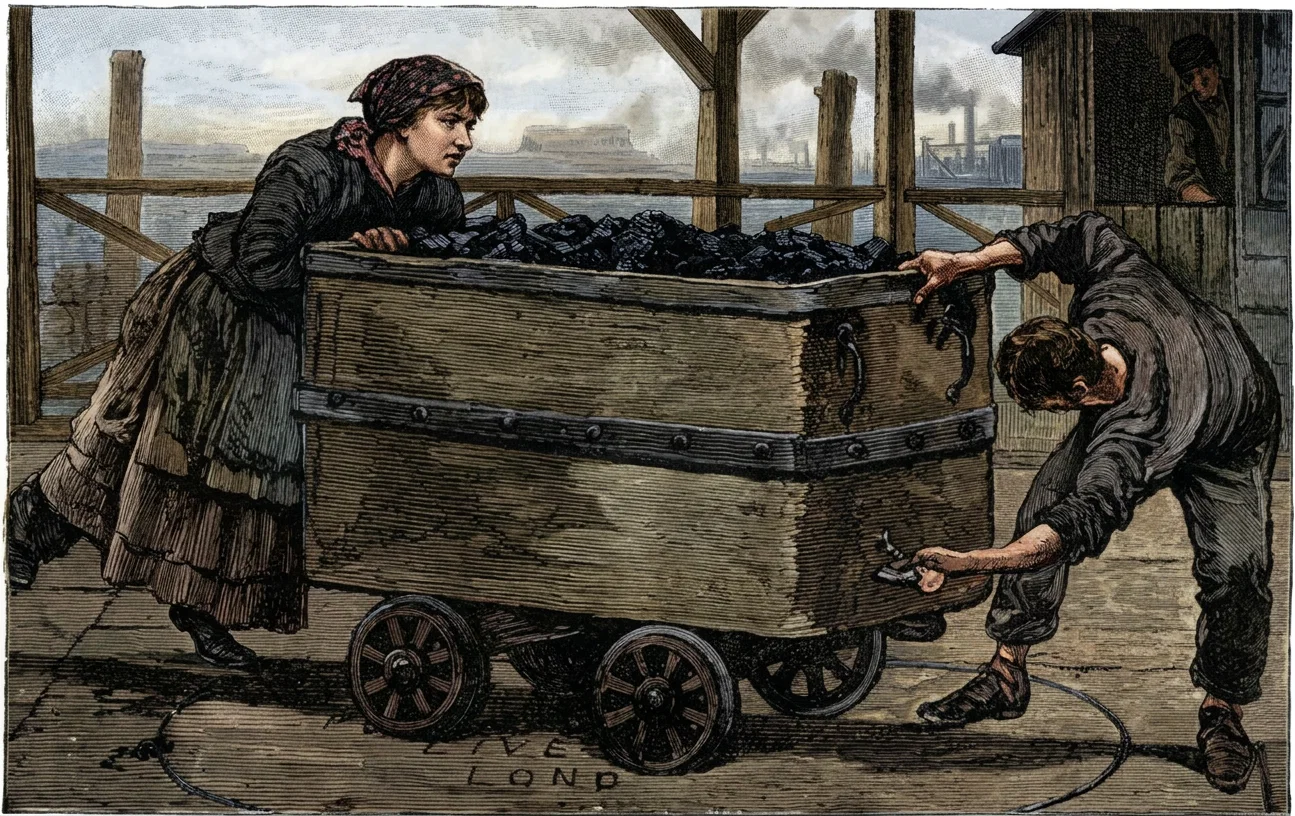
WEIGHING COAL AT THE MOUTH OF A PIT.Restored with AI
WEIGHING COAL AT THE MOUTH OF A PIT.
The vegetation of those days was different from that which now grows in a temperate climate like our own. In the limitless coal seams, are now traced the outlines of monster trees pressed close together, filling the solitary forests with the rankest foliage. Ferns, shrubs, mosses, water-plants, and slender little weeds are all traceable in the huge coal beds of the different countries.
A traveler in the tropical forests of the East, or in South America may be able to get some idea of the ancient flora that now forms the coal beds of the world. In those countries, with their moist, hot climates, may still be seen the same kinds of giant palms, immense water-rushes, strange looking shrubs, and tangled undergrowth of weeds, that once flourished in the long, long ago throughout the world.
In some cases the shrubs and trees have been found standing upright, and so complete that their limbs and leaves were traceable. Sir Charles Lyell tells of a bed of coal in a quarter of England, where, within a quarter of an acre, there were found no less than seventy-three stumps of trees, all their roots still attached to, and forming a part of, a seam of coal ten inches in thickness; and this resting on a layer of clay two inches thick, under which were two other forests separated in the same way, and forming beds of coal.
Strange as it may seem, by some process, vegetation has been transformed into beds of coal. But how was it done? The scientific answer of the chemist would perhaps be, that wood will become lignite, or wood-coal, by parting with its oxygen in the shape of carbonic acid gas, and then it can pass into ordinary bituminous coal. This explanation, however, may not be satisfactory to all our readers, without an illustration to show how such changes take place.
An apparatus was once used by which a mass of sawdust was compressed and enveloped in moist clay, and exposed to a long-continued warm temperature. By this means the gases and vapors arising from the vegetation were allowed to escape in such a way that the decomposition of the organic matter took place while the mass was warm and saturated with moisture, and at the same time under so much pressure as to prevent the separation of the elements of which it was composed. In due time the sawdust of different kinds of wood produced substances resembling various kinds of coal. This may explain why there are so many kinds of coal, hard and soft, now found in our markets.
The fact that layers of clay are found between beds of coal, shows that at some time deposits of earth have, by some action of the water, been spread over the primitive forests. These deposits of earth brought about the same process as related in the experiment quoted, producing the present coal deposits. There was opportunity for this breaking up of the forests, and their being covered with layers of earth, when the flood swept the world from one end to the other, and the “fountains of the great deep were broken up.” In fact, it seems quite probable that this was the time when such deposits were made.
When we stop to consider another thing, it seems doubly sure that this is the proper conclusion. We have already referred to the fact that everywhere the traces in the coal deposits show the same kind of vegetation. We have also seen that these are the same kinds of vegetation that thrive only in a warm, moist climate. Then when we think that the climate before the flood was of just this kind, it is easy to determine that this was the period when the deposits were made. Again, we learn from the Bible that before the flood no rain had fallen, but the ground was watered by a mist which ascended from the earth. This would show that the climate was in just that moist condition which would produce the kinds of vegetation of which all the coal deposits are formed.
The probable reason why these beds of coal are now found at such various depths, some being almost on the surface of the earth itself, is that they have been disturbed by volcanic movements, which have shaken and changed their places and positions, sending some lower, and raising others to all sorts of angles. Had it not been for this, man might not have discovered these valuable commodities.
J. O. C.