SOMEBODY was quarreling in the next room. The door stood ajar, so that the words could be plainly heard. A voice cried,—it belonged to a small boy ten years old,—“Give that here, Myra Barton; that’s my ball, and you’ll spoil it.”
“I won’t either spoil it,” a girlish voice crossly replied.
“Yes, you will!” and a lively scuffle took place, ending in a fall over the sofa, with a bumped nose for Myra, and a bruised pate for Joe.
Mrs. Barton laid down her book. “What shall I do with those children!” she exclaimed, as she arose to bring peace again into the play-room.
Joe and Myra were twins. Joe really thought that no girl was so good as his sister Myra, and Myra was sure no boy was equal to Joe. But they both had quick tempers, and both were selfish; so almost every day, in the play-room or out-of-doors, a small scrimmage took place.
Before Mrs. Barton had crossed the room, a knock sounded on the door. She answered it, but there was only darkness without. She shut the door. In a minute the knock came again. It was louder this time, and she was sure some one stumbled over the doorstone. But no one answered to the cordial “Come in.” Peering into the darkness, nobody could be seen.
“That is very strange,” remarked Mrs. Barton, as she closed the door.
“Better look again,” said grandfather, rousing from his nap by the warm fire.
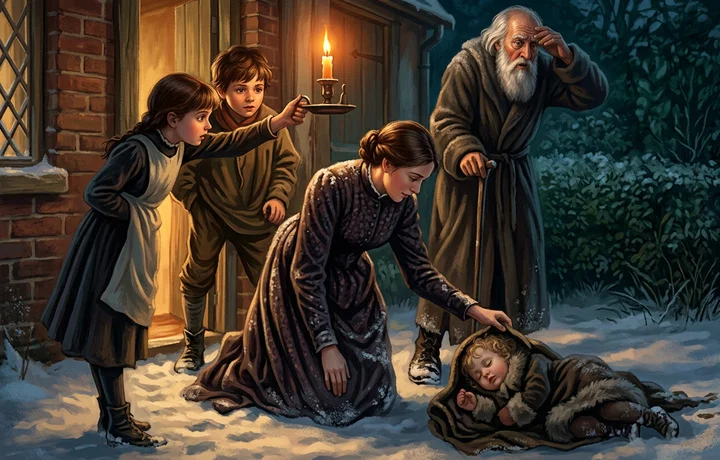
Mrs. Barton opened the door. “Myra, bring the light,” she cried; “here is a bundle I didn’t see before. What can it be?”
With curious, eager haste, the children followed their mother. What Mrs. Barton saw by the light of the candle was such a surprise that she dropped down on her knees in the snow. “A real, live baby!” Joe exclaimed. “Hush! you’ll wake her,” cautioned Myra. “Poor little one!” said Mrs. Barton, as she saw two pearly teardrops on the soft cheeks, and heard the little waif sob in its sleep. “One of the Lord’s own,” said grandpa, hobbling out to get a sight at the stranger. “What can we do with her?” asked Mrs. Barton, when the first surprise was over. “Well,” said practical Joe, “I don’t think I should let her lie there in the cold.” “Do keep her,” said Myra. “Yes, take her in,” added grandpa; and into the house she was brought. Roused by the warmth and noise, baby opened her blue eyes, and gazed with wonder on the strange faces. “Where can she have come from?” asked grandpa. “Why, I declare, I forgot to see if I could find anybody round the house,” said Mrs. Barton, starting up.
But search and questioning in the neighborhood for several days alike failed to reveal anything. The little stranger was there, and evidently liked to stay; and that was all anybody knew about it.
“Well,” said Mr. Barton, setting his coffee-cup down with some emphasis one morning, as the door closed behind the twentieth caller who had come to express neighborly sympathy, “this thing must be stopped. You are wearing yourself out, my dear, with all these curious people; and we will have to put on your tombstone, ‘Died of neighborly kindness.’ Are we, or are we not, going to keep this child?”
Mrs. Barton caught her breath. “I suppose we might as well decide one time as another,” she replied. Then she added, “How would it do to let the children help in the matter?”
“A very good idea,” their father answered.
Myra and Joe looked sober. It was seldom that they were allowed a voice in family councils.
“Do you think you would be willing,” said Mrs. Barton, looking at them seriously, “to share your playthings with the baby? I suppose, too, you would have to go without some things if we should keep her; for papa cannot very well give us any more money than we have now.”
Joe leaned back in his chair, and thrust his hands into his pockets. That meant, he thought, to go without the new skates he wanted; may be he couldn’t have a jackknife, and may be,—worst of all,—he couldn’t have that pair of red-topped boots he had set his heart on. His face grew longer as he looked at the baby.
“I suppose,” said Myra, who always did her thinking out loud, “she’ll break my dolls—and I’ll have to let her have half my new ribbons—and she’ll want to tug ’round when I go anywhere.”
Papa Barton gave Mamma Barton a queer look that meant that he thought it was high time something happened to cure these two small people of their selfishness.
Mamma Barton understood it; and turning to the twins, she said, “But would you really want to send baby to the poorhouse, where she will get sick, and may be die because there would be no mamma there to take care of her? That is what we shall have to do if we don’t keep her.”
The twins remembered a visit they had made to that desolate house one day.
“No, ma’am,” said Joe, “I don’t think I should want her to go there.”
“Nor I,” said Myra, with a shiver.
“Well,” said papa, “there is another thing to be thought of. Baby will grow, and want to do everything you do. Do you suppose you can be pleasant and kind and obliging; or will you teach her to quarrel and be selfish?”
The twins looked very much confused.
“I will try to be good,” said Myra, who was readier always to promise than Joe.
“How about you, my boy?”
“I’ll do it,” said Joe, at last, emphatically.
“Well, then,” said Papa Barton, “we’ll call it settled, and baby shall stay.”
Papa Barton wasn’t mistaken in the good he thought the little stranger might do. It was pleasant to see Joe’s awkward attempts to be gentle and win the little lady’s favor, and to remember to shut the door softly when she was asleep.
And in Myra an equal change could be seen, as she learned to be unselfish, and to take a motherly care of the little waif.
“I think,” said Mrs. Barton one night a year afterwards, “that every day could be a thanksgiving day with me when I see how much more kind and gentle the children have grown.” W. E. L.