All over the world live little boys and girls. They are sometimes naughty and sometimes good, sometimes glad and sometimes sorry, sometimes they laugh and sometimes they cry, just as the children in America do. They have warm, human hearts, and like to be loved. We sometimes forget that when we talk about their queer ways.
In our picture are a lot of little Chinese boys and girls. In picture No. 1 is a little girl. She looks bright and happy. But I do not believe you would look as contented as she does if you lived in her place. The fact is, Chinese girls do not have a good time. Their parents are not glad to have girls in the family. They think it is of no use, because it is a great expense to bring up a girl, and when she has grown old enough to be useful, she is almost sure to get married, and go away from home. So the people do a very dreadful thing: they drown hundreds of girl babies every year, just to save the trouble of bringing them up.
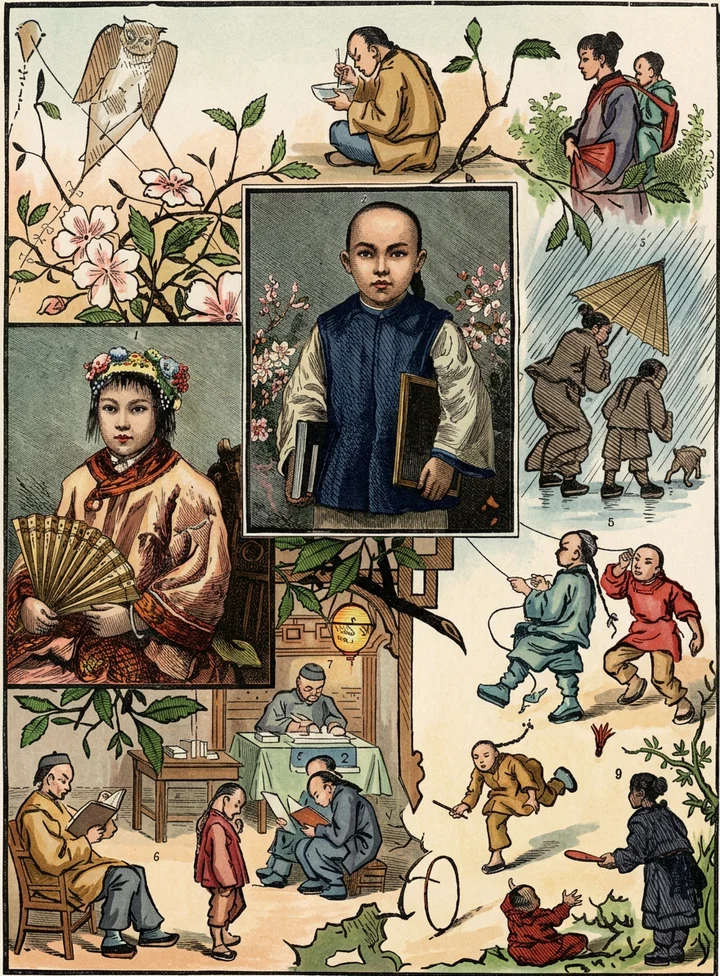
The little boy in No. 2 is a Chinese student. In the lower left-hand corner, you can see the school-room. He goes to school for the first time when he is six years old.
When you see a printed page of the Chinese language, you must remember that those strange characters are not letters, but that each one is a word. The Chinese have no alphabet. So the first thing a little boy has given him when he goes to school is a book called the Sun tsze king, a Chinese primer. It is an easy book, made up of short sentences of three characters each.
As he grows older, he studies harder books, but all of them have to be learned by heart. And in this way it happens that although he goes to school a great many years, he never learns anything but to repeat the words just as they are in his book. He does not learn to think for himself.
At the top of the picture you can see how the Chinese mothers carry the babies, in a hood fastened to the back.
In picture No. 3 is a boy eating his dinner. He is eating rice soup. He has no spoon with which to dish it up; but he holds the bowl close to his mouth, and with two long, smooth sticks, called chop-sticks, he manages to keep a stream of rice soup going down his throat. I am afraid that if you had no other way than this of eating, you would starve before you could learn to handle the chop-sticks.
Down in the right-hand corner are some Chinese playing games. Once every year the Chinese, old and young, keep a curious festival. They go upon the house-tops or upon the highest ground near the city, and men as well as boys spend the whole day flying kites. Nobody knows how this festival came to be kept in the first place.
This people keep many festivals, one for almost every month in the year. They make a great ado at New Year's. Every body feels bound then to settle up his business, even though he has to sell everything in his store for less than it cost him, before he can do so. They offer many sacrifices to their gods, and have great rejoicing. On the last day of the old year, boys go up and down the streets shouting, “I will sell my idle ways.” I suppose they want to begin the New Year aright.
However many of the commandments the Chinese break, because they do not know the true God, and what he wants us to do, and them as well, there is one that they keep very carefully. That is the fifth one, which says, “Honor thy father and thy mother.” Every morning, when a little Chinese boy gets up, he washes and dresses himself very carefully, and then goes at once to his father and mother to know what they would like him to do that day. All through his life, that is, until his father dies, he is expected to be just as dutiful and just as obedient as when he was a child. When he is married and has a family of his own, he cannot do anything which his father says he must not do. And middle-aged men meekly take floggings if their aged fathers think they ought to have them. Indeed, the old men are often severe, and may cast their sons into prison if they disobey them.
So I suspect the little Chinese boys and girls are more often obedient because they are afraid of the punishments than because they love their parents so much that they want to mind them. God wants us to be obedient because we love to do it, and not because we will be punished if we do not do so. Don't you think this world would be a happy place if all the people were good because they loved to be good?
W. E. L.