LONG, long time ago, yes, many hundred years ago, there lived, in a far away country, a very rich man. He could not have been so rich as King Solomon, because the Lord said to this king that he would "give him riches and wealth and honor, such as none of the kings have had that have been before him, neither shall there any after him have the like."
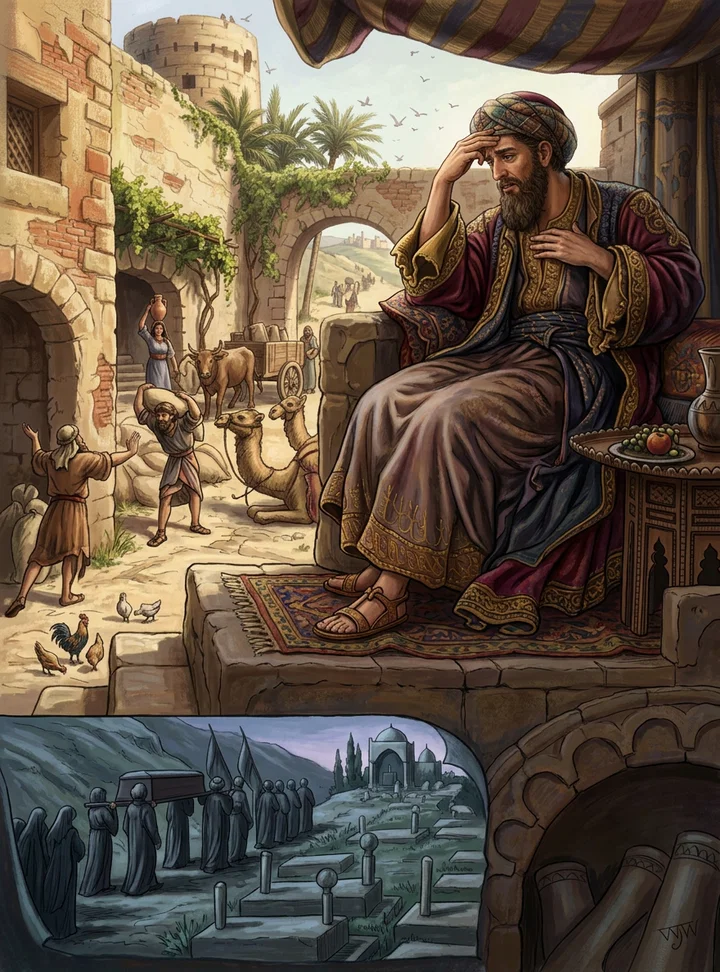
Nor do I suspect he was so rich as Croesus, king of Lydia, whom the Greeks said was the richest king then living. But the man of whom I am telling you had large possessions, and his fields were so well cultivated that they produced great crops of grain and fruits. In fact, his immense farm yielded so bountifully that he was really puzzled to know what to do with a year's produce.
After studying over the matter a good deal, he decided that he would tear his old barns all down and build new ones, large enough to hold his yearly crops, which, gathered from his extensive possessions, would be enough to last him many years. Then he would let his land rest, while he would take life easy.
Why couldn't he do so? With enough laid by to eat and to drink and to wear, and money to spend as he liked, why need he be perplexed any more for a long time?
He settled the matter, that he would not; that he would get things in good shape, throw off all care, and eat, drink, and be merry, as he pleased.
If you noticed the heading of this article, you saw that this story was about a "rich fool." Wouldn't you think he reasoned like a smart man? Let us see. Just as this man had his plans all matured and was anticipating many years of happiness, he died very suddenly one night. He had spent all his thoughts and his strength in accumulating riches, and had set his heart wholly upon them, making no provision for anything beyond. His riches all passed to others, who had no regard for him farther than to get possession of his money. Besides this, and most deplorable of all, he had run up a great debt in the bank of heaven; for he had not had God in all his thoughts. He had buried his talent of wealth, had wronged the widow and the orphan, had defrauded the laborer in his hire, and had robbed God of his tithes, etc., etc. Do you see any good reason for calling him fool?
By the term fool is not always meant a simple-minded person, one of weak intellect, an idiot; but it oftener means one who moves unwisely, acts rashly, contrary to good judgment. Some persons show well-balanced minds in some matters, while in other things they seem to be very lacking in good sense. Belonging to the latter class there are a great many foolish people in the world.
Do you know of any one's ever acting more unwisely than the man in the story? Don't you think fool is an appropriate name for him? But it was the Lord who named him thus, and you have in the above story the parable of the rich man, as found in Luke 12: 16-21.
Some others may not have so much wealth to take up their thoughts as did the man in the parable, and at the same time may be making just as foolish a mistake as he. Why wouldn't the name of fool be just as applicable to one who lets anything else take his thoughts and affections from God? Are you sure that you have nothing that separates you from him? nothing that is absorbing your thoughts and affections so that you justly deserve the same title as the rich man? Don't think lightly of those things that affect your eternal destiny. If fool must be applied to your name, let it be only that you are one for Christ's sake.
M. J. C.