GLIMPSES OF SWITZERLAND.—NO. 8.
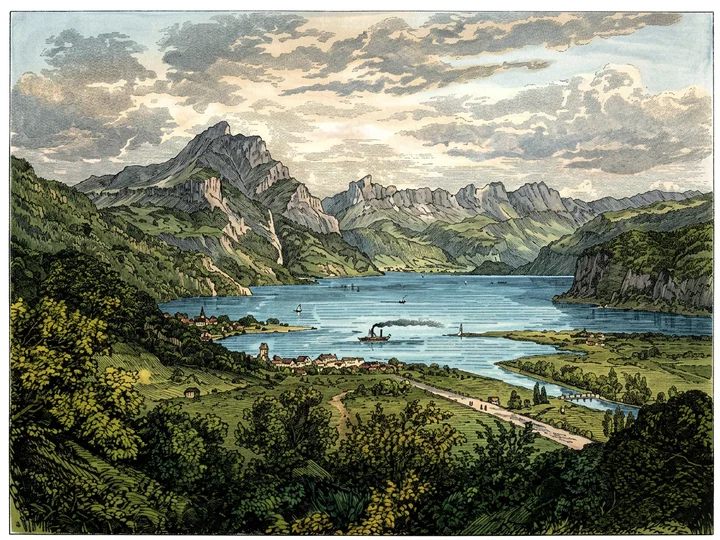
Before continuing farther with incidents of the trip mentioned in the preceding article, let us return to eastern Suisse, not to be astonished at, and admire its wonderful sights, of which there are many; but to consider an instance illustrative of the fact that with other excellent qualities of the Swiss, they have real philanthropy and enterprise. A few miles northwest of Ragatz, at the head of Lake Walen, is a town called Walenstadt. In the picture you see a part of this lake, with a chain of the low Alps in the canton of St. Gall in the background, while in the foreground there is a large canal for drainage, and a wide, smooth street leading to the village beyond. Strasse is the German for street, and stadt is town or city; thus you get the meaning of Walenstadtstrasse.
A hundred and twenty-one years ago, a little German boy named Johannes Conrad Escher was born at Zurich. His father, an eminent judge, chose for his son some place in government affairs, but his life work proved to be of a different nature. After finishing his preparatory course at the home school, and taking a course at Geneva, where he learned to speak the French fluently, he spent two years in untiring study at the celebrated university of Göttingen, in Hanover. Then he visited the principal manufactories of England, and took an important business trip to Italy. During this time, the French Revolution began to involve Switzerland in its turmoils, and for some time Escher figured largely in politics, as an editor of a popular paper entitled Le Républicain Suisse.
But his extensive studies and varied experience until this time were fitting him for a noble work of great value. Referring to this, I quote from Monsieur Ch. Didier:—
“A new career opened before him when there was a question of draining the swamps of the Linth.* Stripped, little by little, by tempests and heavy rains, of their soil, the mountains bordering the river had for centuries poured their spoils into it. Wherever the river bed was shut in by walls of rock, the strong current carried all this débris before it; but where the valley opened, and the channel was not only wider, but near the level of the surface, this accumulation from the mountains had considerably raised the river bed, and each year frightful inundations occurred, . . . and the overflowing torrent had at last converted a large share of the most fertile part of the canton of Glaris into an unhealthful marsh. . . . Pestilential miasma carried death to the very summit of the mountains. . . . Intermittent and putrid fevers reigned periodically over a vast extent of territory. . . . The evil seemed without remedy; for the effort to be made was far beyond the resources of the people, a simple pastoral tribe, brave, energetic, but poor and few in number. This great evil required a great remedy; then a man was found who comprehended the situation, and who executed what he had conceived. That man was Escher.”
After many unsuccessful attempts, he appealed to the nation for assistance, and an association with Escher as president, was formed. A grand beginning was made, when suddenly he was abandoned by all of those who had promised to support him. But, firm in his grand project, he never gave it up, and finally moved to the scene of his labors. “He put himself at the head of the workmen, and devoted a part of his fortune, and sixteen years of his life, to this memorable enterprise. As thorough a geologist as he was skillful and persevering an engineer, he commenced by digging a new channel for the Linth; he conducted it to the lake of Walenstadt, giving it a descent of forty feet to each thirteen thousand, which sufficed to render all clogging of the stream thereafter impossible. . . . All these labors, which may be called gigantic, if they are compared with the resources of the country, and the obstacles to be met, were, with the blessing of God, the work of Escher. Those unhealthful marshes are to-day tillable. Health has taken the place of fevers, and life reigns where before death reigned. . . . When Escher reached the victorious end of his patriotic enterprise, the gratitude of the public, late though it was, knew no bounds. . . .”
“Loved and venerated of all Switzerland, Escher enjoyed his renown. But although he was still young, his health failed from day to day, in consequence of his great labors. It was noticed that his health remained unchanged during the progress of the enterprise, and only began to decline after the victory.
“He died at Zurich the 9th of March, 1823. There was then a general mourning, and his name is still held in veneration by the Swiss.”
A memorial building and school carrying out some of the plans and purposes of Escher, was established on a section of the very territory he had reclaimed, with a view to extend and perpetuate his principles and memory. This little story gives not only some of the characteristics of a leading man of his time, but also a glimpse of the enthusiastic appreciation of real merit on the part of the people and their substantial way of manifesting it. Another instance of this we see in the careful preservation of memorials of Zwingli in his native town, among them the house where he was born, over at Wildhaus, not far from the little lake in the picture.
Speaking of their appreciation of the noble, the beautiful, the grand, reminds me of a thought that has presented itself as I have tried to give some idea of the Alps and other Swiss scenery. It is, that it may appear to some that there is too much said about these, but if such could hear the native inhabitants talk of these features; if they could know of the constant and inspiring pleasure they give to even those accustomed to daily views of the wondrous, changeful beauties and endless varieties of magnificence of the Alps; if they could see how eagerly they seek to catch glimpses of them from all parts of the country; then I think all preceding references to them, and those which follow, would not seem extravagant nor too numerous.
Now to return to the trip in western Switzerland. I secured a circular ticket, good for sixty days, from Basle to Lausanne via Berne and Fribourg, to return via Neuchâtel and Bienne, which, by taking third class, cost a little over three dollars. This was for a distance of nearly four hundred miles, and over a route including many of the finest views in the country. It required some effort to secure a non-smoking compartment, but most of the way, it was done. Many of the Swiss cars are, like those of England, partitioned off crosswise into three compartments, each having two seats facing each other, and a door at each end of the passage between them. Thus these seats run across the car, and the car doors (six of them) are at the sides, not the ends. Each compartment comfortably seats ten persons. Other cars are nearly like ordinary coaches in America, and of late years they are using, more and more, imported Pullman sleepers. Incidentally, I will mention here that our people in Suisse habitually travel third-class, often to save expense.
At various points along the route, I had excellent views of the Alps. But from Berne I caught the most striking, the grandest sight of the high Alps, Jungfrau, Finsterahorn, etc., that I could ever hope to see. I shall never forget the impression upon my mind, when, on making a sudden curve, just before running into the station, my gaze unexpectedly took in, as a blaze of glory, their broad extent of shining whiteness, and jagged summits reaching high into the heavens, as they were lighted up by a bright afternoon sun; apparently they were just across a narrow valley, really they were about forty miles away. Even with knowing that the clear atmosphere of that beautiful day presented little obstruction to the sight, I cannot comprehend how they could seem so near when actually so far distant. Indescribably grand this rare Alpine view—for frequently tourists remain at this point many days hoping to catch something such an unveiling of their magnificence—stamped ineffaceably on memory's walls, one of the loveliest pictures which can ever be placed there! ADDIE S. BOWEN.