THOSE who began at Via Mala, and have in imagination taken the trips through Switzerland as indicated in the preceding articles, have, as will be seen by looking over a large map of the country, touched at nearly all the points most interesting to tourists. They have called at various wild and romantic gorges, fresh and green valleys, been rested by the loveliness of calm and picturesque lakes, felt the exhilarating effects of the clear, bracing air of mountains and rushing torrents, all the way around from Basle to the Rigi in the northern central part, Wallenstadt and Ragatz in the east, Bern, the Alps, Geneva, Lake Léman, Neuchâtel, Bienne, and the Juras in the south and west. From many elevations all along we have had entrancing views of the majestic and sublime Alps,—from between fog-clouds straining eager eyes to catch every peak visible, in a morning light, in afternoon brilliancy, in sunset gorgeousness of coloring and artistic shadings,—and at varying distances, sometimes near their very feet, again from thirty to one hundred miles away.
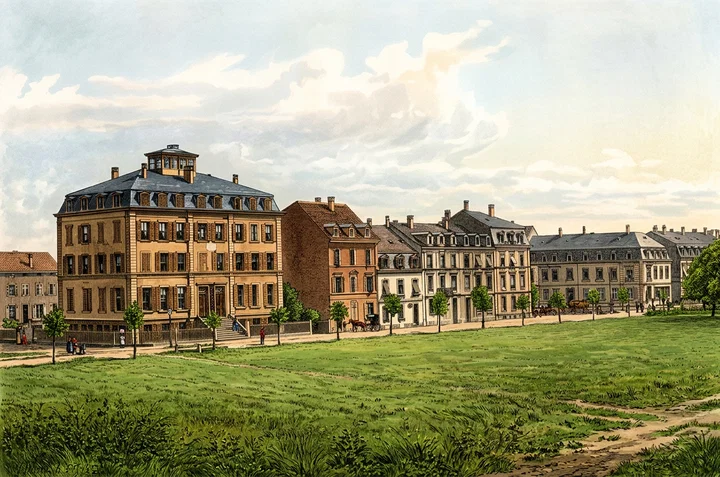
Now let us return once more to Basle and to Weiherweg, on which, as before mentioned, and as is shown in the cut, our publishing house of Central Europe is located. Just east of it, at the right in the picture, the railroad leading out into Germany crosses the street, and farther east and north lies the main city, which is also the oldest part, and presents a decidedly “foreign” appearance. At the west, on Weiherweg, is another large new building owned and occupied by our people and for the Conference school opened there last spring.
A little way to the north are the rooms first occupied by the Central European Mission family and the publishing work in its infancy some ten years since, 68 Müllerweg. To accommodate the increasing work, they moved from here to more commodious quarters at the corner of Belchenstrasse and Wieherweg, where the type-setting, proof-reading, etc., also that part of the printing which could be done by a large hand-press, were done. Here Eld. Andrews laid down his earth-work, and others carried it on as best they could.
Soon the work required more room, and in 1885 the large building you see at the left in the illustration was completed and occupied. This house is about 75 by 45 feet, and built of stone. The corners, two columns in front, also the door and window frames, are of cut stone, but the main wall is of common masonry of quarried stone laid from the basement up to the mansard roof. This wall is about four feet thick at the base, being gradually drawn in to about one half that thickness at the top of the third story. Both sides of the walls are plastered. Outside, the last coat is a mixture of drab-tinted paint and plaster, spattered on with a brush in a way to give a nice finish, resembling a kind of cut stone, a coating quite impervious to the weather.
Some of the workers have rooms here, and half of the first floor is a meeting hall for the Basle church; but the publishing work is increasing, and it is to be hoped that it will soon require the whole building. When the photograph was taken from which the illustration was made, it was desired to have some things characteristic of the country represented; so for one thing we arranged a basket which one of the office girls, formerly accustomed to carrying weights thus, put on her head, and stationed herself at the corner as you see her. The contents of the basket consisted mainly of a duvé,—a large sack of light cloth filled with down, for a bed-cover. These, when well kept, are comforts which many in cold climates would esteem luxuries, for they are light, fluffy, and warm, and not, as some have represented them, soggy, foul feather beds.
In building blocks they have an odd fashion of leaving one end rough and unfinished ready for the proprietor who next adds a house, to join his to it; thus the former outside wall becomes only a thick partition between the two houses. A distinction between houses of the same long block is made by varying the shade of paint, or other arrangement of the outside finish, and frequently there is quite a variation in hight or style of roof. A partial idea of how the rough end of an incomplete block looks, can be formed from the appearance of the house next to the office, though it is not really plain in the picture, for instead of carrying out the Swiss plan in extending this block out to the corner, an alley was left, so their rough wall and roof without cornice remain exposed to view. Light colors or white are used throughout the country for outside finish, and the plaster is painted or white-washed down to the ground, no foundation stones left uncovered. This gives the towns especially, a much pleasanter appearance than where everything is built of red brick, and left with the natural color,p. 22 which with age becomes dingy and dismal-looking, as in England.
The training ground, of which the lower extremity appears in front of the Basle office, is daily used by citizens who have, while younger, passed the required time yearly for several years in training for soldiers, and are now compelled by law to keep up their practice as marksmen. At six every morning, and again after business hours, men come up from the city, and as they fire volley after volley at the stationary targets, the result of which is carefully recorded, and as drills of more or less moment occur weekly, occupants of the office have no opportunity to forget that wars have not yet ceased. All of their warlike preparations, however, are simply defensive, for although Suisse supports a large standing army, and her able-bodied citizens everywhere are kept in practice, and subject to a call to arms at almost any time, it is only to maintain her neutral position among the great European powers.
The opinion that the Swiss have a peculiar and fantastic national costume probably has its foundation in the fact that artists have generally chosen to represent them in their holiday dress. It is true that each canton has its distinctive costume, one for each sex, and on fete days and other special occasions these curious garments are brought forth. Some have a white waist with long and very full sleeves, and over this a velvet bodice or high girdle decorated with bright trimmings. The skirt is of other material, and is also more or less elaborately trimmed. A showy head-dress and fanciful slippers or shoes complete the outfit; other cantons have other combinations. But these costumes are rarely worn. I have seen the crowds on various public fete-days, and at the “inaugural” of a new railroad, etc., and except at carnival time have seen but very few of these strikingly peculiar costumes.
Peasants, or country people, and the working classes generally, are recognized by a uniformly plain dress,—the men appear in a straight, loose blouse, usually of blue cotton, which reaches below the hips, generous-sized pantaloons, a common straw or felt hat, and heavy boots; the women in a plain skirt and loose basque, also with heavy shoes and almost universally bareheaded. These so generally have a load of some sort to carry on their heads, they could hardly attempt to wear bonnets or hats. In Basle I have frequently seen women on the street in winter bare-headed, but with their hands in a muff, and sturdy matrons sitting in the market-places with only the protection of a shawl and an extra pair of large wooden or heavy leather shoes, lined with wool, waiting for customers to buy the vegetables, eggs, etc., they have brought from home on their heads or wheeled in a cart. To be sure, a Basle winter is mild, yet with fine weather a farm-wife of America would deem it beyond endurance to help herself and family as do many of these Swiss mothers.
In cities all the fashions are seen as in America, and in features, complexion, and general appearance, the majority of the people are fully equal to Americans in the same classes of society, while in intelligence and ability they are not inferior. In stature the average is below the average in America and some other countries.
As to language, there is no distinct Swiss language, as some suppose. There are three distinct languages, and each is more or less prolific in dialects. The German especially abounds with them, and not infrequently it occurs that peasants of one canton cannot understand that of the one next to it. These dialects are so far from correct language that an educated German who has not learned the dialects can scarcely understand or make himself understood among those who use them. The French also has its patois, or dialect. Nearly three-fourths of the people are German; the greater share of the remainder are French, and about 200,000 are Italian and Roumanian. In religion, some 20,000 are Jews and Dissenters, while two-fifths of the whole population are Catholic, and nearly three-fifths are nominally Protestant; but Protestantism here bears a marked likeness to Catholicism in ceremonies and forms of worship.
The Swiss, although generally poor, are large-hearted and generous; they make it a practice to give something, though it be but little, to every one in greater need than themselves. They are impulsive and warm-hearted, have great love for kindred and home, and are extremely jealous for the honor and well-being of family relations. They are fond of music, and greatly appreciate the beautiful in art and nature. One finds lovely plants and flowers in almost every yard. In profusion, variety, and beauty, I never saw anything in roses to equal those of Suisse.
It would seem that with the fine tastes, industriousp. 23 and frugal habits of the people, the country might be filled with the finest homes everywhere, and indeed there are a great many. But it must be remembered that in a majority of cases, indulgence of the appetite for strong drink and tobacco absorbs quite a proportion of their small earnings; again, the land is government property, and although not exceedingly high-priced, the great majority of the people can only rent of the capitalists who own a great share of the tillable land, and rent is rather high; then if we deduct the moderate proportion of one-third of the whole area as that part of mountainous regions which is untilable, we have an average of 270 persons to be supported by each square mile, provided farming were the only means of support, and we know this is the only safe basis in estimating the real capacity of almost any country to sustain its inhabitants for a long period.
In this series, I have given many details in order to give the reader as clear and correct ideas as I could, perhaps at the risk of being tedious. In closing, I can but wish, however, that some pleasure and profit may have been afforded as we have caught these glimpses of Switzerland.
ADDIE S. BOWEN.