WHAT MAKES SNOW

3%

S. D. A. Publishing Association · Battle Creek, Mich. · Feb 6, 1889

FromThe Youth’s Instructor, Vol. 37, No. 6.

Read the full edition

WHAT MAKES SNOW.

Four little noses were flattened against the window panes. Four dismal faces looked out at the fast falling snow, and four little hearts were as heavy as the leaden clouds. Two whole days indoors was too dreadful for anything, so the children thought. There was one warm motherly heart that thought so too.
But by and by the snow storm seemed tired out, and only a few great feathery flakes came slowly down. Then mamma brought out caps and coats, arctics and mittens, bundled up four eager little people, and turned them out-of-doors.
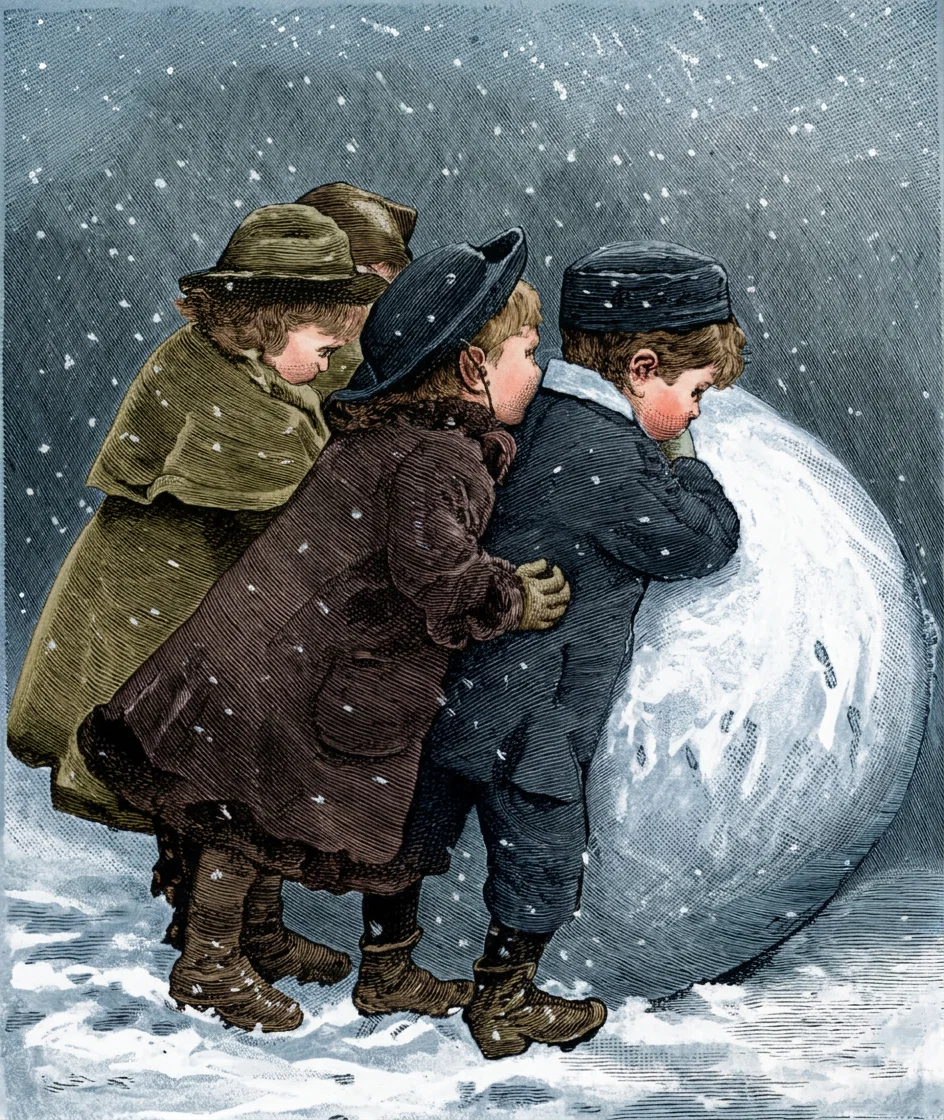
Such a frolic as there was, as the four tramped up and down, made wheels and zigzags on the smooth surface, and shouted themselves hoarse! They began a snow man, but by the time the tea-bell rang, they had only got one great big snow-ball rolled up for a foundation.
Restored with AI
“Oh, see me smoke!” exclaimed Johnny, puffing out his breath, which curled in a frosty wreath above his head.
“Just like old Jacob’s pipe,” said Mabel. And at once four small faces were puffed and red in the effort to see who could make the largest cloud wreaths.
“Come, come! children,” called mamma from the door; “the bell rang ten minutes ago.”
Four reluctant pairs of feet turned towards the house.
“I say, papa,” said Fred, throwing his cap into the corner, and kicking off his overshoes, “what makes a fellow’s breath come out all white, like smoke, outdoors?”
“Well,” returned his papa. “I should like to have you put your cap and overshoes in the proper place before I answer your question.”
“I beg your pardon,” answered Fred, whose mamma had taught him to be as polite to his own folks as he would be to strangers, and he hurried to put the misplaced articles into the closet.
“What makes the smoke?” said papa, when Fred returned. “Your breath is warm and moist, and when you breathe into the cold air, the cold condenses the moisture in the warm air you breathed, and it makes a tiny cloud.”
“Oh,” said Johnny, breathing on his chubby red fist, “the breath is warm, but I don’t see any moisture in it;” and he looked as if he thought papa was joking.
“Just try it on the window that is farthest from the fire,” returned papa, noticing his doubting look.
Johnny went to the corner of the room, and breathed on the window-pane. His breath made a little blur on the glass, and presently a tiny stream of water trickled down.
“It’s so,” cried Johnny, pointing to the water drops, while all the children ran to try what they had tried a hundred times before but never thought about.
Then they sat down to supper, and papa supposed the matter was forgotten.
But he was mistaken. For Fred, who was more thoughtful than the others, had, in the evening, been quietly amusing himself by breathing on the corner window. As the cold had steadily and rapidly increased since sunset, the breath from Fred’s mouth, and the steam from the tea-kettle on the stove, had covered the window with beautiful frost pictures.
“It is very warm here,” said mamma. “Fred, please let down the window.”
Fred climbed up on a chair, and gave the window a push. As he did so, tiny particles of snow sifted down into his face.
“I say, papa,” said Fred again, “what makes it snow?”
“I thought you had forgotten all about such things,” his papa replied. “The same thing that made your breath turn into cloud-wreaths makes snow.”
Fred looked puzzled.
Papa explained. “Cold air cannot hold as much moisture as warm air. The wind that comes from the sea is warm. When it blows over the land, it strikes cold air from above the land, and that makes the moisture in the warm air gather into clouds. When the land air from the mountain-tops and other high places is cold enough, it freezes the vapor into little particles, and we have snow; when the land air is not so cold, the moisture comes down in rain.”},{
“You can see that it is so by remembering how your breath acted on the glass. Before supper, when it was warmer outdoors your breath stood on the glass in tiny drops; now the air outside is much colder, and your warm breath turns to frost on the windows.”
“It is very warm here yet. I think,” said papa, “that we can make it snow in the house.”
At this all the children started up, and mamma laid down her sewing.
“Snow in the house!” said Johnny, running to the window. “It is just as still outside, and the sky is all bright, and the moon shines.”
“So much the better,” said papa; “for now we can be sure that this snow does not come down from the sky.”
The air indoors was steamy from the boiling tea-kettle. Papa went to the window Fred had let down and pushed it up. “We must wait till it is a little warmer in this corner,” he said, and in a few minutes he called out, “Now, children, look;” and he opened and shut the window very quickly. Fine snow particles fell down into the upturned faces.
“It came off the window itself,” said Johnny, who was never ready to believe anything that was told him.
“No, it didn’t,” said Fred; “for the wind and snow came from the other way to-day, and this window is as dry outside as it is inside.”
“Fred is right,” said papa, who saw Johnny was going to dispute him. “The cold air rushing in through the open window met the warm, moist air that tried to rush out, and condensed the moisture, so as to make the tiny particles of snow. If the air were more moist inside, we could make snow that you could see plainer.”
“To-morrow is wash-day,” said Fred; “and I mean to go down to the kitchen when Ann boils the clothes, and see if I can make snow myself.”
“That is right,” papa replied; “when we can do so, it is very useful to try the experiments we learn about. Then we will know for ourselves that the things are so, and we will remember them longer.” W. E. L.