Many people suppose that the Indian children have no dolls or pets. This is a mistake. The Indian baby, or pappoose, is provided by its squaw mother with a sort of doll from its earliest infancy.
The baby itself is tied to a board which is covered with buckskins and fanciful bindings, or with bright-colored cloth ornamented with bead-work and tinsel. This baby-board, which is carriage and cradle in one, looks like the toe of a large slipper, and has a piece of wood bent across the head to protect its little copper-colored occupant from being struck by anything. Just as her convenience may prompt, the squaw hangs her pappoose, thus cradled, on her back while walking, or in a tree when working about the tent, or on the saddle pommel. From the protecting head-board hangs suspended the doll, made of feathers, beads, and red cloth, perhaps representing an Indian warrior. The little pappoose looks at this dangling image all day long, and this monotonous endeavor often causes a horrible squint from which the Indian never recovers.
The squaw mothers sometimes make tiny pappooses, bound to cradle-boards in fancy covering, like their own, for the older children to play with; but it is a still commoner sight to see the girls carrying a puppy in a little blanket over their shoulders. It seems strange that they should make of their pets what is considered the greatest delicacy, puppy-stew, which is the chief dish of a feast given when a child reaches a certain age.
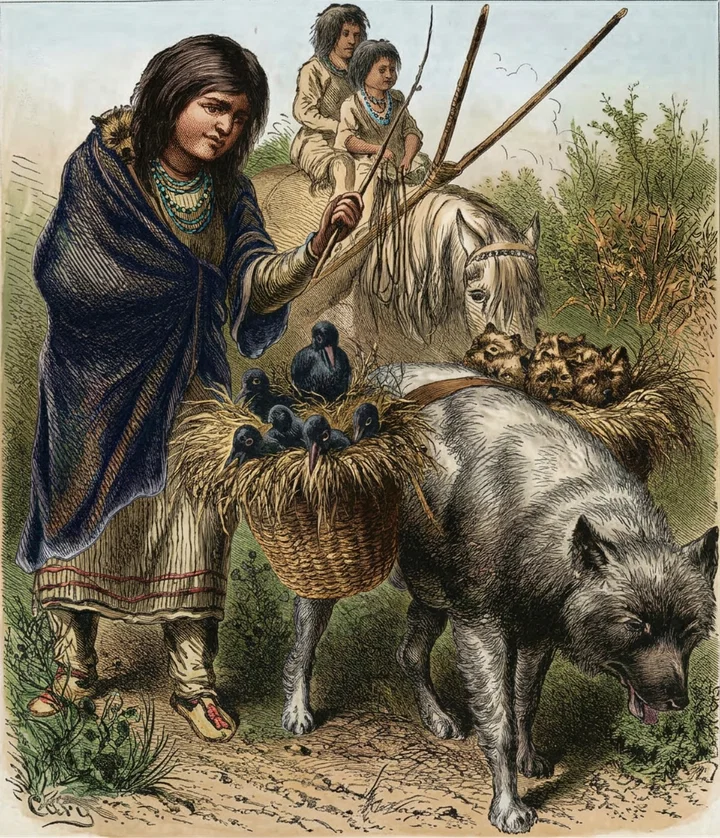
The little Indians also make pets of crows. A little girl will often daily carry about with her a wicker basket filled with crows just as they are taken from the nest by her brother. Beside her an old dog will often be wiled along, dragging her puppies in a similar net or basket, stretched across transverse poles.
The Indian boys have pet colts to ride; and they make pets of young eagles, which they put on a sort of stand with a string attached to one leg to prevent the birds from flying away.
The boys also learn to use the bow and arrows, and are often occupied in driving blackbirds and cowbirds from the growing maize.
Corn is the only vegetable cultivated by the Indian; and the Chippewas, who are semi-civilized, grind their corn into a sort of coarse samp by pounding it in a mortar with a wooden pestle. They also roast the ears and dry them for winter use.
Great groups of children will sit with a squaw (perhaps mending moccasins), who helps them at their work and preserves order. They sit on high platforms the whole day, overlooking the corn-fields, so as to drive away birds as they alight in flocks.
The older boys amuse themselves by different games while tending the horses. First they spread upon the ground a buffalo hide on which they kneel facing each other. Then one takes a little stick and passes it from one hand to the other, first behind and then before, while the other boy guesses which hand it is in. He is entitled to three guesses. The first, if right, counts him three; the second, two; and the third, one. If he misses altogether, he loses according to the number put up for stake. The one guessing makes his guess known by hitting his right or left shoulder, according to the hand he thinks his opponent holds it in.
This, like all other Indian games, is made interesting by the stakes, which generally consist of some ornament, or some service to be rendered.—From Wonder Stories of Travel.