It has been estimated that the steam produced by one pound of good coal will, when applied to an engine, do as much work in a day as a man. Reckoning 300 working days in a year for a man, and thirty years for his working life, we see that he works only about 9,000 days in all his life-time. If it be true that one pound of coal represents one day's work, then it requires only 9,000 pounds, or four and a half tons, of coal to represent the entire life-work of a laboring man. This seems almost too wonderful to believe, and yet we know that coal is a great labor-saver when used in producing steam.
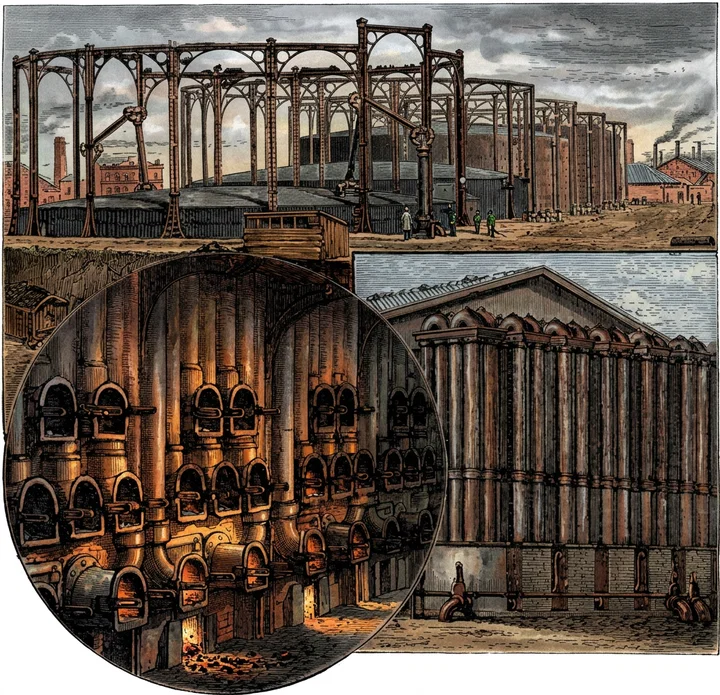
But coal is used for another purpose, which we will notice: that is, for making gas with which to light streets and houses in our cities. Gas is produced by what is called “distillation.” The coal used is first placed in “retorts,” or large ovens, strongly built, and lined with fire-clay. These ovens are built in rows, as shown in the lower left-hand corner of the picture on this page, and are heated from furnaces below, the flames surrounding them with an intense heat.
When the retorts are filled with coal, their projecting mouths are closed by iron covers screwed tight, and are plastered over with wet clay to make the ovens air-tight. At the end of every four hours, the retorts are opened, the old coal is raked out, and a supply of fresh coal is thrown in.
If we could look into one of these retorts when it is first opened, we would see that the coal put in four hours before is one fierce glowing mass, from which the gas has been extracted. The hot gas has passed off through iron tubes connected with the retorts into what is called the “condenser.”
The condenser may be seen in the picture at the right of the retorts. It consists of numerous upright pipes, joined at the top, and standing in pairs over a large cistern, into which the ends of the pipes are inserted. Connected with these upright pipes are others, which are kept cool by means of cold air or water. Through all these, from one to another, the gas is forced, until it becomes chilled, which separates from it all the liquid vapors it brought with it from the retorts. These, when separated from the gas, thicken and condense, and fall into the cistern below, from which they pass, through a pipe, into what is called the “tar-well.”
The gas must then pass through a purifying process to relieve it from the presence of a most nauseous and unwholesome part called “sulphuretted hydrogen,” before it is stored ready for use. The usual way of doing this is to conduct the gas through a pipe into a perforated iron cylinder, which is placed in water thickened with lime. The lime attracts to itself the obnoxious matter, while the purified gas rises to the top of the reservoir, and is passed into the gasometers, where it is stored until needed for lighting purposes. These are shown in the upper part of the cut.
All who have seen the large, boiler-shaped gasholders which are connected with all gas factories, know that they are made of iron plates, firmly riveted together. The lower ends of these tanks are not closed, as at the top, with iron, but the tanks are in the form of an inverted tumbler, whose mouths set down into the water, thus shutting off the escape of gas.
When the gasometer is dropped low down into the water pit, like the nearest one in the cut, it is because it is empty, or nearly so, of gas. But as it fills with gas, it rises in the iron frame which surrounds it, and when its top is nearly even with the frame, it is full of gas. As the tank empties of gas, it lowers into the water, which takes the place that was before occupied by the gas. Then of course when the tank fills again with gas, it lifts out of the water to make room for the gas.
About two hundred years ago, Robert Clayton, of Cork, by experimenting with coal, learned how to extract the gas from it. His experiment was then looked upon by most people only as a curiosity. Afterward, in writing about his discovery, the bishop said: “I kept the spirit [gas] in bladders, and when I had a mind to divert strangers or friends, I have frequently taken one of the these, picked a hole therein with a pin, and compressing gently the bladder near the flame of a candle till it once took fire, it would continue flaming until all the spirit was compressed out of the bladder, which was the more surprising because no one could discern any difference in appearance between these bladders and those filled with common air.
The bishop's experiment was much talked of by some, and was indeed brought to the notice of the Royal Society. But that body did not consider it of enough importance to warrant their taking any definite action toward making it a useful discovery. There were those who even thought it possible to manufacture gas from coal on a grand enough scale to light houses, and perhaps the streets of towns; but the theory was laughed at by others, while scientific men opposed it on the ground that its use would be very dangerous.