In tropical countries where periodical rain-falls saturate the earth, the variation and profusion of vegetable life seems almost limitless.
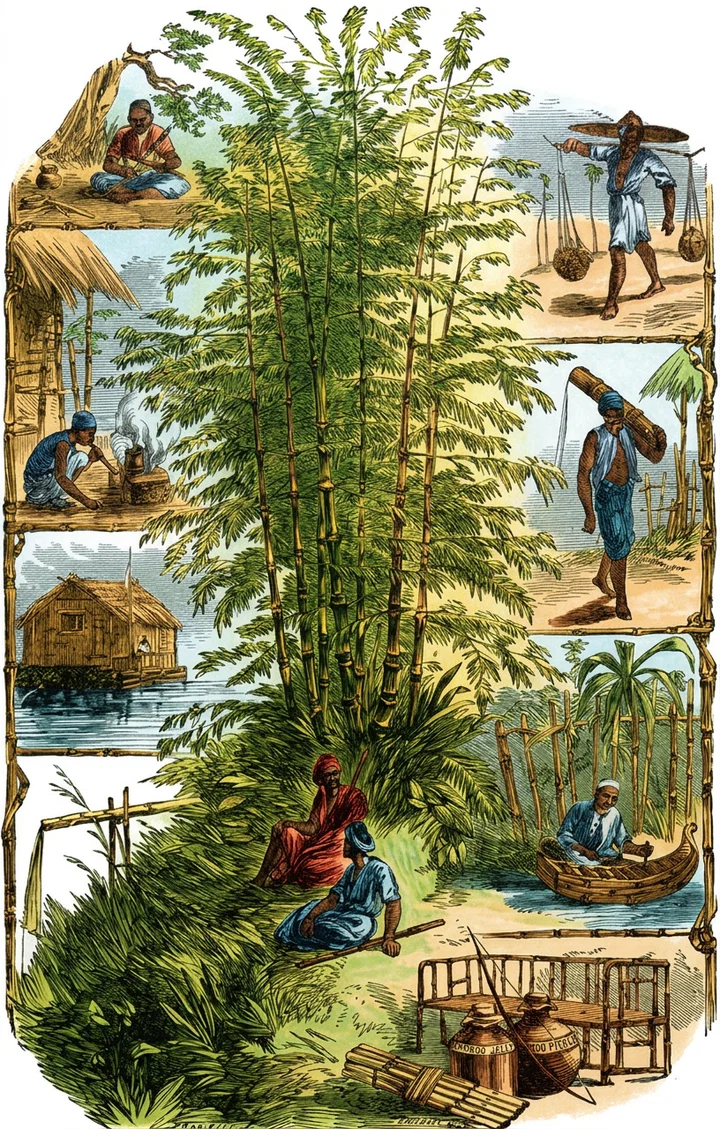
The trees are put to a variety of uses to which it would be difficult to adapt any one species of the temperate zone. Perhaps the most useful of these is the palm. “Palms in unending variety of form and fruit,” says one writer, “present the most striking feature of a tropical scene. The masses of the people in our own latitude get their daily bread, literally, from the grass family. Here palms furnish the people with food, clothing, and building material.”
But no less useful than the palm is the bamboo, found in nearly every part of the tropical world. It belongs to the grass family,—one of those arborescent grasses,—half grass, half tree. Its jointed stems are formed not unlike those of the wheat and other grains; but they shoot up to a hight of forty, sixty, or even eighty feet, taking on the woody nature and appearance of a tree.
The bamboo is remarkable for its rapid growth. Says a well-known writer, “In the Royal Botanical Garden of Edinburgh, a bamboo was observed to increase six inches a day in a temperature of from 65° to 70°. The Bambusa gigantea (gigantic bamboo) of Burmah has been known to grow eighteen inches in twenty-four hours; and as the Bambusa Tulda in Bengal attains its full height of seventy feet in a single month, its average increase cannot be less than an inch per hour.” “The culms (or single stems) attain a thickness of six inches, the single joints are twenty inches long, and the leaves are of indescribable beauty. . . . Sometimes a hundred culms spring from a single root, not seldom as thick as a man, and towering to a hight of eighty or a hundred feet. Fancy the grace of our meadow grasses, united with the lordly growth of our Italian poplar, and you have a faint idea of the beauty of a clump of bamboos.”
In India, China, and the East Indian Archipelago, the bamboo is cultivated with great care. Shoots are placed in a pit two feet deep, in the autumn or early winter, and the pit filled with rich soil and sulphur. All growth for the first three years is cut back, but the shoots of the fourth year are allowed to grow.
All this care is well bestowed upon the bamboo, which is put to an almost endless number of uses. The tender shoots in spring are served up like asparagus. They are salted and eaten with rice, preserved in sugar as a sort of jelly, or made into pickles. The seeds of this plant are also used as food.
But it is the stem of the bamboo which is made most use of. Bows are made of it, the light, slender stalks serving as arrows. The larger joints form water buckets, and the smaller ones bottles; the Dyaks of Borneo using them as cooking vessels. Lengths of bamboo are made hollow, joined together end to end, and serve as pipes to carry water.
Bamboo is also useful as timber, and many houses are made entirely of this material. For posts and columns, undivided stalks are used. The split stalks form floors, rafters, and roof, and are woven into lattice-work for the walls.
And for the inside furnishings of the house, its uses are many; it goes to form all the furniture, baskets, cages, chairs, beds; writing paper is made from the inside pulp, and pens, or reeds, from the slender stems; and one Oriental species is so hard that it can be used for a knife, and is also employed as a whetstone. Indeed, the bamboo is “one of the most wonderful and most beautiful productions of the tropics,p. 38 and one of Nature’s most valuable gifts to uncivilized man.”
But we do not need to go across the seas, nor out of our own home to study the economy of Nature. Within a stone’s throw of our own doors the returning spring will soon work miracles wonderful beyond all telling, but unnoticed and unappreciated many times, because they are so silently performed. Who will have eyes to see what is done? W. E. L.