LAST summer Lynn moved from Florida to Canada. He had never seen any snow in all the six years he had lived. He could not think what it was like. He was impatient for winter to come.
It was summer time when he came to Canada. As the weeks flew by, the days grew shorter and the nights longer. The weather became colder and colder; and one morning he waked up to find snow on the ground. It was fluffy and white, like the soft down on his baby sister's cloak. He hurried to dress, and ran outdoors. But he found the snow was cold, and melted when he took it in his warm hands, or brought it into the house.
He could hardly wait to eat his breakfast. He was continually jumping down from his chair to run to the window. At last his mamma dressed him in his gay toboggan coat and cap, and sent him outdoors.
Lynn did not know much about snow. He thought he could walk off on top of it the same as he could on the ground. His mamma did not tell him anything about it; she thought he would like better to find out for himself.
Lynn ran off the clean-swept porch into a drift. He went into the drift up to his knees. The snow flew up on to his cap and into his eyes. “Oh! Oh!” he said. He did not know whether to laugh or to cry. You never saw such a surprised little boy. He looked up at the window where his mamma stood laughing. Then he laughed too, and his mamma came and helped him out. He wanted to wade in the snow all day, but she would not let him.
When Lynn's papa came home to dinner the next day, he brought him a queer present. At least, Lynn thought it was a strange one. His papa told him they were snow-shoes, and that after dinner he might put them on.
The shoes were made by bending a stout strip of hickory in an oval form. The ends of the hickory strips were fastened together in a point behind. The frame was made firm by stout strips of hickory, and the whole was filled in with strong thongs, or strips, of leather, netted together. There were straps to fasten the shoes on the feet.
Lynn said he did not want to wear such shoes. They were not pretty; nobody else would have such strange things on their feet. And he pouted, like a naughty boy, all through dinner time.
Papa laughed. “All right,” he said; “we will wait till some other day.”
It was more than two weeks before Lynn thought of his shoes again.
It kept on snowing for several days. The snow got quite deep. It was hard work for Lynn's papa to wade through it. It thawed a little, and froze a good deal. This made a crust on the snow that almost bore Lynn up.
Then Lynn's papa brought out the queer shoes. “Now,” said papa, “I will put on these new shoes, and show you what they are for.”
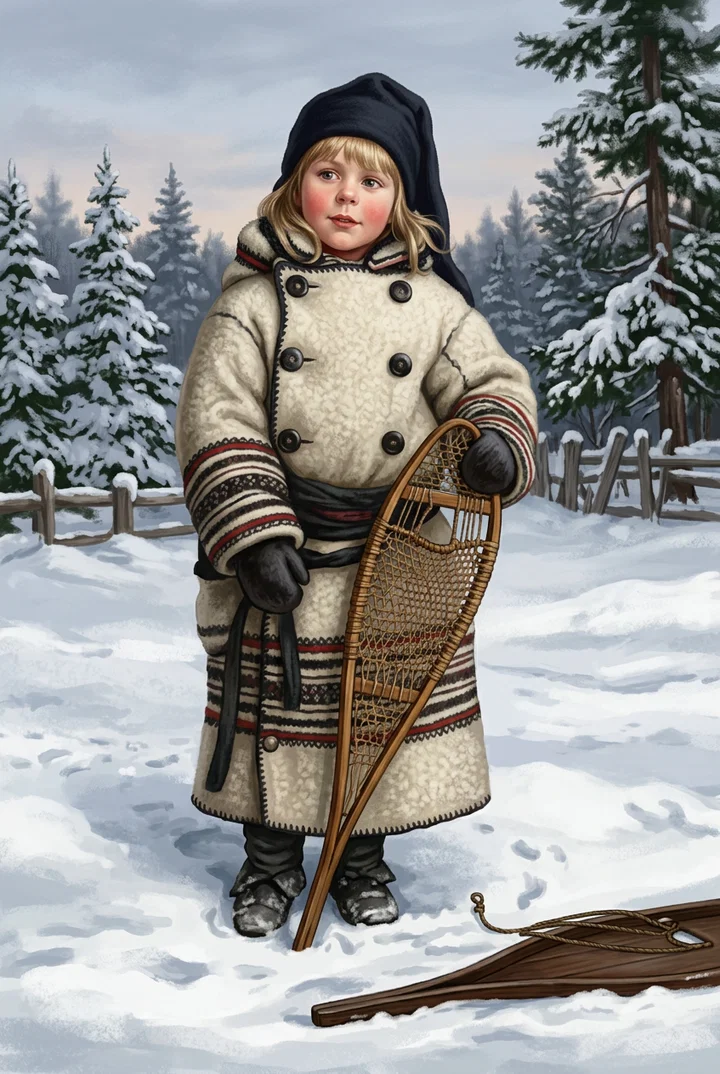
He strapped them on, and started off on the crust. Lynn was delighted. “Come back, papa! come back!” he shouted; “I want to put them on.”
Papa came back and put the shoes on Lynn. “Now go slowly,” he said, “and be careful not to trip up.”
“I can do that easy enough,” Lynn replied. He was not careful; he wanted to walk as fast as his papa did. The very first step he hit one snow-shoe on his ankle. It hurt, but he would not cry. At the next step he set the edge of one shoe on the other. Then he could not lift his foot; he lost his balance, and went over into the snow.
Papa helped him up. “It is not so easy as I thought it was,” Lynn said.
“Do you want to give it up?” his papa asked.
“No, sir,” said Lynn, “I mean to try it every day, until I can walk as well as you do.”
He has kept at it, and now he can walk on them very well.
Where Lynn lives, the winters are long and cold. The snow gets very deep, and the crust thick. The Indians and the trappers, and many other people, wear snow-shoes. If it were not for these useful articles, it would be very difficult for them to go anywhere.
W. E. L.