One would not think from the picture on this page that men and boys are the only fishermen. Well, we all know they are not. Some of the best fishers are found among the birds, among those four-footed animals that live partly in the water and partly on the land, and even among the fishes themselves.
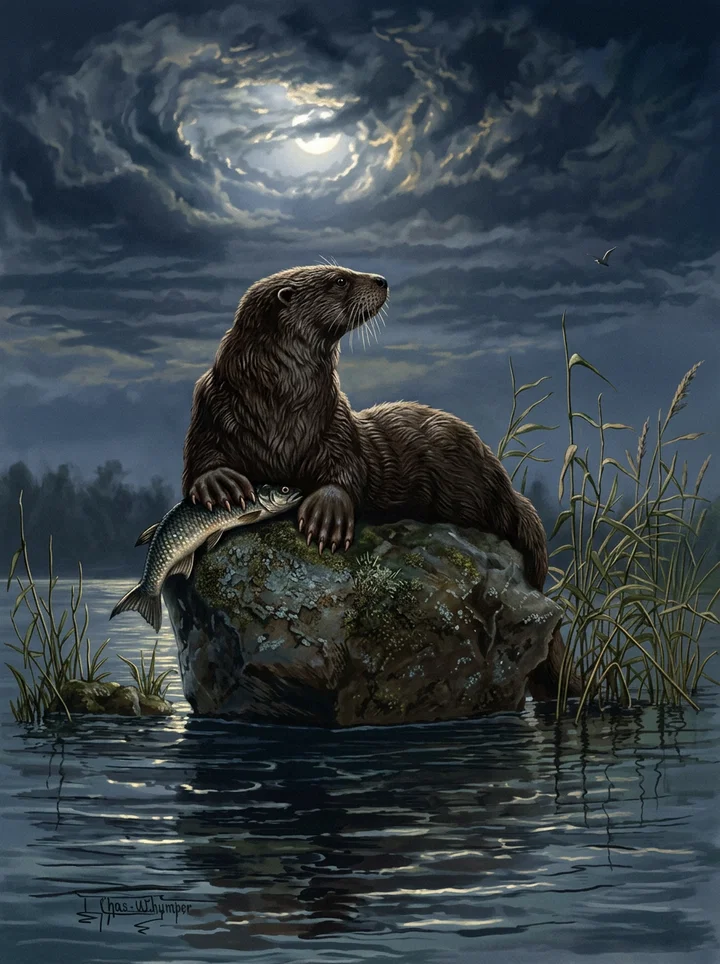
The fisherman in the picture is the otter. He can dive and swim like a fish, or he can breathe the air and live on the land as we do. He cannot live under water all the time, so he builds his house high above it. To keep this house dry, and to keep out dogs and other animals that might disturb his home, he has a cunning way of building.
He chooses a place on a stream where the banks are high; then he dives down into the water and begins digging into the bank, low enough down to have the door always under water, that no land thief may enter it. After digging into the bank a little way, he digs up, and up, sometimes making rooms two and three or more stories high, so that if the water should enter one room, he could move higher up. From the top of the highest room, he digs a little hole up to the surface of the ground, for ventilation. He manages in some way to line his rooms with reeds, grass, or rushes.
The otter eats only one meal a day, generally of fish, and that always at night, so he lies quietly in his house or on the rocks all day. But when he goes into the stream after his supper, you may be sure he makes it pretty lively for the fishes. He is such a perfect fisherman that it is almost impossible for them to keep out of his way.
If this animal is caught when it is young, it may be tamed. It will then follow its owner about like a dog, coming at a whistle from him.
In some countries tame otters are taught to fish for their owners. A man in England had one that would go out with him in a boat on the river, when it would jump overboard, and bring fish back to him. This it would do until the man was satisfied. If at any time the otter remained away too long, the man had only to call him by name, when he would return to the boat at once.
One day when the man was away from home, his little boy thought he would take the otter and go fishing, as he had seen his father do. All worked well at first, and the otter jumped into the river just as he did for his father; but he did not bring him any fish, neither would he come back, although he called his name repeatedly. And worst of all, he had to go home without the animal.
The father grieved for his pet otter, not expecting ever to see him again. But several days afterward, as he was walking along by the old fishing-ground, he called his pet by name, when, to his great joy and surprise, the otter swam out of the water, and laid himself down at his master's feet.
The American otter amuses himself in sliding down hill, the same as boys do. In some of the Western countries, where the soil is slippery clay, there are what are called “otter-slides.” The otter will go to the top of one of these, which is often so steep as to make it real hard to climb, and slide down as swiftly as a boy can. Once the celebrated naturalist Audubon saw two otters slide twenty-two times each down the bank of a stream that emptied into the Ohio River, before he disturbed them.
In the winter time they will climb to the top of the highest snowy hill, lie down upon their stomachs with their forepaws bent backward, and with their hind feet, steer themselves head foremost down to the stream below. They will play in this way until all tired out.
The otter is found in every part of the earth, but most plentifully in Europe and America. The European otter differs from the American in some particulars, but principally in size. While the European species is only two feet in length, the American is some four feet long. It has two coats of fur, one short, fine, and thick, through which there grows a thinner coat, coarser and longer, and quite glossy in appearance. Its fur is brown, and skins of the common otter are of considerable value; but skins of the sea-otter, in Europe, are valued at prices ranging from thirty to sixty pounds.
The sea-otter is much larger even than the common otter of America, the great sea-otter weighing seventy or eighty pounds. It confines itself more closely to the water than do the other kinds. It sleeps in the water, lying upon its back, the mother otter in the meantime holding the baby otter in its forepaws.
The sea-otter is very playful. Hunters claim that they have watched it full half an hour as it lay upon its back in the water, tossing a bit of sea-weed fromp. 42 one paw to the other, seemingly taking great pleasure in catching it before it should fall. It spends hours, too, in playing with its young.
Otters are all very affectionate, and sometimes grieve themselves to death at the loss of their young.
M. J. C.