We have learned in former articles of the difficulties under which people labored before the discovery of coal and the invention of the gas-light. We can, however, have little real idea of the difference between that time and ours, unless we can imagine all our modern improvements swept away, obliging us to do our work without them. Take the common match, for example. How many ever think how they would be obliged to get along if these had never been invented?
In primitive times, the only way known to “strike a light” was to rub briskly two pieces of dry wood together until the friction produced a fire. If any one wishes to know how tedious this process must have been, he has only to try it for himself.
Later, what was known as a tinder-box came into use. This was a small box in which was put very inflammable material, such as scorched linen. The box was then placed on a stand, or in some convenient position, and the person wishing a light held a piece of steel over it, and struck that with a slanting stroke, producing a spark of fire. This spark, dropping into the box, set fire to the tinder, from which a larger fire could be kindled.
But this was so much trouble that people sought a better way to start fires. In time there appeared “briquets phosphoriques,”—small metal bottles containing phosphorus and other chemicals. Into these were dipped little splints of wood tipped with sulphur, which, when withdrawn, slowly burned, because of the chemical action of air upon them. Although this was an advance over previous methods, it was expensive. Other inventions followed, but it was not till 1826 that a match was produced which would give instantaneous light.
It took a long time to bring these into public favor. Many objected to them on account of their strong smell, and also concluding that they must be very dangerous, they refused to use them. In England, especially, matches were not allowed to be made, unless the factory was removed at least fifty feet from all other buildings. The consequence was that other countries took the lead in manufacturing this useful article.
Sweden stood at the head of this industry, and for many years supplied all Europe with matches. It was the Swedes who first introduced what was called the patent safety match, which was warranted to “light only on the box,” and, as some wag suggested, “very seldom there.”
The match trade has now become an enormous industry in all countries, and matches of all kinds and descriptions are to be had everywhere for a mere trifle.
We will study the manufacture of matches for a few moments. First, a large pine log is sawn into lumber, the best and straightest of which will be made into matches, and the rest into boxes in which to pack them. That portion of the lumber designed for matches is planed and sawed into blocks a match-length long. These blocks are then placed in a machine in which are knives that split them into the thickness of a match. They are then returned through the machine, where they are again split, in the opposite direction, into the tiny square sticks that make the matches. These fall in a shower from the machine, and are gathered, by an ingenious machine, into rings of iron, where they are held separate from each other, yet fastened tightly in the frame, and the ends of them are dipped into a solution.
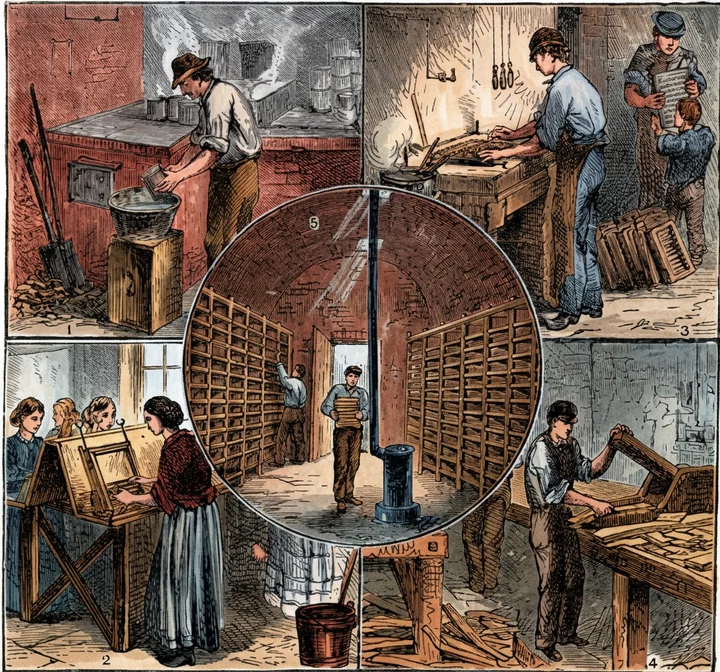
These frames, still containing the dipped pieces of wood, are then taken to the drying room. When dry, the matches are taken to the boxing room, where boys put them into the boxes in which we find them at the stores.
The accompanying picture shows how the work of making matches was carried on some years ago, before the perfected machinery of the present time was employed in their manufacture. That part of the cut marked 1 shows a man scorching the ends of the match sticks, before they are dipped in the solution; No. 2 represents a woman filling the frames with the sticks, preparatory to the dipping process; and No. 3 shows that process. No. 4 presents a man stamping the boxes, and No. 5 shows the drying-room, where the matches are dried after the dipping process.
It would seem to many that the manufacture of matches is rather small business; but when we stop to think of the millions upon millions of boxes that are used every year, we see that it must be a flourishing industry. In one year, Sweden alone sent out 134,616,448 boxes of matches, each box containing 100 matches. Considering that these are only a small part of the great number made every year, it shows that a large amount of timber must be worked up into these tiny fire-kindlers. J. O. C.