A GOOD many years ago, I cannot say exactly how many, a company of young people were making merry over a new poem by a certain young poet. The poem was called “The September Gale,” and the title certainly has a sober air, although the poem is an exceedingly merry poem.
That young poet was Oliver Wendell Holmes, and since that time he has written many merry poems to make people laugh, as well as some pathetic ones. “The Last Leaf,” which is both merry and sad, was a favorite with our beloved President, Abraham Lincoln.
Dr. Holmes (for he is a physician as well as a poet, essayist, and story-teller) was born in Cambridge, Mass., in an old house with a gambrel roof, which is still standing on the college grounds. Not long since, I walked around it; its lilac hedges were just coming into leaf.
In a little, old almanac, still in existence, this entry is made, dated August 29, 1809: “Son b.;” which means “Son born,” and it was written by his father, and that is the date of the son’s birth.
He is sometimes called our patriotic poet, because he has written so many patriotic poems and songs. The poem that first made him famous is a patriotic poem. Every American schoolboy has, sometime, to “speak” that poem; it is called “The Old Constitution,” and it begins this way:—
“Ay, tear her tattered ensign down! Long has it waved on high, And many an eye has danced to see That banner in the sky; Beneath it rung the battle shout And burst the cannon’s roar,— The meteor of the ocean air Shall sweep the clouds no more.”
The Government had made up its mind to take in pieces the Constitution, but the people said, “No! we cannot have the gallant old frigate torn in pieces,” and Dr. Holmes, then a young man, said so too in his fine verses, which were printed far and wide, and the Government changed its mind.
Dr. Holmes tells us that he wrote this poem in the white chamber of the old gambrel-roofed house, Stans pede in uno, which is Latin for “standing on one foot.” The verses are very stirring, and it is not to be wondered at that the boys like to “speak” them. It is a poem that everybody likes.
To this old gambrel-roofed house was attached an old-fashioned flower-garden, that is, a garden that had cinnamon roses, and blush roses, and garden lilies, and hollyhocks, and such old-fashioned plants. In course of time these plants disappeared, and the garden became grass-grown. And when the boy Oliver became a man, he remembered the old garden, and thought he should like to have it back again.
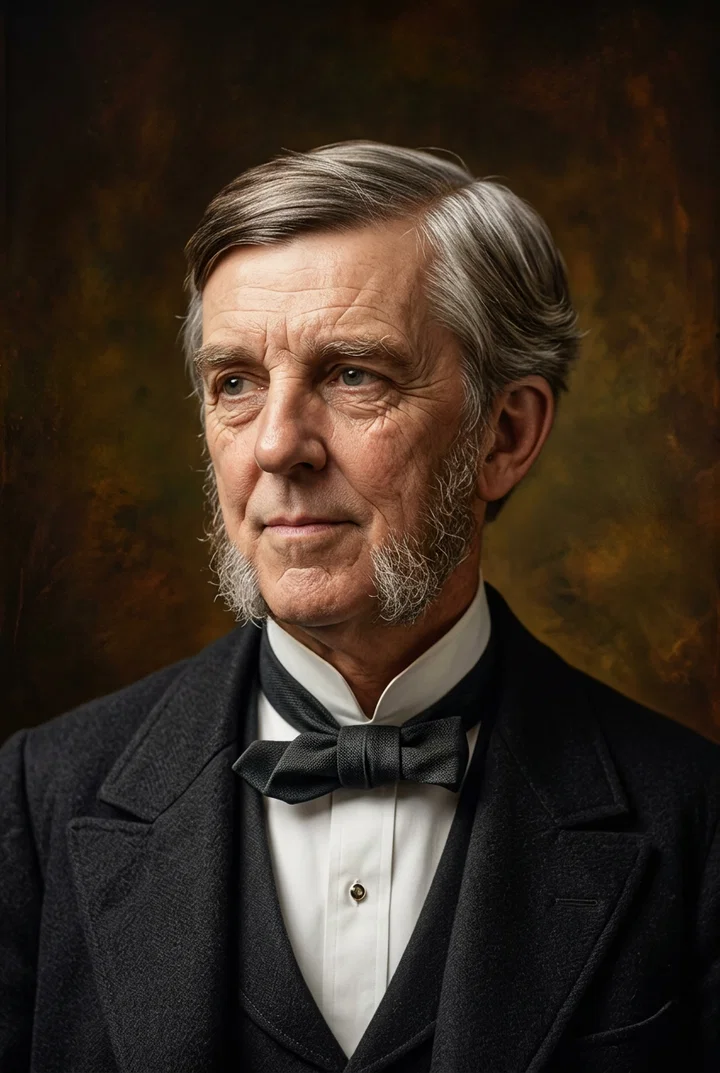
So he had the old-fashioned things planted over again. He remembered that when he was a boy, a row of sunflowers grew in this garden, that the yellow-birds visited, and so he had a row of sunflowers planted, to see if the yellow-birds would come back again. And, lo! when the sunflowers had grown and blossomed, there were the yellow-birds! And they flew as merrily and gracefully about the great rayed flowers as did the yellow-birds of his young days.
In 1847 Dr. Holmes was appointed Professor of Anatomy in the Medical School of Harvard University, where he remained until a few years ago.
He has written many books of interest to grown people, besides many poems which children will like, although not written especially for them. The history of a “One Hoss Shay” is as “diverting” as was “John Gilpin;” the “One Hoss Shay,”—
“That was made in such a wonderful way That it ran a hundred years to a day.”
Dr. Holmes lives in Boston, on Beacon Street, in a pleasant house which looks out upon Charles River.—Frances A. Humphrey.