BIRDS OF PREY

9%

S. D. A. Publishing Association · Battle Creek, Mich. · Apr 9, 1890

FromThe Youth’s Instructor, Vol. 38, No. 15.

Read the full edition

BIRDS OF PREY.

There are a great many kinds of birds. They differ not only in the color of their feathers and in their size but also in their habits of living, just as a white man differs from an Indian in the way he lives.
We call those people who spend their time studying the habits of birds and animals naturalists. In order to study and talk more easily about the animals and birds, naturalists have divided them into groups, or classes, putting those that are most alike on account of their habits and form into one group, and others into another, and so on. There are the perching or singing birds, like the bluebirds, and robins, and swallows; the climbers, like the parrots, wrens, and woodpeckers; the swimmers, like the ducks and swans; and many more.
The birds of prey take the same place among birds that lions and tigers do among wild animals. They are fierce and strong. Instead of living on seeds and insects, they devour small animals and birds. Some of them eat animals that have been dead a long time. The eagles and buzzards and hawks, the vultures, and the owls belong to the birds of prey.
Restored with AI
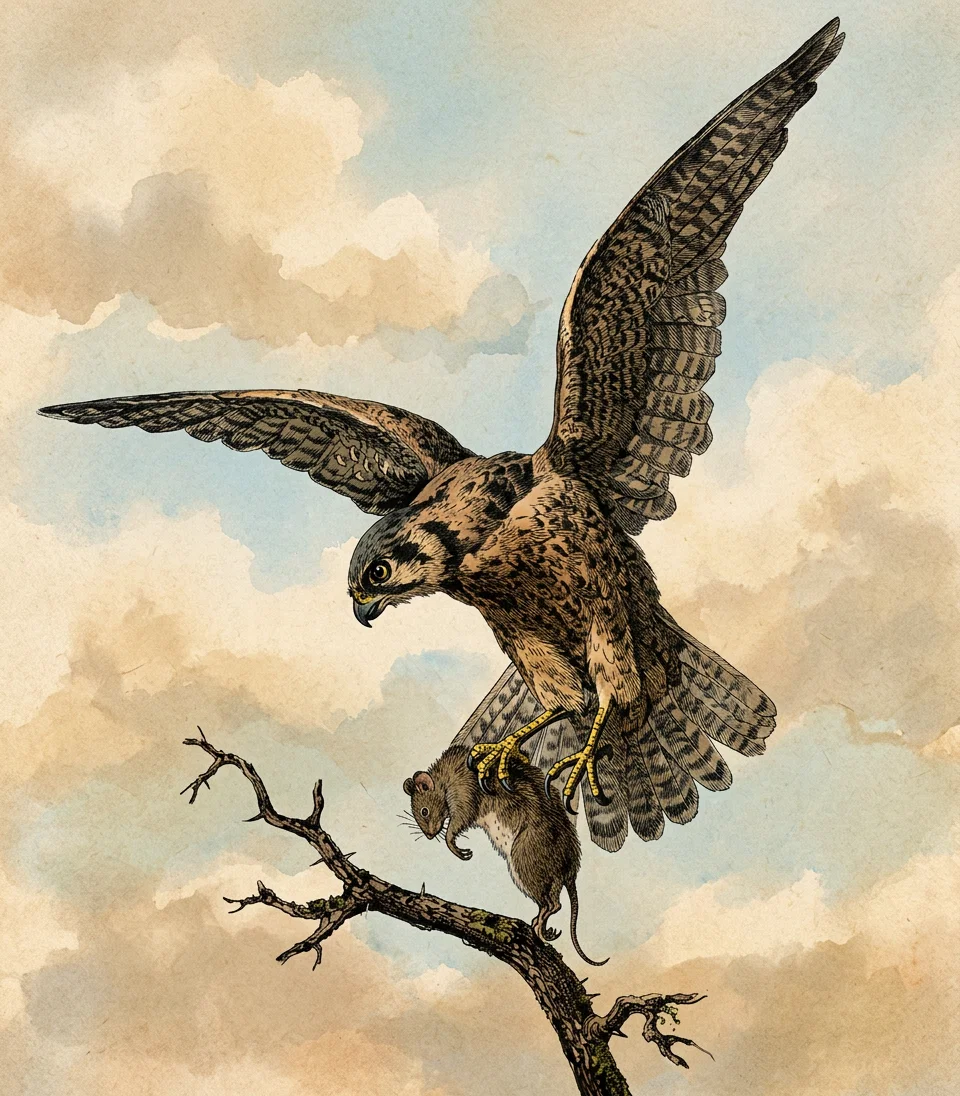
Our picture shows a hawk carrying off a poor little field-mouse for his breakfast. The sparrow-hawk is the one we oftenest see. Perhaps you have seen these birds sitting erect on some fence-stake, or broken tree, or the corner of the barn, watching for a mole, or a mouse, or a grass-hopper.
The blue-jay does not love the sparrow-hawk, and follows him, mocking his cries. The sparrow-hawk often pays the teasing blue-jay back by falling on him and eating him.
The goshawk is the largest of the hawks. Its body is about two feet long. Its flight is very rapid. It catches squirrels and rabbits with ease. It flies along the margins of fields, through the woods, or along the edges of rivers, and swoops down upon its prey. It is almost always on the wing, except when it stops to devour its food.
The goshawk builds its nest in the trees. It is one of the handsomest of the birds of prey. Its head is black, its back bluish slate color, and the rest of the feathers pure white, with bars of slate color upon them.
A long time ago, hawks were trained by English sportsmen to go with them in hunting wild-fowl. The hawks were often fond of their owners, and showed great affection for them.
W. E. L.