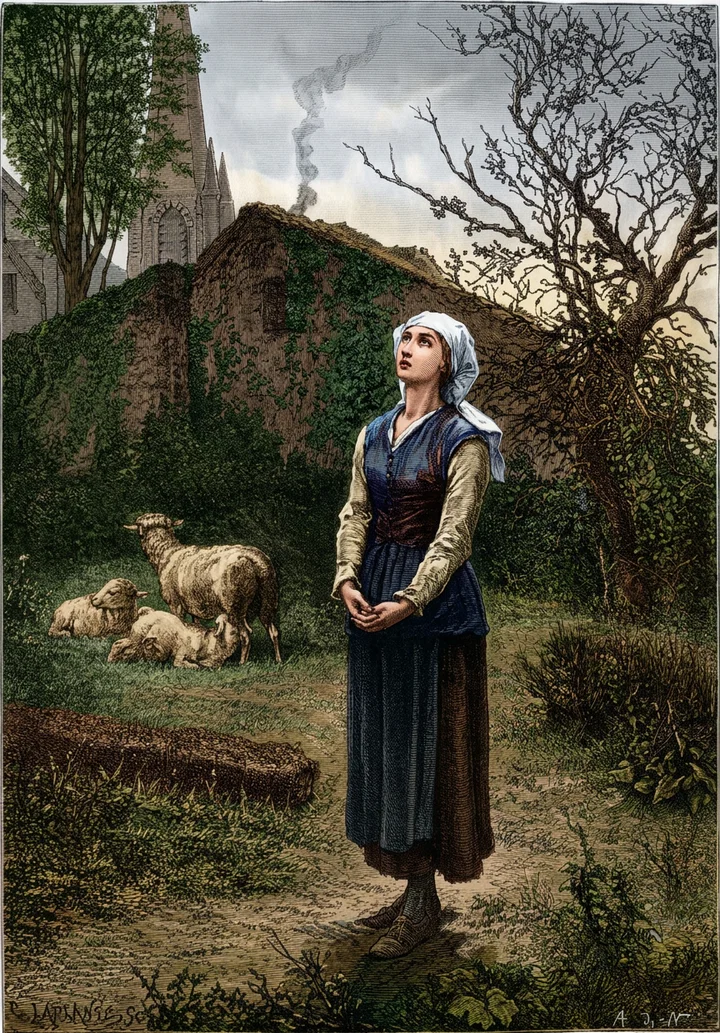
On the eastern borderland of France, among the wild hills of Lorraine, lived the girl we shall learn about in this story. She was a humble peasant; but she was a good girl, and often dutifully tended her father's sheep and cattle upon the bleak hills, as the peasant girls of that country were in the habit of doing. It was not pleasant work always, you may be sure; and no doubt she would sometimes have preferred to stay in the house; for we are told that she was a very skillful housekeeper, and the finest needle-woman in the town. But she was conscientious and faithful, and there is no reason to believe she did not do her duty cheerfully, even if it was unpleasant. She was so unselfish and kind-hearted, and so good to her parents, that every one loved her. It was more than two hundred and fifty years ago that this girl lived, in the village of Domremy. Her father's name was Jacques D'arc, and the girl's Joan D'arc, or Joan of Arc.
There was war then between England and France; indeed, there was quite apt to be a contention of some kind between these two countries. England wanted to rule France; but the French preferred to have a king from their own nation and to rule themselves. So sometimes when the English king happened to be a man who could hardly rule his own affairs, the French got the upper hands in government; but when an aggressive ruler happened to be upon the English throne, there was apt to be trouble between the two nations.
Joan dearly loved her country, and she felt very sad to see the French king giving up inch by inch, and the English overrunning the land. She thought about it constantly while tending the flocks on the hills.
By and by the French king died, and his wife Isabella, instead of trying to keep the kingdom for her son, disinherited him, and gave the country into the hands of Henry V. of England, who had married her daughter Catherine. But Henry V. did not live long after he had gained France. When he died, he left an infant son, Henry VI. Of course, while Henry VI. was a young lad, some one had to be appointed as regent to take charge of the kingdom for him, ruling in his name. There was a great deal of trouble in deciding which duke should be appointed for this purpose, and who should have the regency of France. While these matters were adjusting, the dauphin, as the oldest son of the French king was always called, thought it was a good time for him to assert his claims to the throne.
He did so, and the events which followed in consequence opened up war with England. There is not space to tell you how these wars progressed, but at length the English gained such victories that the dauphin thought of flying to Scotland or Spain. Just then something happened to change affairs.
There was an old prophecy of an enchanter named Merlin, which was still told by the superstitious peasantry. This prophecy declared that the calamities which should befall France through the depravity of one woman would be removed by a good young woman; and it also said that this woman should come from Domremy. Ever since Joan was a little girl, she had heard this prophecy, and believed it; and as she grew older (she was now twenty), and saw the evils that had befallen France through Isabella's management, she felt very sad, and wished she could do something to help her country. She was very courageous and energetic. She remembered this old prophecy; and as she led the sheep day after day upon the lonely hills, she thought she heard voices calling and telling her to deliver France. She said St. Michael appeared to her in an unearthly brightness, and commissioned her to go.
Her father and mother were greatly distressed when she told them that she was sent by Heaven to crown the young dauphin at Rheims and to relieve the city of Orleans, which was then about to fall into the hands of the English. Her old father told her it was her fancy, and not the voices; that called her, and that she would better stay at home and lead a quiet life, as other girls did. Whether Joan really heard the voices, or whether it was her imagination, I do not know. There is no doubt but that she believed everything she claimed. At last she set out on her mission, accompanied by an old uncle, who believed in the voices as much as Joan herself did. She had to make a fatiguing journey, and encounter a great many difficulties before she could see the young king; for people would not believe what she said. But when a council of priests examined her, and said they found nothing in her contrary to the Catholic faith, and that they thought she was the one who was to fulfill the old prophecy, the people changed their minds.p. 82
An army of four or five thousand men was put under her charge, and donning a suit of armor, she rode off at their head to raise the siege of Orleans. It was not thought so strange then for a woman to go to battle as it is now, because the ladies sometimes did go to war dressed as pages, so as to be with their friends in peril.
Joan gained the victory at Orleans, after some very hard fighting. When the battle went well, her soldiers believed in her claims; but when the English seemed to be getting the upper hands, they doubted her. This victory, however, settled the matter, and every one believed her.
After some other battles, in which the French were victorious, the king was persuaded to go to Rheims to be crowned. It would have been much better for Joan if she had gone back to her sheep-tending among the hills as soon as the coronation was over. But the king would not hear to it; he had made up his mind that she was a very useful person, and he made her stay near the court.
Joan went to many battles after that, and helped the generals fight. All went well for awhile; but in one of them the English beat, and took Joan prisoner. King Charles was a lazy man, and he did not like to go to the trouble of getting her free; so he let the English keep her. He did not even act as if she had been of the least help to him. Probably he had found her so difficult to manage that he did not care if she was shut up.
Poor Joan was kept in prison a long time. I am sure she must have wished many times that she had never seen the French court, or the king, or had gone to fight the English, but had stayed at her father's humble home, tending sheep.
After a time the English delivered her into the hands of the Inquisition, where her persecutors tried to make her repent of ever doing what she had done. They cross-questioned her, and harassed her, and tortured her, until she was nearly distracted, and at last confessed that she had never heard any voices, but had lied about it, and that all her miraculous help had come from the Devil. Then they made her promise she would not put on a man's clothes again. They condemned her to imprisonment for life, "on the bread of sorrow, and the water of affliction."
But by and by Joan thought she heard the voices again. And I am sure that being kept on bread and water and in a dark prison, did not tend to make her any less fanciful than she would have been if things had been pleasanter. One day she forgot her promise, and put on a suit of men's clothes that had been purposely left in the cell, to entrap her. Then her tormentors took and tried her for a heretic, and she was burned at the stake, in the market-streets of Rouen.
Poor Joan had learned, through bitter trials, how ready people are to cast aside and forget those who have been useful to them, when they have ceased any longer to be of service to them. She found that more happiness lay in humbleness and obscurity than in greatness and fame. “From the moment of her capture, neither the French king nor one single man in all his court raised a finger to save her. . . . But it is no wonder that they who were in all things false to themselves, false to one another, false to their country, false to Heaven, false to earth, should be monsters of ingratitude and treachery to a helpless peasant girl.”
“In the picturesque old town of Rouen, where weeds and grass grow high on the cathedral towers, and the venerable Norman streets are still warm in the blessed sunlight, though the monkish fires that once gleamed horribly upon them have long since grown cold, there is a statue of Joan of Arc, in the scene of her last agony, in the square to which she has given its present name. I know some statues of modern times—even in the world's metropolis, I think—which commemorate less constancy, less earnestness, smaller claims upon the world's attention, and much greater impostors.” W. E. L.