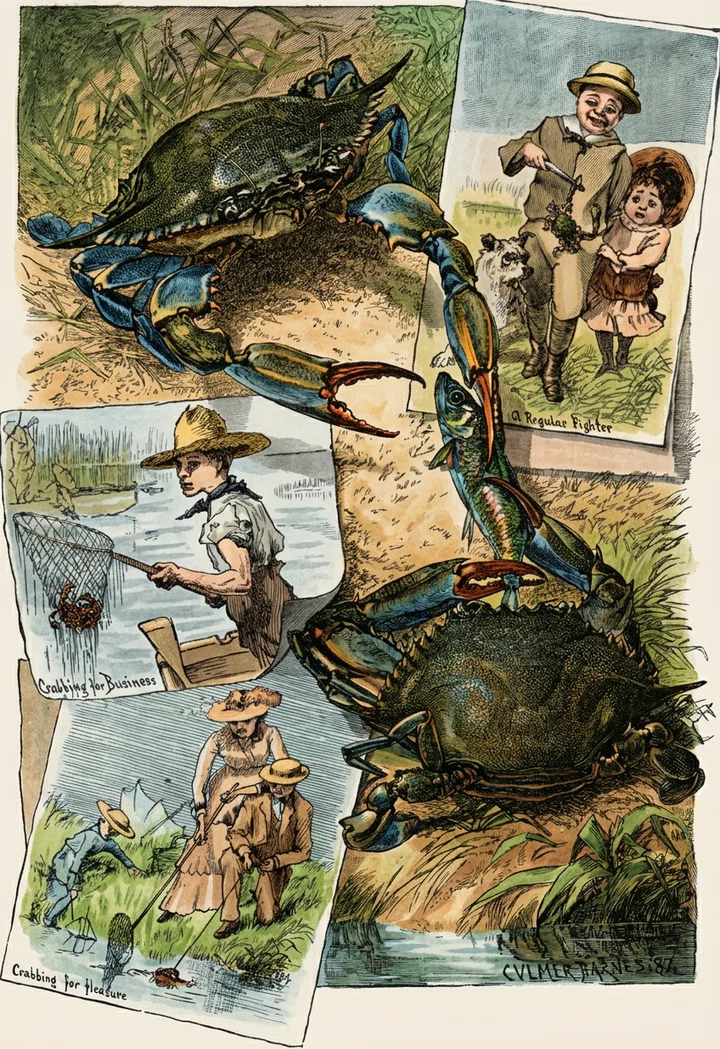
“CRUS-TA-CEA!” This is a hard name for little boys and girls to speak, I know; but it is the name of a very interesting family of animals. They were called by this name because their bodies and limbs are covered with a hard, shell-like crust. Crabs, lobsters, shrimps, and some other animals are branches of this family. We have on this page a picture of crabs, so may be you will like to learn of their curious habits.
How many of you have ever seen a crab? I am almost sure some of you have not, because you do not live near streams or bodies of water, and this animal most always lives in the sea or in the brooks. There is one kind of crab, though, called the Land Crab, that lives in the mountains, sometimes ever so far from the sea; but its home is not in this country.
Like little boys and girls, it takes the crab several years to grow to its full size. Inside of his hard coat he has a soft body. It is this that grows. His shell does not grow. You would not think it strange if his coat should sometimes pinch him, would you?
Well, it does, and so it is his fashion to change his dress every year. The old one bursts open, and Mr. Crab creeps out of it. For awhile he has nothing to protect his soft body, so he hides away, and grows as fast as he can; and while he does this, the lime in the water, and something that comes out of his body, makes a new crust, or coat.
When the crab is done growing, he does not change his shell any more. He has a great deal of trouble after that, though; for sea plants and animals fasten themselves right to his back. He tries to shake them off, but they won't go, and he has to carry them around the rest of his life.
I have told you that the Land Crab lives in the mountains. Well, even he makes a visit to the sea once every year. These animals form into a long procession, sometimes three miles long and 150 feet wide, and all go together. The first thing they do when they reach the sea is to take a bath. Then they lay their eggs in the water, after which they find hiding places where they can creep out of their old coat, and stay until a new one forms.
After their eggs hatch, and the little crabs are big enough to travel, they too, go to the mountains. Very many crabs lose their lives in these long journeys to and from the sea.
While on their march, they make a great clatter with their bony claws, to make people afraid of them. It is said that they sometimes crawl right into people's houses.
In the land of cocoanuts there is a crab that feeds on those nuts. People used to think he climbed the tree, and picked them for himself; so they gave him the name of Robber Crab. Now it is thought that he only eats what he picks up on the ground. But they do say that he lugs nuts up on to some high place, and lets them fall upon the stones below, to break them.
One crab is so quarrelsome he has been given the name of Fighting Crab. One of his claws is ever so much larger than the other. When it runs, it holds up the large claw, and moves it in a way that looks as if he were motioning to something to come to it, so it has had another name given it,—that of Calling crab.
The little Pea Crab, which lives in oysters, you may have seen. Then there is the Swimming Crab, that floats about on the seaweed.
The largest is the Japanese Crab, which lives in deep water. It is really a Spider Crab. It has nippers five feet long, and measures ten feet between the ends of the nippers. One in the British Museum is said to measure eighteen feet between the tips of the first pair of legs.
The Spider Crab acts as a scavenger, and eats the decaying animal matter that is always found in the sea. He has a way of flinging his food into his mouth as regular, and as fast, as a Chinaman puts his food into his mouth with his chop-sticks.
Some of the Spider crabs do not keep their coats very clean, and so they have to carry around a load of plants and animals which grow to their backs.
But the most curious of the crabs is one called the Hermit or Soldier Crab. The forepart of his body has a hard covering, but the back part is soft; so he has no way to protect himself from danger only by getting into somebody else's house. This he will live in until he outgrows it, when he has to go house-hunting again.
He is very hard to please. Sometimes he will handle a great many shells, turn them about, take a peep into them, try them with his feelers, and if they do not suit, try another. If he finds one to his liking, it makes no difference to him if it already has an owner; for he turns him outdoors, and likely as any way, eats him up.
The Hermit Crab has a way of carrying his stolen house around with him when he likes. May be it is to keep some other thief out of it.
In those countries where crabs are used for food, fishermen make it their business sometimes to catch them. They make use of a kind of basket called a crab-pot.
You do not need a baited hook to catch crabs; for they will bite at almost anything placed before them, and will be pulled out of the water before they will let go. They bring a high price in the market.
Boys sometimes go to the seashore in low water, and with a long stick to which is fastened a hook, pull them off from the rocks.
But the monkey's way for catching them is the most comical. After looking about the rocks until he finds a crab hole, he puts his long tail down into it, when Mr. Crab, thinking an enemy has come, fastens his claw to the monkey's tail. No sooner does he do this, than the monkey pulls him out and makes a meal of him. I have not space to give you the names of all the crabs. You must read books that tell of the wonderful things in the sea, and you will learn about them.
M. J. C.