TOMMY ATKINS had had a pair of skates given him at Christmas, and oh, how anxious he was to try them! But it seemed that everything was against Tommy’s desires. Instead of its snowing and freezing, as a respectable winter should, it rained and misted. Now it would be a little cold, and the wind would blow, and Tommy would begin to see something worth living for; but next day down would pour the rain in a most disheartening way.
Tommy grumbled and growled about the weather, and fretted and grew cross, just as though that would help matters. He would stand at the window with a great lump in his throat, watching the rain, and feeling that the Lord certainly didn’t care much for him, or he would change the weather.
Restored with AI
“Why, Tommy!” said his little sister, on hearing his complaints, “don’t you suppose the Lord knows what is best for everybody? You’d be thankful if it would freeze and snow, but may be some poor little boys that don’t have even shoes would feel sorry.”
“Yes,” said mamma; “and besides, my son, you have a splendid chance to put a good timber into your building.”
“What building?” asked Tommy.
“Why, your character. Let me see, you ought to put the timber of patience in; for you think you are having a great deal of trouble, and the Bible says, ‘Tribulation [that means trouble] worketh patience.’”
“Well, a fellow has to be patient whether he wants to or not,” said Tommy.
“Oh, no! I see you have a wrong idea of patience. It isn’t patience to wait and fret and murmur. Patience is a beautiful grace that helps one’s very heart to wait and sing. Paul speaks of it as ‘joyfulness in tribulation.’ Now, Tommy, if you could say, ‘All right, just rain away; I’ll wait and be happy and thankful,’ and then look around to see what you could do to make others happy, and to serve God, you would really be putting a timber of patience into your building.”
Tommy thought this was very fine talk; but for all that, he still looked at the rain, and even helped it on by raining a few bitter tears himself. He muttered to himself that mother had never been a boy, and had never been in such a trying place in her life, so he wasn’t going to mind a word she said.
Tommy’s little sisters were playing house under a shawl, and they teased Tommy to come and be doctor, for one of their dolls was sick; but he said he didn’t care if the doll died, he wasn’t going to play baby plays any more. Tommy spoke so cross that his sisters looked very sober, and somehow they couldn’t have such a good time after that as they had had before.
When mamma wanted Tommy to bring in an armful of wood, he slammed the door, and so he kept spreading his selfish disappointment over the whole house.
But one morning Tommy’s sisters came to his bedroom door before he was up.
“Tommy,” they cried, “get up quick! it’s snowing! The ice will be sure to freeze to-day.”
It didn’t take Tommy long to dress, and he wanted to go right down to the pond before breakfast, but his mother bade him be patient, and do everything decently and in order.
The way Tommy ate his breakfast ought not to be imitated; for if it was practiced often, it would ruin the stomach. After breakfast Mrs. Atkins made Tommy wait for prayers, and then the chores had to be done, and then it was almost school-time.
“I don’t think the ice will be strong enough to skate on to-day, Tommy,” said his mother. “It is not very cold, so please do not go to the pond till to-morrow.”
Tommy was putting on his long boots, and his face grew very red, and he pulled the straps harder than he needed to.
“That’s always the way,” he said to himself, as he stopped in the woodshed; “mother is just as mean as she can be. I don’t care what she says, I am going to see how the ice is.”
Tommy didn’t kiss his mother good-by, and he was not going to wait for his little sisters, only his mamma called and asked him to.
The pond was near the school-house, a little way from the road, and so Tommy led the way to it. “Pshaw!” he exclaimed, “I believe that ice is plenty strong enough. I’m going out on it.”
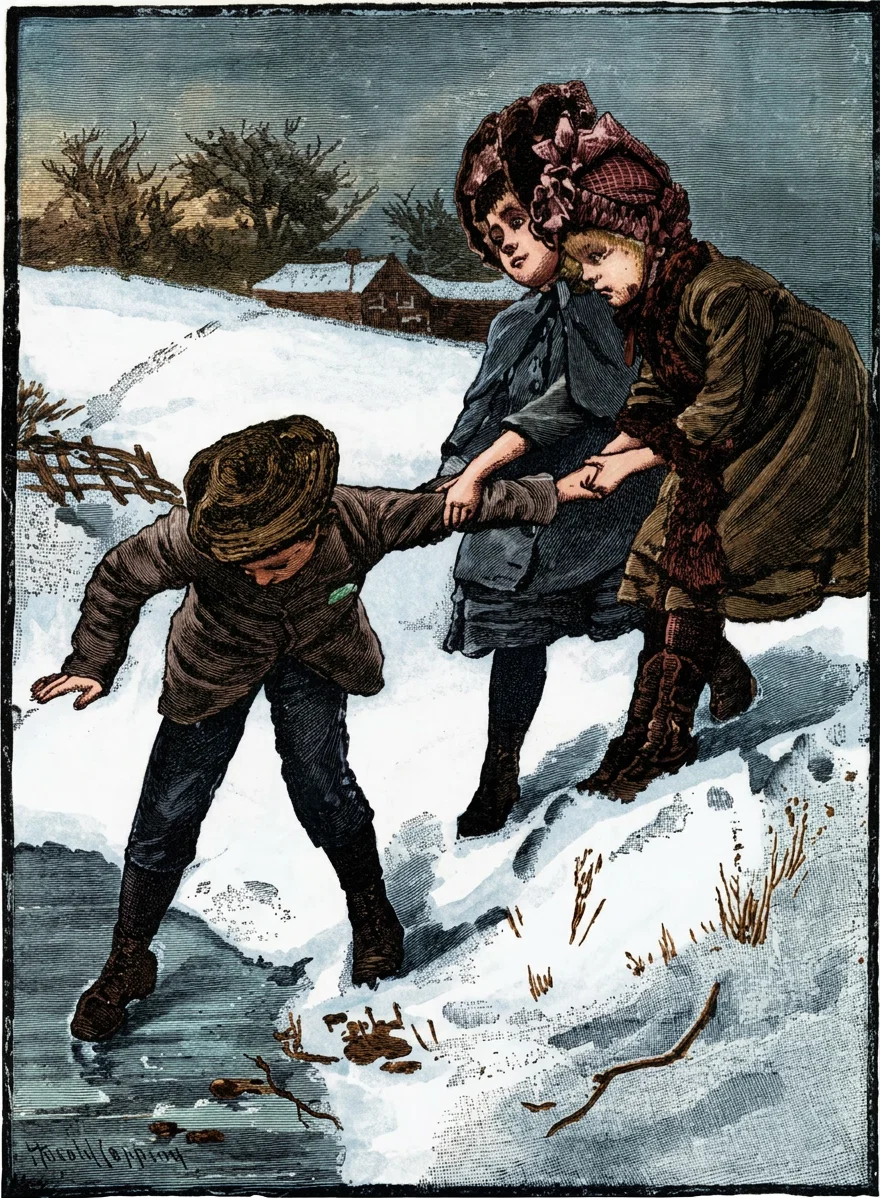
Tommy started out, but both his sisters begged him not to, and when he would go, they caught hold of his hand. Along the edge of the pond the ice seemed quite hard, but as Tommy walked out, it began to crack, and suddenly down he went. He had jerked his hand away from his sisters, and now he sunk in the water above his boot-tops. O how cold it did feel! The girls began to cry, and Tommy waded out.
“Hush!” said Tommy. “There’s nothing happened to make such a fuss about. I’ll just take my boots off and empty the water out, and everything will be all right. Say, girls, there’s no use of telling mamma about it. It will only worry her. I’m sorry enough I did it; but I’ll never do it again. You won’t tell on a fellow, will you?”
Blanche and Maggie looked at each other. They loved Tommy, and yet they didn’t want to do wrong.
“I wouldn’t be ‘tell-tales,’ if I were you,” said Tommy.
“All right,” said the girls, “if you don’t want us to, and it is all right, we won’t tell.”
Tommy sat in school all day with wet feet. The chills would creep up his back, and his face grew very hot, and oh, how his head did ache by night! Something else ached, too,—that was his heart.
He didn’t tell any one how bad he felt. He tried to do up his chores as fast as usual, and after they were done, his mamma told him she thought the ice would be safe to skate on, as it had grown so much colder. She was surprised to hear Tommy say he guessed he’d wait till morning.
Tommy went to bed early; but he could not sleep. His throat was sore, and how he did ache!
When mamma came up, and went around to see if her babies were all snugly tucked in, she found Tommy moaning with pain.
Mrs. Atkins had to go down again, and heat water, and wait on Tommy for several hours. As he felt her kind hands on his forehead, and heard her loving words, he felt as though his heart would break. He knew he had disobeyed her, and had thought she was a mean mother.
Mrs. Atkins examined Tommy’s boots and stockings, and knew what had brought on Tommy’s cold, but she did not say one word about it while he was so sick.
Tommy’s throat was very sore, but it didn’t feel as sore as his heart did. When Maggie and Blanche came up in the morning, he told them he wished they would tell mamma what he had done, but they thought Tommy would better tell her himself.
So, after awhile, when Mrs. Atkins brought him up some nice toast and cocoa, Tommy got hold of his mother’s hand, and sobbed out the story of his disobedience. Mrs. Atkins cried with Tommy, and then told him how he had grieved not only her, but his kind Father and loving Saviour in heaven.
Tommy wondered if Jesus could forgive him, and love him again. But when his mother told him how she had loved and pitied him before he told her he was sorry at all, and that Jesus was more loving than she was, he began to hope that God would forgive him.
Mrs. Atkins and Tommy had prayers together, and then Tommy went to sleep. It was a good many days before he was able to be up; and when he did get up, he could not skate; for if he went out in the cold, his limbs would ache, and the doctor said he had only just escaped having the inflammatory rheumatism.
When the boys went by with their skates that winter, and he heard their happy shouts from the pond, sometimes Tommy would sigh, but not a word of impatience or murmuring came from his lips. He knew he had cheated himself out of the good time by not learning his lesson of patience on the first trial.
Tommy concluded he must try to make others happy, so he would play doctor or nurse with his little sisters, and wind yarn for his mother, and Mrs. Atkins thanked God for the change she saw in her boy. His little sisters thought he was the nicest boy in the world, and Tommy himself said in after years that he wouldn’t take a thousand dollars for the lesson he learned that winter. FANNIE BOLTON.