“Tommy! Tommy! It is time to get up,” came sounding in Tommy’s ears one crisp autumn morning.
Tommy turned over, and snuggled the clothes closer about his head.
“Tommy! do you hear?”
“Yes’m,” came from a voice under blanket and spread.
“Get right up; it is six o’clock,” his mother added as she left him.
Tommy knew his father would be displeased if he was not out to morning prayers. But the bed was so comfortable! He stretched, and yawned, and shut his eyes again. Fifteen, twenty minutes, half an hour passed.
“Tommy!” This time it was his father’s voice, and Tommy bounded out of bed. He dashed some water into his face, and hurried the comb through the front of his hair. One shoe-string was gone, and he couldn’t find his collar button. He rumpled the clean linen trying to fasten it with a pin. Then he rushed out to the sitting-room.
Tommy’s father looked him over from head to foot. He noted the half-combed hair, the crumpled collar, and the unfastened shoe, but he did not say anything. Tommy tried to look unconcerned. It was the third time he had been late that week.
As no remarks were made, Tommy began to breathe easier. Perhaps his father did not mind it so much, after all. But when breakfast was over, Tommy’s heart failed him, as he saw a peculiar smile on his father’s face, and heard him say, “It’s too bad a boy can’t sleep all he wants to, isn’t it, Tommy?”
Tommy made no reply, and his father added, “Your mother and I think so, and so you may undress now, and go back to bed.”
“O, I don’t want to, sir!” begged Tommy, in distress; “the boys are going nutting, and I promised to go too.”
“Indeed!” said his father, in surprise, “I should suppose you would be too tired to go; in fact, I can’t think of allowing it.”
Tommy knew that it was useless to beg off, so he turned slowly toward the bed-room. His mamma stayed with him while he crept out of his clothes, hung them in order on the chair, and disappeared between the sheets. Then she went out, leaving the door open.
He heard her clear off the table, and wash the dishes. Then the broom was whisked rapidly over the carpet. By and by he heard the clatter of tins, and the rolling-pin clap, clap, on the molding-board. It was baking day. Oh, dear! what was mamma making?
He twisted and turned in bed. It wasn’t the nice, warm place he had left. It wasn’t even soft; there were lumps in the mattress and wrinkles in the sheets; the clothes had pulled out at the foot, and all the feathers would crawl up into one end of the pillow, and that wasn’t the end under Tommy’s head.
Nine—ten—eleven—whirred the little clock on the mantle-shelf. Was there ever such a long day?
Presently there came a scraping of shoes and a tug at the window-sill. A torn straw hat and a brown face appeared at the opening.
“Say, Tom, ye’ sick?” queried the new-comer.
Tom turned over, and did not answer.
“Say, Tom,”—then a pause, and a chuckle as Tom’s friend took in the situation,—“say, Tom, did yer mother put ye’ to bed?”
“Shut up!” said Tom, growing cross.
“O my! a’n’t we a baby! have to take a nap in the daylight!” said the mocking voice.
The hot blood was tingling to the end of Tommy’s toes. He sprang out of bed, and hurled a shoe at the intruder.
“O see us in our new clothes!” continued the voice.
A dipper of water sent by Tom brought his tormentor to the ground, and silenced further remarks. Just then Tom’s mother came in.
“Tom,” said she sternly, “go straight back to bed.”
Tom did not dare to disobey her when she spoke like that.
“Now what is the matter?” she asked, as Tom lay down again.
“He called me a baby!” said Tom, punching up the pillow with his brown fists as if he wished it were Dick Smith himself.
Tom’s mother smiled.
“Say, mother,” said Tom coaxingly, noticing the smile, “how long have I got to stay here? You don’t want the boys to call me baby, do you?”
But Tom’s mother was not to be coaxed. “You will have to stay there until your father says you may get up.”
Tom groaned. It would be two o’clock before father started from his uptown office, and three o’clock before he reached home!
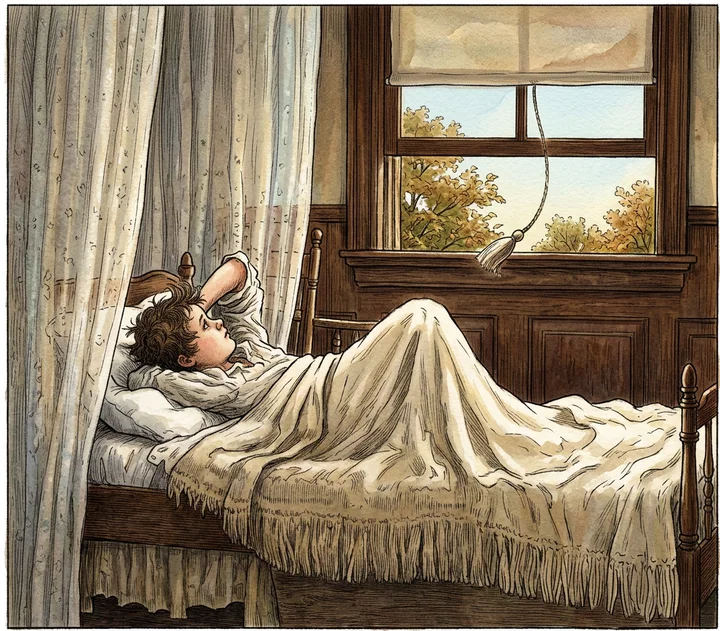
How hard the bed grew as the hours rolled by! Every bone in Tom’s active body ached with the enforced quiet. What did the sun want to shine so bright for? What delicious air blew in through the open window! And the nuts—how they must rattle down after such a frost as this?
Twelve o’clock! One o’clock! Two o’clock! Oh, dear!
By three o’clock Tom had fully made up his mind he could get up in the morning; and it did not take him long to tell his father so, and get permission to dress. The remembrance of that day, and the teasing the boys once in a while give him, has so far been enough to get him up bright and early on the coldest morning.
W. E. L.