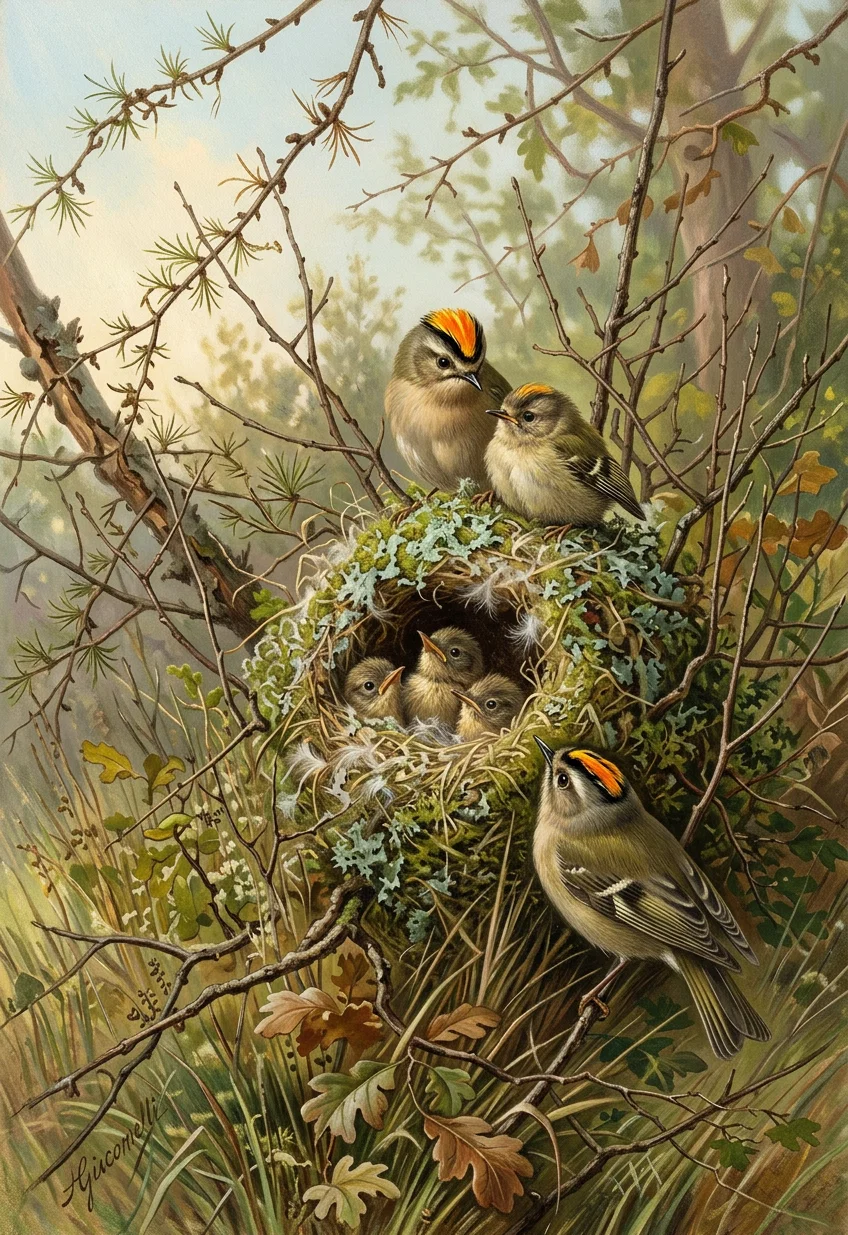
IN “Song Birds and Seasons,” André Theuriet gives an interesting description of the golden-crested wren, the smallest of the British birds. The accompanying engraving shows this little bird at home with his family. Mr. Theuriet thus describes this tiny bit of feathered royalty:—
“I found one day a marvelously constructed nest in the boughs of a larch tree. Imagine a large ball, delicately woven of moss and gossamer threads, wadded inside with the warmest and softest down, gathered from the catkins of poplars, the ripe tufts of thistles, and the cottony seed of the willow herb. This soft nest, into which one could only penetrate on one side by a narrow opening, was the work of the golden-crested wren, that Liliputian bird, the smallest of our European birds.
“The golden-crested wren scarcely ever warbles excepting at the time of brooding; at all other times it utters only a sort of single shrill cry, which is very much like that of the grasshopper. But if it does not shine by its song, it makes up for this imperfection by wearing on its forehead the badge of royalty. Its plain brown plumage is set off by a beautiful gold-colored crown. This crest consists of moveable feathers which the wren, by means of certain muscles in the head, can raise or lower at pleasure. The crest is edged with black; a white line at its base and a black trait on both sides of the eyes mark yet more the courageous and resolute mien of this miniature monarch.
Restored with AI
“And indeed the golden-crowned wren is full of vivacity and energy; there is not a bird who undertakes more bravely the struggle for existence. In summer’s sun, in winter’s cold, it skips courageously from tree to bush, from bush to blade of grass, shelling the yellow grain of fennel seed, clearing the needles of the larch tree, picking in the crevices of the bark of willows, to find larvæ of insects or eggs of butterflies.”
“It is exceedingly fond of biting off young leaves from the boughs of the trees of the pine family,—pines, fir-trees, juniper-trees, which conceal a whole world of larvæ and eggs between their needles. The wren is a master in the art of destroying caterpillars. It has been calculated that a golden-crested wren can devour yearly three millions of eggs and of chrysalides.
“It pursues its occupations, followed by its whole family, with order and method. The whole band flies from one tuft or shoot to the other, in a certain direction determined by a special instinct of migration.”
“The golden-crested wren is fond of large trees. It suspends its nest beneath some forest pine-tree, in whose boughs the wind sings such melodious strains, or else beneath the majestic fir, all bordered with lichen. In this nest, rocked by the waves of the big forest, the female lays from seven to eleven yellowish brown eggs, about the size of green peas.
“In its small body, the golden-crested wren combines at the same time royal and plebeian blood. By its size, its industrious habits, and its good humor, it belongs to the people; but it wears a crown, and reigns in the forest in a fashion of its own. In the large, sleeping forest, the golden-crowned wren represents movement and life. When the frozen brooks are silent, when not one blade of grass is moving, when the wood-cutter warms his fingers by blowing on them before taking up the hatchet, he hears suddenly a light, merry cry, and sees a lovely, diminutive apparition, crowned with a crest of gold, gliding between the bare boughs. It is the familiar spirit of the great forest, the beautiful, golden-crowned wren, which laughs at the bleak north wind, and continues picking caterpillars from the juniper trees, almost buried in the snow.”