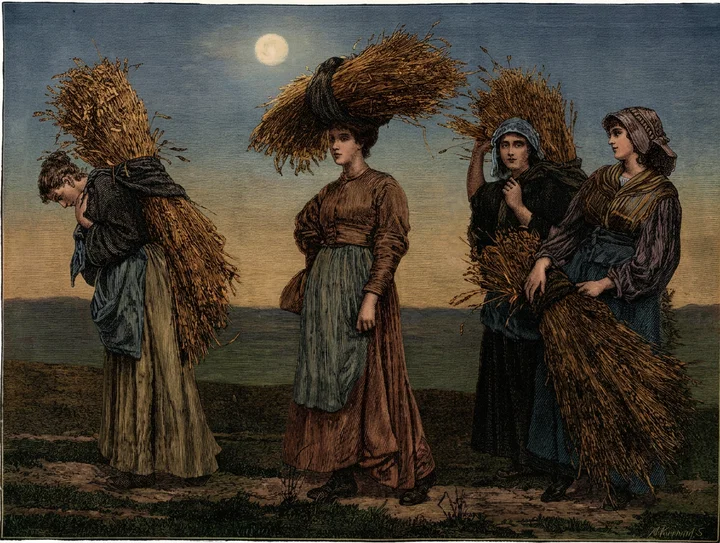
ONE need not go back half a century to learn that harvesting is conducted very differently now than in years gone by, modern machinery having superseded the early method of gathering grain with the sickle and the scythe. None of us question the advantages gained by the change, but we may well doubt the power of machinery to impart the fascination that usually attended an old-time harvest scene, such as, indeed, your parents were familiar with in their early days, or as others have witnessed in this and foreign lands. One who was forty-five years a missionary in Palestine and Syria was particularly impressed with some such harvest exhibitions there. Upon one occasion he said:—
“No description can produce such a tableau as I witnessed in riding, in early harvest time, through the fertile fields from Ramleh to Ludd. A thousand reapers and gleaners were abroad and busy when the morning sun shot his first rays down through the olive-trees, which half hid, half revealed the merry harvesters,—men, women, and children,—the first reaping, the second gleaning, and the children at play or watching the flocks and herds which were allowed to follow the gleaners.”
In witnessing a similar scene he says that “all seemed to be in good humor, enjoying the cool air of the morning. There was singing alone and in chorus, incessant talking, and laughing long and loud.”
“Hundreds of men, women, and children were reaping, gleaning, and carrying the grain to the great threshing-floors. Long lines of camels, carrying on their backs burdens of unthreshed wheat larger than themselves, were slowly converging to the villages from every part of the plain, and the grain lay on the threshing-floors in heaps mountain high.”
Instead of binding the grain in sheaves, the Syrian method is to gather it in large bundles. “Two of these, secured in a network of rope, are placed a few feet apart. A camel is made to kneel down between them, the bundles are fastened to his pack-saddle, and at a signal from his driver up rises the patient beast and marches off toward the threshing-floor near the village. Arrived there, he kneels down again, and is relieved of his awkward load only to repeat the same operation all day long, and for many weeks together; for in some places there the harvest extends through at least two months.”
The missionary saw that the women did the gleaning; but they were paid wages for it, as were the men for reaping. Anciently the custom differed in that instead of gleaners’ receiving wages for their work, they were entitled to what they gathered, as evidently were the misses shown in the accompanying engraving. This custom was introduced for the benefit of the poor, by the Lord himself away back in the days of Moses. His instructions to the Israelites were:— “When ye reap the harvest of your land, thou shalt not wholly reap the corners of thy field;” “neither shalt thou gather any gleaning of thy harvest. Thou shalt leave them unto the poor, and to the stranger, the fatherless, and the widow.” The Israelites were also commanded to leave a portion of their fruit unpicked in time of grape and olive harvests. What was so left belonged to the poor, and they had a right to take it away from the fields. It was because of this provision that Ruth so freely entered the fields of Boaz to glean.
After a time it was decided by law that the portion of the corners of a field equalled about a sixtieth part of the crop in the whole field, so that thereafter the owner might reap all the grain, and separate a sixtieth part for the poor.
I suspect many of our readers have gleaned after the reapers the scattering grain in their father’s harvest fields. I well remember the first sheaf of my own gleaning, in a neighbor’s field; and I have but to revert to it in thought now to experience something of the same pleasure that the picking up of those heads of wheat gave me upon that occasion.
But there is a broader field in which we may all work. Our heavenly Father invites us to labor in his great harvest-field, which is the world. Both reapers and gleaners are wanted; for every precious head of wheat must be garnered. What is unavoidably missed by the reaper, must be picked up by the gleaner. The work of the latter is just as necessary as that of the former, and as the lighter work of gleaning belongs to children, here “is something for children to do.”
In every way that you help to carry the light of truth to others, either by sacrifice or labor, you may consider yourselves gleaners; and if you gather all the sheaves you can, according to your several ability, you may by and by come rejoicing, bringing your sheaves with you. Who will begin work to-day as never before for the Master? Who?
M. J. C.